Paternal Leave Review (Sarajevo Film Festival 2025)
Leo, 15, leaves her home in Germany for a train journey to Marina Romea, Italy. There, she intends to track down and finally meet her father, Paolo. She arrives prepared: confident, composed, and armed with a list of questions she hopes will expose the reasons for his absence. She wants answers, yes, but she is also thoughtful enough to leave space for understanding who her father, a stranger to her, is.
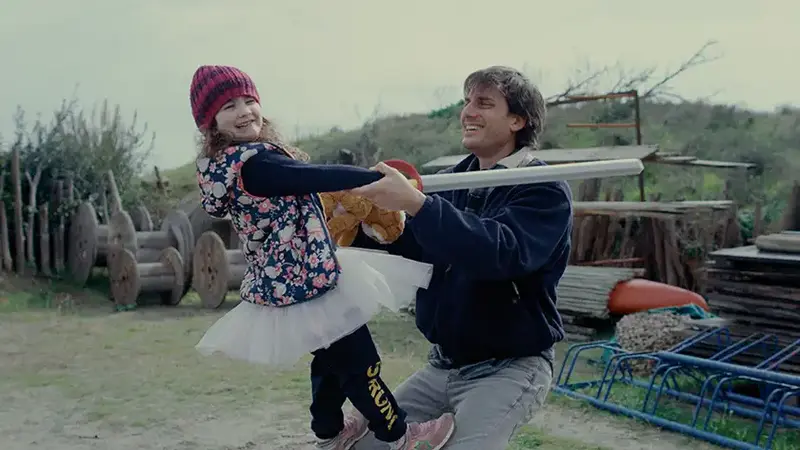
Paolo, 35, is a part-time surf coach with what he describes in an online interview as a noble mission: to offer community and family to those in need. In reality, he runs a wind-stricken beach café, recently damaged by a storm. He has the temperament of a quintessential Italian man (boisterous and full of gestures), but struggles to extend even the most basic hospitality when Leo shows up at his doorstep. Once he learns she is, in fact, his daughter from a summer fling 15 years ago, his resistance hardens. Paolo now lives with his young daughter from another relationship, and he will do whatever it takes to protect this already fragile domestic arrangement from disruption.
Paternal Leave is a simple story, told without excess or embellishment, and executed with startling precision, mesmerising photography, and flawless rhythm. In her directorial debut, German actress Alissa Jung crafts an absorbing and quietly powerful directorial debut about paternal responsibility. Paolo becomes a vessel for this question, seen from two sides at once: what is owed by a parent, and what is expected from a stranger. Jung avoids any romanticisation of his position. Yes, he is charming, and yes, Leo carries recognisable traits of her biological father, but that is not enough even for cinema to casually beget such a bond. No excuses are given. No affection is guaranteed. And while flamingos wade through the lagoons of the Po Delta, catharsis is a long ride. The result is something earthy, level-headed, and strikingly mature.
The film has been described as a tender coming-of-age narrative, but I would argue that adulthood is already present in Leo. Juli Grabenhenrich, in her first on-screen role, gives a performance of remarkable force and control. She gifts Leo the kind of internal clarity most actors take years to develop. Luca Marinelli, real-life husband to the director, wears Paolo like a second skin. His portrayal avoids likeability and plays with discomfort, allowing the character’s contradictions to sit uneasily with the viewer.
Strangely enough, he is awfully familiar. A man too self-interested to accept responsibility for his own child will not shift perspective, even when that child, 15 years apart, travels 700 kilometres to appear on his doorstep. Jung understands this. Paternal Leave is all the more effective because it refuses reconciliation in favour of emotional realism.
Produced by The Match Factory, this is a riveting and memorable film that could stand firmly on its own in theatrical distribution. It had its international premiere at the 2025 Berlinale, competing in the Generation 14plus section, and later screened at the Sarajevo Film Festival in the TeenArena programme. Given how perceptive and grounded the film is, I’m left perplexed as to why both festivals chose to frame it so squarely within a teen-oriented lens. The film may follow a 15-year-old protagonist, but its questions extend well beyond adolescence. Paternal Leave will remain a rare and clear-eyed portrait of adulthood, selfhood, parenthood, and responsibility.
★★★★ 1/2
Playing as part of the 2025 Sarajevo Film Festival / Juli Grabenhenrich, Luca Marinelli, Arturo Gabbriellini / Dir: Alissa Jung / The Match Factory / Germany, Italy
Discover more from
Subscribe to get the latest posts sent to your email.
About the Author