Interview: Efthimis Kosemund-Sanidis on his Feverish A Whole Person Almost
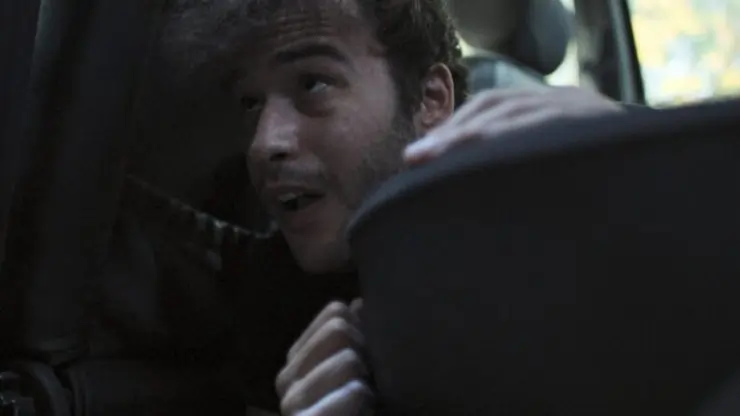
If you enter a film with precaution until the story establishes itself, this one will keep you firmly on your toes. The opening is remarkably startling, suspenseful, and sharp, and it’ll have you holding your breath forevermore. Ilias returns to the island where he was raised with suspicious objectives; he is hiding as much as he is searching. On the way to the capital, his interactions allude to deceptive intentions. Whatever the cause of his wary moves, the camera trusts him, and soon we have no choice but to slink away with him as he makes his way past the villagers. Passing through banana trees and wailers, Ilias ends up in a misty room with an open coffin. The village doctor has died. Upon exiting, Ilias slips, and in that exact moment, as if the director commanded, “Action,” the story jolts alive.
Efthimis Kosemund-Sanidis debuts with an intuitive, honest film that possesses a distinct character of its own. It also functions as a tribute to the island of Lesvos, a place that is never explicitly named but sources the gravitational forces driving the narrative. Greek director Kosemund-Sanidis agrees that the mystery dressing A Whole Person Almost belongs to the landscape:
“Lesbos is the place of my childhood. It’s also an island very close to the Turkish coast and central during the influx of refugees coming from the East towards the West. When I was growing up, this sense of uprooting, in a way, was present. There was already this uncanny kind of feeling that I had connected with the island.”
The cinematography is vibrant, tracking the honesty (and at points, the sheer nudity) of the script in a visceral, allegorical way. This nudity, acting as an organic approach, steers the story much like fate dictates a day. Tremendous care is given to the vernacular, the daily language of the locals, which seeps directly into the gestures and interactions of the faces onscreen. Some of the oral ghost stories that survived through word of mouth find their way into the picture, contributing to an eerie, chilling vibe that is utterly alluring. The director confirms:
“Local elements have informed quite a lot of what we ended up having in the film. I’ve worked with this mixture of non-actors and actors alike. I am part of these communities, and quite often I use some of these pre-existing relationships, friendships and family relationships, reframing them within the context of the script.”
A Whole Person Almost feels like a field game Ilias has stepped into, only to remain and fight a creature that appears downright monstrous. Bodies break down, noses crack open, blood flows, and things fall into darkness just because. The island holds back its power, affirming its presence only intermittently. This vehicular appeal to a superior force was equally summoned in his short, All the Fires the Fire(2019), which served more as an allegory of internal anger. But here, that same expression manifests on the physical form with an exciting animosity. Ilias and Kallipi (his islander companion) surrender to the horror of their bodies in a choreography that steadily leads toward a union:
“We had a lot of ideas with the co-writer Elisabetta (Ilia Georgiadou). We both deal with psychosomatic symptoms in general, which is a phenomenon of our times, I guess. We had our personal pool to draw from, but we also did a lot of rehearsals with the two of them (actors Anastasis Georgoulas, Flomaria Papadaki). We worked for months, and we tried a lot of silly stuff, taking it very far from one direction to another. We researched a lot about specific conditions, and we tried to find things that connect and make sense all of a sudden because both their bodies are being taken over by the island.”
Until a deeply poignant line is finally voiced (which, for reasons of cinematic decency, I won’t recite), there is no linear progression. Events do not follow a consequential course; instead, they submit to a condition, a vibe—one that is highly convincing, recovering the diverting essence of pure filmmaking:
“We find out about the narrative architecture of the film and what we are interested in later on in the process and gradually as we continue writing, and even as we are filming. This is very counter to the way the industry works. Everyone asks for a text and to find logic behind what you’re doing. I understand this process, and I did it as well. But for this film we ended up narrating it in different ways throughout the process of writing, pre-production, filming. During editing we rediscovered the film. That’s where we found some of the story’s arcs.”
By the end, the story makes its case. Yet, what holds us so tightly is the atmosphere, almost the soul of the island. From the bright veils of the lamenting women to the yielding darkness of a lightless sky, the camera exposes touching details:
“Christos Voudouris is a fantastic director of photography. He has a very unique and personal way of connecting with things in general and a very substantial way of connecting with ideas or moments. We’ve worked together on all of my films, so through the course of many years (since 2014) we’ve gradually developed a language and a common universe. We also started somehow ditching our references and relying more and more on things we did that worked or didn’t work so well. We usually have discussions months prior to shooting, but on the day of shooting we might just change our minds. It has become quite organic. There is trust in our working relationship. We discuss the concepts of the story, of the narration of light and darkness, and how these things work together in the film, both literally and metaphorically. We also have a common way of doing things; for instance, we like the image to be dirty. We might use lenses that have character and are not super clean. I think in general, when the image has a kind of distance from reality, it’s easier for the spectator to be involved with the film. If it’s too clean, too real, it feels more distant in a way.”
And he’s right; A Whole Person Almost is spellbinding, like a dream.
★★★★ 1/2
Premiered at the 2026 Karlovy Vary International Film Festival as part of the Proxima Competition / (Enas olokliros anthropos schedon) / Director: Efthimis Kosemund-Sanidis / Screenplay: Efthimis Kosemund-Sanidis, Elizampetta Ilia Georgiadou / Dir. of Photography: Christos Voudouris / Editor: Livia Neroutsopoulou / Producer: Yorgos Tsourgiannis / Production: Horsefly Films / Greece, Bulgaria, Germany, Cyprus, Romania
(adsbygoogle = window.adsbygoogle || []).push({});
Discover more from
Subscribe to get the latest posts sent to your email.
About the Author