Dongji Rescue Review
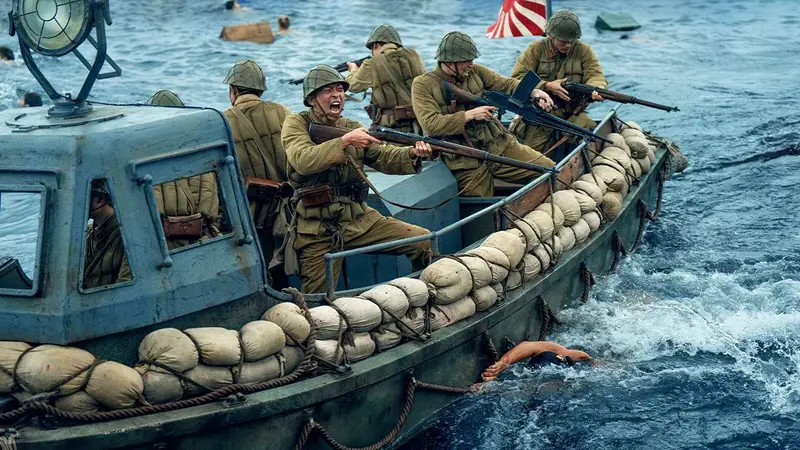
Just shy of a month ago, I watched a documentary that brought to life a harrowing World War II tragedy, The Sinking of the Lisbon Maru. It was a documentary that was so emotionally devastating and left such an impact that the film lingered long after the credits rolled. Introducing me to an event so rarely acknowledged that it is barely featured in mainstream history books. Due to the success of the documentary, it was only inevitable that a dramatic action film adaptation would follow. Directed by Guan Hu and Fei Zhenxiang, Dongji Rescue chronicles the heroic actions of the fisherman who acted selflessly and risked their lives to rescue hundreds of British prisoners from drowning or worse, being shot by Japanese soldiers.
The story unfolds in October 1942, on the island of Dongj, which is currently under occupation by the Japanese. Due to occupation, a blockade is imposed on the fishing boats that served as the connection to the sea, stripping them of their identity. Abi (Yilong Zhu) and Adang (Lei Wu) are two brothers who are outsiders due to symbols on their bodies and have a rebellious streak that drives them to defy the blockade and sail regardless of the risks.
They are currently planning to escape the island for Shanghai so they can have a better life, but everything changes when they witness a submarine torpedo a Japanese vessel and rescue a British soldier, Thomas Newman (William Franklyn-Miller), from the water. Despite a language barrier, Thomas desperately tries to inform the brothers that the ship he was on, the Lisbon Maru, is carrying hundreds of British soldiers, and that they are all in danger.
Strangely, Dongji Rescue seems almost embarrassed by its factual events. Rather than embracing the raw heroism of the fishermen’s selfless rescue, the film reconfigures the event into a tale of vengeance against the Japanese. This choice leads to a film that delves into clichéd narrative beats for a WWII film, with Japan being the enemy and revenge being the driving force of their actions. The fishermen do not heroically save the prisoners of war due to seeing the sinking ship from the island and taking decisive action. They are depicted as people taking action to fight against the Japanese for how they treated them and killed their loved ones. It makes the narrative less special and trades emotional strength for conventional wartime storytelling.
While dramatic liberties are inevitable, as reality is not as much of a spectacle as fiction, the film’s embellishments undermine the actual events that occurred and become another film that is simply evil Japanese rhetoric. The worst example of this is with the characters. All the actions are shaped to spite the Japanese. It makes the entire cast just inherently selfish. Hua (Ni Ni) has an impassioned speech that brings the village to get to breach the blockade and rescue the British soldiers, but a large portion of the speech is about how they bent over to the Japanese and the island should have fought back against the occupation, and now is our time to fight back. In addition, the scenes where we see the Japanese commit horrific acts like immolation against the inhabitants have little impact, as you have no emotional connections to the characters.
Many war films are deeply intertwined with human drama. The heightened stakes and relentless tension of conflict amplify the emotional weight, which is often presented through the harrowing events they endure and the physical and psychological scars that war leaves behind. Sadly, Dongji Rescue ultimately fails as a human drama, due to a cast of extremely one-dimensional characters. Abi and Adang can be defined by a single trait: Abi is overly protective, and Adang is overly naïve, with very little meaningful development. Hua, Abi’s Girlfriend, is too passive for most of the film’s runtime; she is simply his girlfriend who suddenly, at a late hour, leads the village to take action. The supporting characters fare no better. An example of this is with the teacher character, who is a crazy deserter whose climactic scene should have been emotionally impactful, but instead is overly melodramatic and lacking depth.
What ultimately salvages the film is its climactic final set piece, the actual sinking of the Lisbon Maru. It’s the only moment where the film’s unusually wide 2.87:1 aspect ratio feels not only justified, but genuinely cinematic. The tension is at its apex during the set piece. The British forces seize control of the vessel, only to be ambushed by Japanese boats, forcing them to leap overboard in a desperate bid for survival. While in the water, the Japanese start to pick them off like flies. It all culminates perfectly with the fishermen’s act of heroism. Seeing them risk their lives to save as many British soldiers as possible is truly nail-biting. Scrambling to pull as many people aboard as possible while avoiding the treacherous whirlpool that is formed by the ship’s final plunge is utterly enthralling.
Dongji Rescue is a black mark on Guan Hu’s incredible filmography. Though the climactic set piece is utterly thrilling and saves the film from being a total disaster. It is a film that is conflicted about the emotional weight of its source material. Dramatic liberties being taken might have been forgivable if they were in the service of compelling characters and resonant human drama, but both are conspicuously absent. This led to a film that is one of the biggest disappointments of the year and a wasted opportunity to bring this incredible story to life.
★★
In UK Cinemas on August 22nd / Yilong Zhu, Lei Wu, William Franklyn-Miller, Ni Ni, Haoyu Yang / Dir: Guan Hu, Fei Zhenxiang / Trinity CineAsia / 15
Discover more from
Subscribe to get the latest posts sent to your email.
About the Author