Nightmare Alley Review (Criterion Collection)
Classic film noir has always been darker than the mainstream cinema of its time – both visually and morally. Yet even the bleakest entries were constrained by the Hays Code, which forced them to skirt around showing explicit violence. The nastiest noirs are often more disturbing for their restraint: I’m thinking of Cloris Leachman’s bare legs framed beside a pair of pliers in Kiss Me Deadly, or Richard Conte kissing Jean Wallace before moving downwards and offscreen in The Big Combo.
The original ending of Edmund Goulding’s Nightmare Alley is one of the great “what ifs” of the genre. By the end, we all know where Tyrone Power’s amoral swindler is destined to end up, but the Production Code neutered the film’s ink-black heart, resulting in an artificially upbeat ending that offers a glimmer of hope. Guillermo del Toro’s lovingly crafted remake seems designed to redress this balance, reinstating the grisly ending of William Lindsay Gresham’s novel in all its grim irony. Elsewhere, though, it feels more like a sumptuous caricature of noir than an authentic addition to the genre.
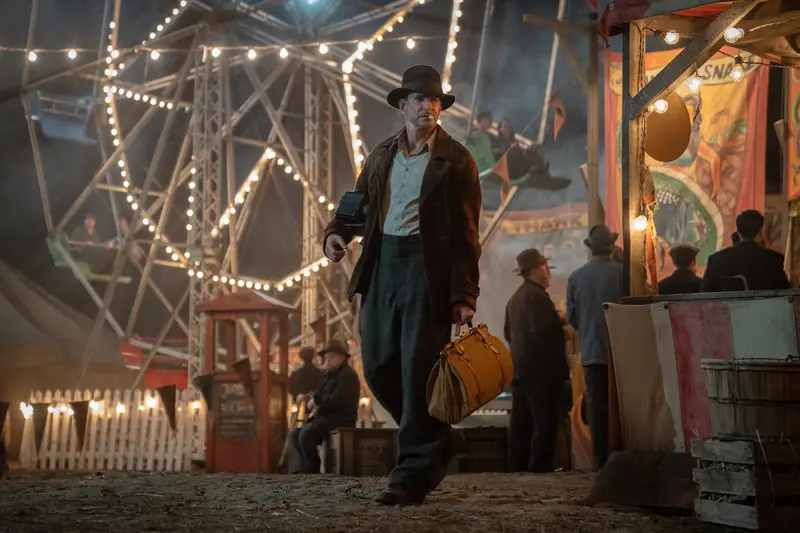
The film follows Stanton Carlisle (Bradley Cooper), a charming, ambitious drifter who worms his way into a travelling carnival and quickly comes to grips with the tricks of the trade. Soon, he abandons the carnival for high society, taking with him young ingénue Molly (Rooney Mara) and deploying his newfound knowledge to fleece the rich and influential. He eventually crosses paths with calculating psychiatrist Dr. Lilith Ritter (Cate Blanchett), who concocts a scheme to target rich industrialist Ezra Grindle (Richard Jenkins).
Bradley Cooper is a compelling protagonist, making Stanton both a heel and convincingly charming, and still engendering sympathy by the film’s end. He’s much more impressive in the early, largely non-verbal scenes, as opposed to the exposition-heavy plotting of the second half. The film is generally strongest in the early carnival scenes, where the cast feels like a genuine ensemble, with lived-in, authentic performances across the board, from Ron Perlman’s brutish strongman to Dafoe’s callous ringmaster. Most impressive of all is David Strathairn as the faded mentalist, turned to drink. Strathairn plays both his melancholy and innocence beautifully; every line tinged with regret, and yet there’s an elfin quality to his performance nonetheless. That little sleight of hand he does with his cigarette is a wonderful signature move for his character.
Toni Collette is also great as Zeena, the fortune teller, but she doesn’t have that world-weary edge that Joan Blondell brought to the 1947 version. Where Blondell coolly twists the knife in her final scene, Collette gives Stanton a warning – she clearly cares for him, despite herself. The opposite is true of Cate Blanchett, who vamps it up a storm as the icy psychiatrist. With her low voice and sultry, statuesque looks, she’s almost a parody of the classic femme fatale; there’s never a moment where you believe she isn’t playing Stanton for all he’s worth, so the final reveal fails to land as effectively as it might.
Del Toro’s fascination with deception, storytelling, and performance is evident throughout the film. There are layers of cons at play – plans within plans – and he delights in depicting the art of the grift, from the showmanship of harmless illusions to the cruelty and emotional manipulation of “the spook show.” What del Toro repeatedly demonstrates is that the trick itself is less important than the presentation and patter that surrounds it. This is apparent in Pete’s demonstration of the mind-reading trick, in the ringmaster’s rehearsed, macabre speeches about his bottled foetuses, and in Lilith’s more sophisticated manipulations. If the decision to restore the novel’s ending is the film’s central “trick,” the rest of Nightmare Alley becomes a cinematic misdirect: a dazzling distraction from the grim inevitability of Stanton’s fall, signposted from the very first scene.
The problem is that it becomes apparent all too quickly that Stanton isn’t half as clever as he thinks he is. This isn’t an issue in and of itself, but it’s never clear if this is intentionally obvious or if we are supposed to be blindsided by his eventual downfall. There’s a subtle but crucial distinction between inevitable and predictable, and here, del Toro tends to veer towards the latter. If the audience is always several steps ahead of the protagonist, that’s not a good sign.
This director-approved release from Criterion of Nightmare Alley features both the theatrical cut in colour and the black-and-white director’s cut, and both look stunning. The colour version feels like a lush love letter to noir, beautiful to look at, but always at a slight remove. It’s a bit too immaculate to feel truly gritty. The black and white version, though, is something else entirely – it feels completely immersed in noir, with the monochrome palette transforming Dan Laustsen’s exquisite cinematography into something elemental, with every beam of light and wisp of smoke charged with fatalism.
For all its excess, del Toro brings everything home in the final moments with a dreadful sense of poetic justice. Cooper’s performance in the final scene may be the best acting of his career, as he finally recognises his place in the food chain – it’s a suitably nasty end for a nasty protagonist, and Cooper sells the desperation beautifully.
This Criterion release of Nightmare Alley is an act of cinematic resurrection twice over – first in restoring the story’s original ending, and again in unveiling the revelatory black-and-white director’s cut. Before, I considered the film a flawed but decent tribute to noir, but with the chiaroscuro photography, it all feels a lot more cohesive and complete. It might not be up there with Del Toro’s best work, but it’s definitely worth a second look.
★★★★
On Blu-ray and UHD Blu-ray from November 3rd / Bradley Cooper, Rooney Mara, Cate Blanchett, Toni Collette, Willem Dafoe / Dir. Guillermo Del Toro / Criterion Collection / 15
Special Features:
- New audio commentary on the extended director’s cut featuring del Toro
- New documentary on the film’s performances, visual language, costume and production design, and score
- New conversation between del Toro and actor and producer Bradley Cooper
- New conversation between del Toro and co-screenwriter Kim Morgan
- Trailers
- English subtitles for the deaf and hard of hearing and English descriptive audio
- PLUS: An essay by crime-fiction and true-crime expert Sarah Weinman
Discover more from
Subscribe to get the latest posts sent to your email.
About the Author