Ink Review (2026 BFI London Film Festival)
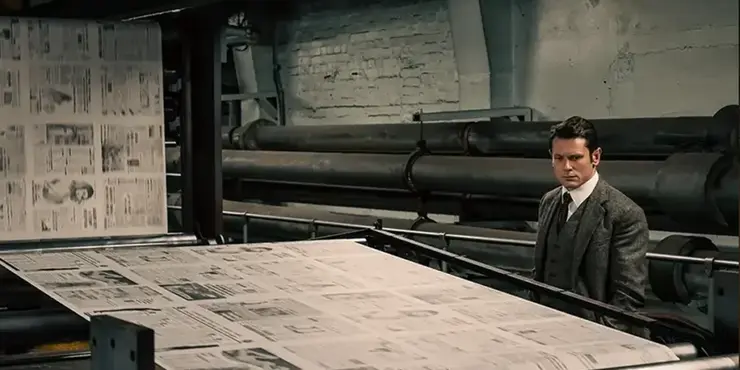
When did you last buy a newspaper – a proper daily paper? A tabloid or broadsheet, the kind that meant you needed to wash your hands after reading it because your fingers were covered with ink? Time was that they set the news agenda, but towards the end of the 60s, they caught the attention of Australian media mogul Rupert Murdoch who saw them as a way of not just making money but accumulating power to challenge the British establishment. It’s the starting point for Danny Boyle’s latest, Ink, the story of a media revolution which gave us all a taste of things to come.
Murdoch (Guy Pearce) buys an ailing broadsheet, The Sun, and hires the Daily Mirror’s Larry Lamb (Jack O’Connell) to turn it into a success. Along with a motley crew of hacks poached from other titles, he throws journalistic tradition out of the window and turns the paper into a tabloid where news becomes entertainment. But it’s a strategy that backfires when the wife of Murdoch’s deputy, Alick McKay (Jonathan Hyde), is abducted and Lamb uses the paper to run a high-profile public campaign to catch the kidnappers. The resulting media frenzy ends badly, leaving nagging questions about the costs that go with tabloid journalism and Murdoch’s control over his runaway success.
Fans of Boyle’s usual propulsive style will love that the energy that’s always characterised his films – think Trainspotting and its sequel, T2 Trainspotting – is still intact and comes coupled with flashily lurid graphics, thumping music and plenty of his usual drive. He’s taken James Graham’s 2017 play, also called Ink, and expanded it into a much wider world, including the newspaper print rooms and Fleet Street, where the entire newspaper industry was based at the time. It certainly benefits from his approach, and there’s never a moment when it feels stage-bound.
Read more from the 2026 BFI London Film Festival →
That alone, however, is not quite enough to make up for the film’s shortcomings. It’s a challenge to watch, mainly because none of the characters is especially likeable. Claire Foy’s features editor, Jules, comes closest. It’s all too apparent that she’s more than a match for her male so-called superiors, but this is 1969, and she has to tolerate being patronised and pushed to one side. She bright, astute and seriously underrated by the crowd around her, raising the question of how the paper would have fared under her leadership. Boyle takes a surprisingly detached attitude to his characters and resists passing any kind of judgement on them. Instead, the audience is left to make up its own mind and, as none of the portraits is especially flattering, it’s not difficult. But when the 80s come along, bringing with them big changes for Lamb and his gang, sympathy for them is in short supply.
The director has, however, chosen his two leading men with a keen eye. O’Connell is still riding high after the success of Sinners and 28 Years Later:The Bone Temple, both of which demonstrated that the talent we saw on show in the earlier days of his career, such as ’71 or Unbroken, was no flash in the pan. The role of the working class, Yorkshire-born Lamb suits him to a T and he’s on fine form. Pearce is all icy ambition as Murdoch, hungry for power and ruthless with it. Whether in the lead or playing a supporting role, he always adds quality to a film, most recently in The Dog Stars. Overall, though, Ink’s sense of direction is lacking. Without the social conscience of Spotlight or the politics of All the Presidents’ Men, it simply ends up as being little more than a morality tale about the bad old days of print media. And showing why it didn’t get any better.
★★★
Playing at the BFI London Film Festival on 12th, 13th and 18th October / Jack O’Connell, Guy Pearce, Claire Foy, Jonathan Hyde, Brian Gleeson, Bertie Carvel / Dir: Danny Boyle / StudioCanal / 15

Discover more from
Subscribe to get the latest posts sent to your email.
About the Author


You must be logged in to post a comment.