Never After Dark Review: Eerie, Atmospheric J-horror Ghost Story
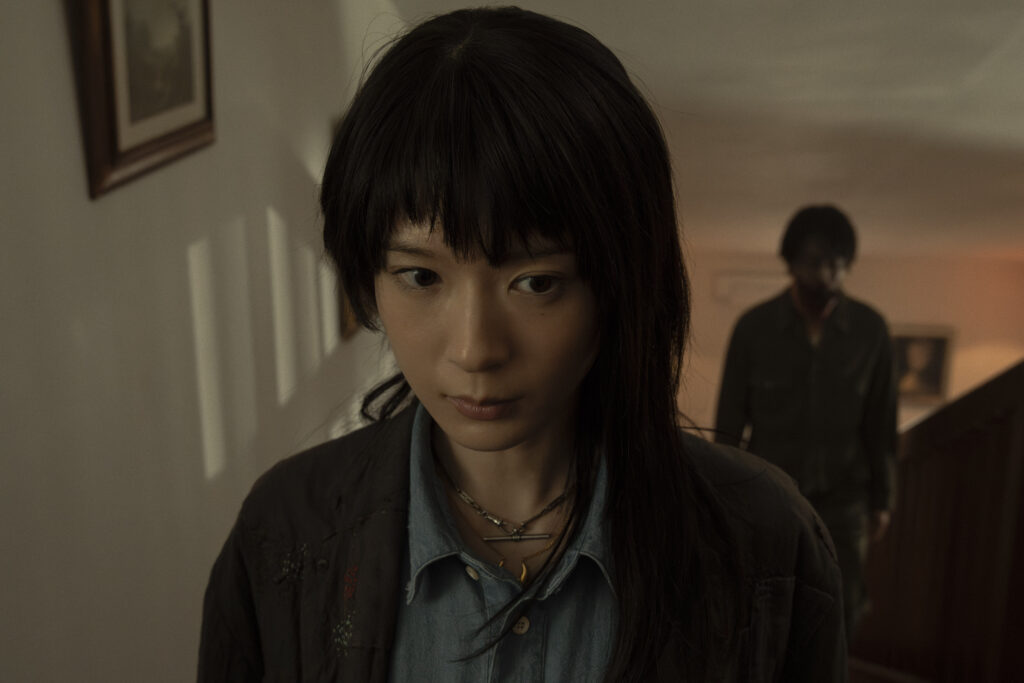
When it comes to the hotel featured in the deliciously eerie new J-Horror Never After Dark, arguments over who should change the bed sheets are the least of the problems. American director Dave Boyle, who has a longstanding association with Japan and its traditions, does an admirable job of assimilating the feel of classic Japanese Kwaidan (ghost stories), drawing heavily on suggestion, shadow and spectral menace to bridge the divide between this world and the next. In classic Japanese tradition, the movie is also refreshingly clear-sighted and pragmatic about the co-existence of the living and the dead.
Shogun star Moeka Hoshi gives an excellent and tremulous performance as Airi, a medium who travels from place to place exorcising spirits. More specifically, as she tells her latest clients, she pierces the veil between the corporeal and spectral realms, encouraging ghosts to move on. However, she says she never undertakes this after dark, as “The veil is too thin.”
Said clients are the proprietors of a woodland inn, Gunji and Teiko (Kento Kaku and Tae Kimura), whose residence is plagued by an especially terrifying spirit that seems fixated on one of the upstairs rooms. When Airi agrees to make contact with the phantom, she discovers that it’s unlike anything she’s encountered before, something potentially caught in a temporal paradox, which threatens to unravel the thread of her psyche as well as the tenuous link between material reality and what lies beyond.
So far, so familiar, and from that description one might imagine a classier, more highfalutin’ variation on the Conjuring or Insidious formula. However, Boyle, who also writes the screenplay, has more than a few tricks up his sleeve to elevate the premise, starting with its emotional impetus. For one, Airi is shadowed by visitations of her late sister Miku (Kurumi Inagaki), who passed away in mysterious and tragic circumstances. These conversations operate on two levels, both a projection of Airi’s inner turmoil and a moment of intersectionality between what is living and what is dead.
Primarily, it allows Hoshi to imbue subtle notes of self-doubt and panic into her otherwise upright performance, a potent reminder that human frailty is often more of a threat than any spectre with whom she makes contact. In a rare moment of alcohol-induced forthrightness, she tells the suspicious Gunji, who suspects Airi of being a fraud, “I fear the living more than I fear the dead.” (Said quote invokes the tagline of Guillermo del Toro‘s terrific chiller The Devil’s Backbone.)
Discover the six scariest J-horror movie moments →
Anchored by the emotional arc of its striking central performance, Never After Dark is then free to pierce its own veil between your standard spook story and something far richer. This is where Boyle honours the longstanding Japanese tradition of folk stories by Lafcadio Hearn, not to mention superior ghostly horror movies (think Onibaba or Kwaidan), operating in that quintessential liminal space whereby a simple cross-shoulder camera move takes us from one plane of reality into another. This is best exemplified by the spirit-summoning sequences in which Airi combines a lock of her hair with some kind of archaic zoetrope to cross over, an approach that steadily erodes her sense of control to terrifying extremes as the film progresses.
However, this isn’t ‘othered’ or exoticised: Airi’s remarkable abilities are contextualised as rationally as the hallways she stalks, a very different approach from Western ghost movies, where living people and ghosts are often partitioned from each other. Never After Dark is a DNA helix of real and unreal, good and evil, one constantly bound to the other, and bleeding through from what is material to unreal, and back again. Airi doesn’t fear the crossover so much as what it threatens to expose about her own demons and the human world in which she lives.
There’s a lovely cross-pollination of domestic horror hits like Hideo Nakata‘s Dark Water with the Western tradition of Jack Clayton’s The Innocents or Robert Wise’s The Haunting, movies that made a spine-tingling virtue of shadow play and silence before hitting us with a diabolical reveal. Open-minded about its subject matter, atmospherically filmed and graced with some memorable shock moments (the third act descends into surprising levels of gruesomeness), Never After Dark is another reminder that Japanese spectral movies have the capacity to haunt us as no others can.
★★★★
On digital platforms in the UK from November 2nd / Moeka Hoshi, Tae Kimura, Kento Kaku, Mutsuo Yoshioka / Dir: Dave Boyle / Blue Finch Films UK / 15

Discover more from
Subscribe to get the latest posts sent to your email.
About the Author


You must be logged in to post a comment.