Ulya Review
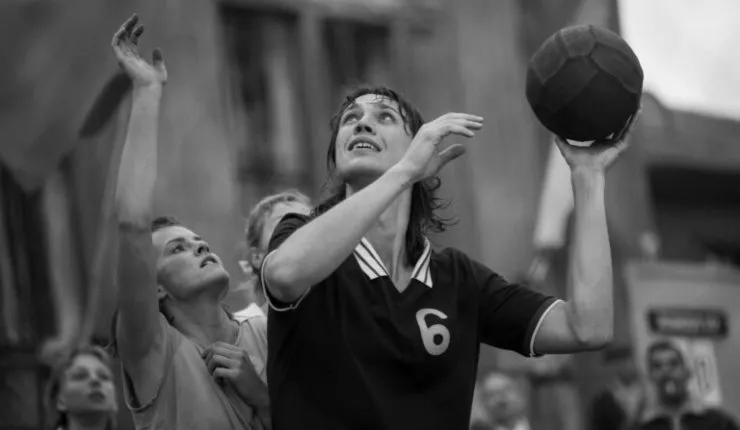
The real life of Soviet-Latvian basketball champion Uljana Semjonova is as extraordinary as it is legendary. Starting from the rural and strictly religious upbringing of old believers to her exceptional figure and remarkably pure spirit, leading to her phenomenal scouting and inevitable success in female basketball. All the successive occurrences create firm, fortunate, and rich footings for a cinematic exemplum with allegorical extensions. It was only a matter of time before her story found its way to the screen.
The timing of this advancing towards cinema holds a dash of serendipity. Ulya was completed shortly before Semjonova’s death, at the age 73. Nearly forty years after her athletic career, the film proves it was worth the wait. Careful prep work, paired with a tender, laser-focused vision, and in tandem with the high-end means of production, yields a mesmerizing drama.
The gentle sportsmanship and respectable grit that reportedly characterized Uljana, placed front and center by the laconic writing, are absolutely key components of this beautiful picture. Ulya might be about a real salt-of-the-earth person, but it is not delimited by the expected drama such a character might elicit when tested by life and by narrative making. The film owes much of its authority to the stripping away of color and to the reduced spatial occupancy. The black and white image gives a sense of historical security, and the nearly square ratio offers a candid, nonsecular focus on the character. These choices, kept at high stakes, forge the potent emotional sentiment of every scene, while they also mark effectively sensitive registers that outline not only the country’s societal imbalances (which are canonical and recurring) but also a generation’s predicaments that, to the day, I must admit, are still resounding.
No surprise here, but let’s also state it outright: the film’s visual marvel rests squarely on its cinematography. Polish director of photography Wojciech Staron, with much acclaimed work internationally, here performs a stable interplay with the internal happenings whenever Ulya is in the frame. The camera follows Ulya (reiterated by Latvia’s star Kārlis Arnolds Avots, who adds an intriguing sense of androgynous outlook) like an invisible bestie who never interferes but will, nevertheless, be ready to come down with her if the occasion commands. The story is enclosed within the first encounter between Uljana and the world—what a relief!
Latvian director Viesturs Kairišs (who was rediscovered overseas by the Tribeca IFF for his coming-of-age feature, January, in 2022) does an excellent orchestration to keep the cornerstone in and around the unwanted attention and the adjacent alienation. This sharp vision meets us now, over half a century past the chronicles, and in a fully exposed and observed life, delivering an experience at once piercing and frankly humbling—a welcome antithesis to our contemporary relationship with attention.
Ulya was first screened at Un Certain Regard at Cannes earlier this year and will continue its international festival run until the Oscars. Ulya is Latvia’s reasonable proposition for this year’s Best International Feature Film at the Academy Awards.
★★★★★
Dir: Viesturs Kairišs / Cast: Kārlis Arnolds Avots, Chulpan Khamatova, Aleksas Kazanavičius, Shamil Khamatov / Prod: Ego Media, Allfilm, Staron-Film, Tremora / Latvia, Poland, Estonia, Lithuania / 12A
Discover more from
Subscribe to get the latest posts sent to your email.
About the Author