Being Heumann Review: Superb Drama Fighting for Disability Rights On Screen
Being Heumann
Watching Being Heumann at the London Film Festival as someone living with an invisible disability was an incredibly poignant and moving experience. There is something particularly powerful about seeing the fight for disability rights on screen, especially when so much of that fight is still relevant today. It explores how often disabled people have to fight to be listened to, understood and treated equally, and how much of that experience remains unseen by those who don’t live it. Judy Heumann’s story is one of determination, frustration and collective strength, but above all, a reminder of what can change when people refuse to be ignored.
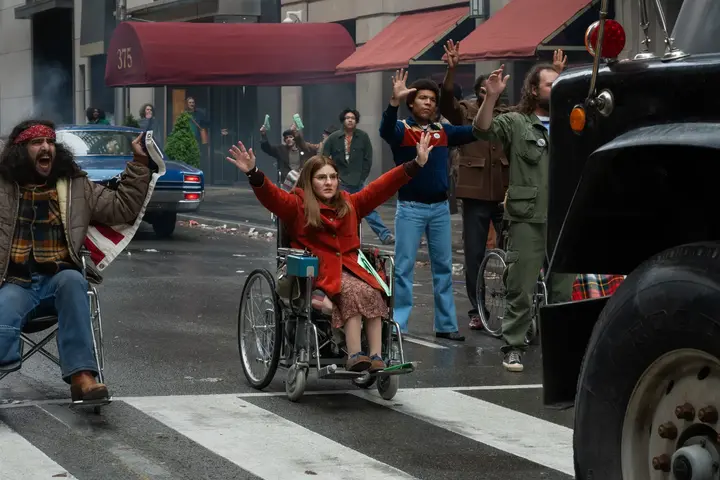
The film tells the true story of disability rights activist Judy Heumann (Ruth Madeley) and her fight for equality. Set in 1977, it centres on the historic 26-day occupation of a federal building in San Francisco, where Heumann and a group of disabled activists demanded that the US government enforce Section 504, legislation protecting disabled people’s rights. What starts as a protest becomes a landmark moment in the disability rights movement, highlighting the power of collective action.
I loved that this film wasn’t ‘inspiration porn’. When Judy is told she is an inspiration, she replies: “Inspired to do what?” It’s a brilliant line that sums up the film perfectly. Disabled people aren’t here simply to make others feel inspired by their everyday lives. They’re people with their own ambitions, frustrations, humour and lives, and this film does a great job of showing that.
There are plenty of comedic moments, with perhaps one of the most iconic lines being “show your cleavage and cry”, before cutting to Judy (Madeley) doing exactly that. Mark Ruffalo, playing Joseph Califano Jr., is constantly flustered, even resorting to hiding from the activists by jumping out of his home’s window. There’s also darker humour in the scenes where the police can’t even get the activists’ wheelchairs into their vans or the jail because they aren’t accessible. It’s funny, but also a stark reminder of the barriers disabled people faced.
Madeley’s portrayal of Judy Heumann is remarkable. The opening scene, where Judy has to use her wheelchair in the road because of a lack of dropped kerbs, made my heart sink, until she starts flipping off the drivers who honk at her, which made me laugh out loud. Madeley brings real spirit and grit to the role. As a wheelchair user herself, she understands what this fight means. Sometimes it takes someone as tenacious as Heumann to make change, even if it doesn’t make you popular. Judy isn’t necessarily there to be liked, but she is sure as hell there to make a change. Being a fellow Northerner, I was also surprised by how accurate Judy’s Brooklyn accent was.
The supporting cast also do a phenomenal job, showing that this was never just one woman’s fight. Madeline Delp is great as Kitty Cone, Judy’s fellow activist, while Dylan O’Brien brings an interesting dynamic as Evan White, the reporter who initially approaches the protest from the outside but gradually gets caught up in the fight himself.
Explore more of our reviews →
Director Siân Heder was chosen by Judy Heumann herself to make the film. Sadly, Heumann passed away in 2023 before the project was completed, making it all the more important that her story is being brought to a new audience. After the screening and Q&A, I got to meet Ruth Madeley, congratulate her and chat briefly about the importance of telling disabled stories on screen. The main cast all have disabilities, and access coordinators helped make this possible. Ruth said that the next time someone tells her a film can’t be made with disabled people, she will use this film as an example of why they can, and why they should.
The film proves that productions can work with disabled talent, provided access coordinators are brought in before production even begins. Accessibility needs to be taken seriously, rather than treated as an afterthought or a reason why something can’t be done. It’s something the screen industry needs to learn from. The film also highlights the Social Model of Disability: that it is often society’s barriers, inaccessible spaces and attitudes that disable people, rather than their conditions or impairments themselves.
Anyone can become disabled at any time, yet many people outside the community don’t always have to think about accessibility barriers. I got my diagnosis at 19; it has changed me and shaped me, but it doesn’t define me. If anything, it’s made me more resilient to whatever life throws at me.
Working now in inclusion in the screen industries, and having a disability myself, I can see the fight we’re still having, from rollbacks on Access to Work to the government’s and media’s relentless reviews of PIP and disability benefits. But it’s a fight worth having. I hope this film inspires more people outside the disabled community to join it. Maybe we can all be a bit more Heumann.
★★★★★
Discover more from
Subscribe to get the latest posts sent to your email.
About the Author