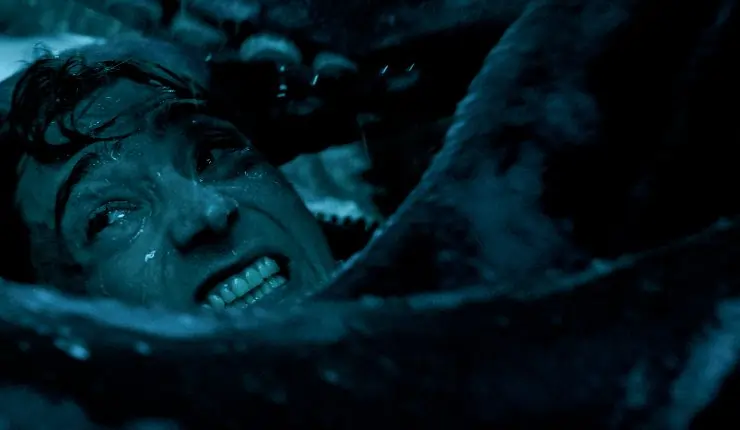
The Last Viking Review
Few contemporary filmmakers blend absurdity and melancholy as well as Anders Thomas Jensen. With The Last Viking (Den sidste viking), Jenson once again returns to the strange emotional territory that has defined his previous films: Adam’s Apples and Riders of Justice. The result is a darkly funny, bizarrely moving film that explores trauma, identity and brotherhood.
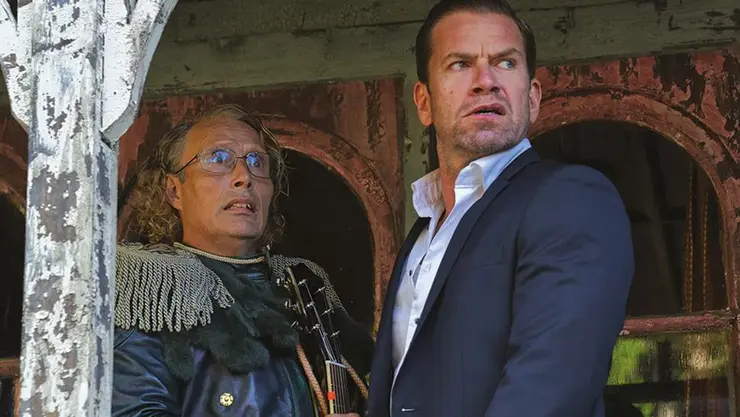
The story follows Anker (Nikolaj Lie Kaas), who is released from prison after serving a long sentence for armed robbery. Before his incarceration, he entrusted stolen money to his brother Manfred (Mads Mikkelsen), asking him to hide it until his return. However, much to his great frustration, fifteen years on, Manfred claims he can no longer remember where the money is buried. Suffering from severe psychological issues, Manfred has developed an alternate identity disorder, frequently believing himself to be John Lennon. To stop Manfred from stealing dogs and throwing himself out of windows in protest, Anker plays along with Manfred’s Liverpudlian psychosis and goes to absurdly comical lengths to uncover the cash.
Anker takes Manfred to their childhood home, hoping to jog his memory and break through his brother’s delusions. However, their mission is hijacked by a motley crew of outlandish characters, including an eccentric doctor (played by the very convincing Lars Brygmann), a posse of his patients, suspicious hotel owners, and Anker’s former crew, who are hungry for their own share of the missing money. What begins as a quest to recover stolen money gradually transforms into an intense journey through memory, confronting trauma, and evading the past.
At first glance, the premise seems impossibly ridiculous, but Jensen has always excelled when turning outlandish ideas into emotionally significant stories. The film’s greatest strength lies in its embrace of comedy, finding humour in situations that are multilayered with tragedy. Manfred’s delusions, coupled with his doctor’s schemes and his brother’s growing frustrations, make for the film’s funniest moments. Yet, the film never treats Manfred himself as a joke. Instead, his condition acts as a means through which the film examines pain, neglect, and the way people can reinvent themselves to survive and escape.
The film features a whole host of outstanding performances. At the forefront is Mikkelsen, who delivers one of the most unconventional roles of his career so far. Most audiences will associate Mikkelsen with intimidating villains or unflappable heroes, but here he embraces raw vulnerability alongside eccentricity, mirroring his expectational work in Another Round (Thomas Vinterberg). His portrayal of Manfred is hilarious and heartbreaking; he simultaneously manages to be the most emotionally volatile and emotionally intelligent character in the movie
Equally impressive is Lie Kaas as Anker. While Mikkelsen occupies much of the spotlight, Kaas’s selfish emotional immaturity provides the narrative’s dramatic foundations. The chemistry between the two actors feels lived-in, reflecting their long history of collaboration with Jensen. Their relationship on screen feels extremely nuanced and honest, evolving from a story of mutual resentment between brothers into an honest exploration of brotherly love and forgiveness.
The screenplay is packed with oddball dialogue and surreal situations. Yet, at times, especially within the establishing scenes, the film often feels like a collection of bizarre anecdotes loosely corralled by a road-trip formula. Yet, once the brothers arrive at their family home, the sprawling nature of the film begins to focus. That said, it’s not without flaws. Jensen moves rapidly between slapstick comedy, psychological drama, and moments of extreme violence, which can often feel somewhat jarring.
Certain supporting characters also feel less developed than they deserve, functioning more as comic relief than fully realised people. However, despite the film’s confused genre devices, it delivers on a satisfying ending and manages to pull its many ideas together at the last hurdle.
The Last Viking’s most impressive and striking accomplishment is its exploration of healing. Rather than presenting trauma as something that can be easily overcome, Jensen suggests that healing is a messy, incomplete, and often completely insane process. As we conclude, what seemed like a Wacky Races-style treasure hunt becomes something far more meaningful: an exploration of how damaged people learn to accept themselves and each other. Anders hides his emotional truths behind absurdity, revealing his hand slowly. This is the kind of film you need to stick with; the wild journey is long and intense, but the destination is worth the ride.
The Last Viking stands as another strong entry in Anders Thomas Jensen’s body of work. Supported by exceptional performances from Mads Mikkelsen and Nikolaj Lie Kaas, it succeeds both as an outrageous black comedy and as a heartfelt family drama about acceptance.
★★★★
In UK Cinemas June 26th / Mads Mikkelsen, Nikolaj Lie Kass, Lars Brygmann, Sofie Gråbøl, Kardo Razzazi/ Dir: Anders Thomas Jensen / Picturehouse Entertainment / 15
Discover more from
Subscribe to get the latest posts sent to your email.
About the Author