Humint Review

From a government perspective, the greatest security threat often comes not from external actors but from within. Staff who already work for the government are more likely to cause breaches, as humans can be compromised far more easily than systems. A simple bribe or an irresistible offer might persuade someone to plug an unknown USB stick into a computer or photocopy a sensitive document. It is generally easier to extract information from people than from machines, and anyone has the potential to become an agent. This form of intelligence gathering is known as human intelligence, or humint for short.
Ryoo Seung-wan’s latest film is an enthralling espionage action thriller all about Humint (it’s even the film’s title), following South Korean agent Manager Zo (Zo In-sung), who, after an unsuccessful operation in Southeast Asia that leads to the death of an informant, travels to Vladivostok, Russia, based on the information the informant provided. That information points to a drug called bingdu being tied to human trafficking of North Korean women. Meanwhile, North Korean agent Park Geon (Park Jeong-min) is also sent to Vladivostok to investigate disappearances along the border, which he soon learns is connected to North Korean Consul General Hwang Chi Sung (Park Hae-joon).
Humint’s biggest strength narratively is the morally grey world it paints around spy work. While the Russians and the North Koreans serve as the main antagonists of this tale of espionage, the South Koreans are far from morally innocent. This is perfectly highlighted early on, when Manager Zo is ordered to abandon his informant, despite having promised her freedom, because the operation has already yielded the intelligence they needed. It’s a grim reminder that an asset is only as valuable as the information they can provide. This ambiguity also extends to North Korean agent Park Geon, who, while investigating General Hwang Chi Sung, may be forced to form unlikely alliances to complete his mission.
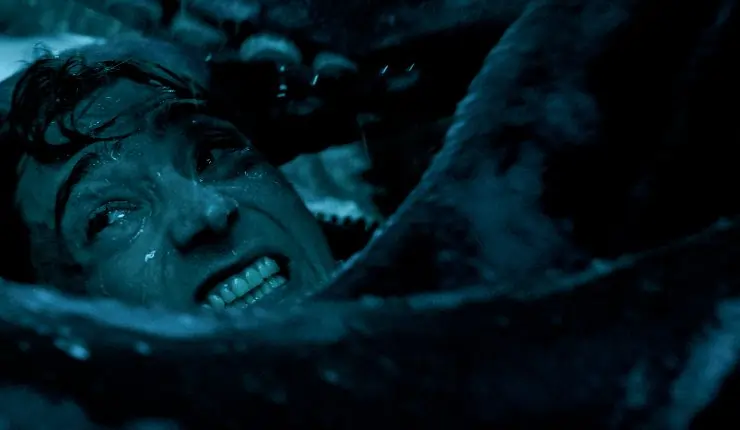
It feels reminiscent of thrillers from the height of the Cold War, when your neighbour could be a Russian spy, rather than the post 9/11 era of government surveillance and the war on terror. This grey worldview also extends to the film’s tonal darkness. Ryoo Seung-wan doesn’t sugarcoat the depiction of human trafficking or violence. The opening illustrates this immediately: when we first meet Kim Soo Rin, her body is black and blue, a victim of abuse who becomes an informant in the hope of breaking that cycle and reuniting with her family. As the film progresses, we see how deeply violence is woven into espionage, from heinous acts of torture to the moment an informant is given a pen to “do the right thing” and cover for Hwang Chi Sung’s actions.
There’s more to the violence than its insidious acts. Humint delivers terrific action, and the final set piece, in particular, stands out as one of the year’s best, a colossal sequence that runs for nearly 30 minutes. It features a thunderous mix of punchy gunplay, with some of the best squib and zirc work I’ve seen in a long time. This then transitions into gnarly, hard hitting hand to hand combat, filled with devastating impacts that will make you jump out of your seat. It all comes together to form an impeccably crafted, genuinely enthralling sequence.
The action also highlights the film’s excellent sound design and mixing. Gunshots echo with real force, cars drift across the rear channels, and the soundtrack swells to reinforce the film’s overall tone. The soundstage, especially during the action, is expertly constructed and impressively dynamic, allowing the audience to be fully absorbed in the tension. Throughout the film, dialogue remains clear and never feels drowned out in the mix. Even watching at home without access to the Dolby Atmos track, the 5.1 mix punched through my speakers and delivered a genuinely strong listening experience.
Given how performance-driven Humint is, anything less than stellar acting would do the film a disservice, and thankfully, every performance is exceptional. Zo In-sung is immaculate as a calculated yet deeply human South Korean agent, a balance he plays with remarkable restraint. This contrasts perfectly with Park Jeong-min, who is overwrought with emotion, especially when confronted with his ex, Chae Seon Hwa, for whom he would do anything to spare her from harsh punishment. Shin Sae-kyeong and Park Hae-joon are also excellent as Chae Seon Hwa and Hwang Chi Sung, respectively.
The film, despite its warm yet dark colour palette, is beautifully vivid. Many shots are genuinely striking. The use of shadows within interior spaces adds great depth, and there’s an excellent split diopter shot that heightens tension as the truth slowly comes into focus. The film’s use of selective focus is equally impressive, creating bokeh that dazzles in its soft, hazy glow. The cinematography is just as strong during the action, with well-composed wides that capture the brutal elegance of the violence. The pacing is also pitch-perfect. When the credits rolled, I couldn’t believe two hours had passed.
Humint is an action thriller at its finest. Rather than painting espionage with a broad brush, Ryoo Seung-wan brings complexity and humanity to the affair. The narrative is tense and keeps you on the edge of your seat, and the action is intense and utterly gripping. Every aspect of this film is utterly brilliant. Humint is easily one of the best films of the year, and a must-watch for anyone who loves the genre.
★★★★1/2
Out now on Netflix / Zo In-sung, Park Jeong-min, Park Hae-joon, Shin Sae-kyeong, Robert Maaser / Dir: Ryoo Seung-wan / Netflix / 15
Discover more from
Subscribe to get the latest posts sent to your email.
About the Author