Whalefall Review: Austin Abrams Becomes Humpback Food In Taut Thriller
In 2004, Bravo aired a TV documentary miniseries titled 100 Scariest Movie Moments; the number one spot was given to Jaws, Steven Spielberg’s 1975 adaptation of Peter Benchley’s novel of the same name, focusing on a Great White shark devouring anyone who braves the ocean of a New England beach town. The Texas Chainsaw Massacre director Tobe Hooper stated that he agreed with the classic creature feature as number one: “The idea of being eaten alive by an animal really came home to [his] DNA.”
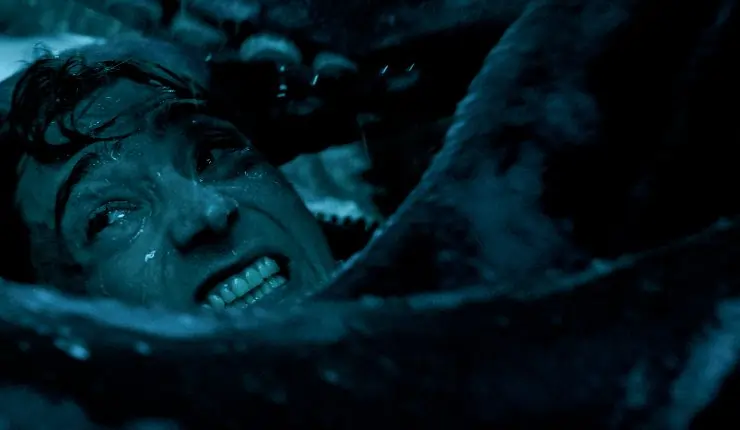
Now, 51 years after Spielberg terrified audiences out of the waves, director Brian Duffield is aiming to re-enact that deep, human phobia for filmgoers with Whalefall, his junior feature following Spontaneous and No One Will Save You, based on the 2023 novel of the same title by author Daniel Kraus, who also shares scriptwriting credits with Duffield. The survival thriller stars Austin Abrams as a young scuba diver called Jay, grieving his late estranged diver father, played by Josh Brolin, hoping to find his father’s remains in the sea, only to be swallowed alive by a sperm whale. With his submersible pressure gauge tauntingly ticking away the one hour of oxygen he has left, Jay must fight for his life in the multi-chambered stomach of the whale before he is digested.
Reading the film’s logline, Whalefall reads as one of the more original, creative, and challenging-to-digest concepts as a theatrical release in a drought of sequels, prequels, spin-offs, remakes and the upteenth adaptation of a book, with most contributions to its genre centring on a geographical location. Yet Duffield’s latest work breaks both these moulds, anchoring its creative spin on a film/survival thriller by locating the threat to survival inside one of Mother Nature’s creatures, not landscapes, kicking up the terror to tear into man’s survival instincts as the thought of being digested by a living mammal bends the mind from horror.
Essentially, the film’s hook is used to create an intense ride through an unimaginable, horrific situation that reads as the ultimate punishment for the utmost evil, and it’s just some poor, grieving kid trapped in its torture. The visual composition is the central vessel for such intensity; apart from Abrams’s amazing, mostly physical, performance as per usual, a team involving cinematographer Aaron Morton, production designer Ramsey Avery and visual effects supervisor Guillaume Rocheron, working under Duffield and Kraus’s vision, unleash the horrors of the film’s situation on the fullest scale.
The events onscreen are framed and shot to amplify the exhilarating stress our protagonist endures and crumbles under, with close-ups of Jay’s face and body parts emphasising the intense claustrophobia his brain bends to process and work around. Additionally, key images are perfectly framed to capture Whalefall’s atmosphere in a detailed union. There is clear and triumphant hard work to drown audiences in the nauseating and nightmarish spatial intensity filling out on the screen, one that will make sure your eyes are as wide open as your jaw is, even though you would rather look away and hide.
This makes Whalefall a needed cinematic experience of the year, as its technical and visual scopes make for a terrific and immersive component.
Read more of our reviews →
As mentioned, Abrams’ performance is the standout detail, with Duffield’s film providing another contribution to the ongoing saga of ‘Austin Abrams just trying to get home and away from the worst scenario you could imagine, which only seems to get worse‘, following Zach Cregger’s Weapons and Resident Evil. The star of the show pulls out all the stops in anchoring the film’s force and severity, mastering the art of facial expressions and body language as these prove to be the only forms of expression available as the film opts for minimal dialogue once we are inside the whale.
The actor is just unmissable on the big screen, exercising the heart and soul of any script he takes on.
In a more divisive context, the film’s script also attempts to wield an intense weight of emotional vulnerability and strained family bonds within the standard survival thriller elements once the visuals have answered the concept’s supplicating to the fullest rank. What follows in the wake of a rather ambitious tonal shake-up choice obviously splinters how Whalefall lands with audiences; as you can recognise, a film author would choose to embed a sensitive backdrop into a survival narrative, such as a source of inspiration, the catalyst for the protagonist’s final leap to make it out alive and adding depth to the character design. Nonetheless, this tone fragmentation exposes the film as tawdry, with only a faint scent of cheese, and audiences may quarrel with some of the later directions this aspect takes.
Overall, Whalefall provides one hell of a cinematic ordeal. The sentimental aspects may potentially tamper with its echo, but what we bear witness to onscreen beforehand is a concept that is just indispensable and accomplished thanks to some methodical imagery and well-orchestrated story trajectory.
★★★
d-Brian Duffy/20th Century Fox/Austin Abrams, Josh Brolin, Elizabeth Shue, John Oritz, Jane Levy, Emily Rudd/ Rated

Discover more from
Subscribe to get the latest posts sent to your email.
About the Author


You must be logged in to post a comment.