The 10 Greatest Pixar Movies Ever Made
© Disney
With the recent release of Toy Story 5, audiences have inevitably started comparing it to the others in the series, going right back to Pixar’s very first feature. As such, now feels like the ideal time to look back at the very best the studio has to offer. For just over three decades, Pixar has captivated children and adults alike, and set an impossibly high standard that other animation studios have struggled to match.
This reputation means that Pixar is also judged more harshly than other studios. Their recent films aren’t bad (Hoppers was particularly great), but they’re measured against an astonishing 15-year run that few filmmakers could hope to match. Narrowing the catalogue down to just ten films is no easy task, and there are painful omissions: As groundbreaking and influential as it is, Toy Story just misses out; Inside Out 2 is a dazzling continuation of its predecessor, and even A Bug’s Life still boasts the studio’s greatest villain in Hopper.
This is an unapologetically personal list (sorry, Cars fans), and you will doubtless notice a pattern among the top picks – I’m always drawn to Pixar at its most heartfelt. At its best, the studio taps into those intangible things that provoke emotional reactions from adults and children alike, and the top picks reflect this.
10. Ratatouille
The premise of Ratatouille shouldn’t work – a rat controlling a chef like a marionette is something that really tests the audience’s suspension of disbelief. However, the film itself is so charming, and director Brad Bird commits to the idea so wholeheartedly, that you get over the jump in logic almost immediately.
Remy (Patton Oswalt) is a rat with impossibly refined culinary tastes, who follows his dream of creating gourmet cuisine in one of Paris’ finest dining establishments by cooking vicariously through inept kitchen boy Linguini (Lou Romano). Unironically one of the best cinematic representations of life in a working kitchen, with gracefully choreographed chaos as the chefs bustle past each other, painstaking attention to detail (see the burns on the sous chef’s forearms) and lovingly animated cooking sequences as Remy puts together his recipes – the animation is extraordinary.
But what elevates the film is its emotional payoff – the “blast from the past” tasting sequence that serves as the film’s emotional climax is a virtuoso piece of animation that elegantly humanises formidable food critic Anton Ego (Peter O Toole) in a matter of seconds, as a single mouthful immediately transports him back to his childhood.
9. Inside Out
It’s a testament to Pixar’s cultural cachet that they were able to build a story around personified emotions and turn it into one of the defining family films of the decade. Inside Out takes a wildly ambitious concept and grounds it in an emotional family drama that resonates just as strongly with adults as with children.
Some of the mechanics of the plot become a little convoluted, others are a bit on-the-nose, but the emotional core never falters. At the film’s heart is a surprisingly sophisticated message that sadness isn’t something to suppress, but an essential part of being human. Few family films have delivered such an important lesson with so much warmth, and this is helped immeasurably by the mismatched dynamic of the irrepressible Joy (Amy Poehler) and perpetually downcast Sadness (Phyllis Smith)
Then there’s Bing Bong (Richard Kind), one of the most indelible Pixar characters despite his brief screentime. Introduced as Riley’s irritating imaginary friend, he ends up being one of the studio’s most poignant creations. “Take her to the moon for me” remains one of the most devastating lines of the studio.
8. Toy Story 2
It might seem like sacrilege including Toy Story 2 when the original narrowly missed out (for what it’s worth, Toy Story would have been number 11), but this sequel is a cut above the original in almost every way. The animation is richer, the jokes are sharper, and the characterisation is much deeper, leading to some moments of real pathos.
It’s also the genuine ensemble piece in the series. While Woody (Tom Hanks) comes to terms with his identity as a collectable, the rescue mission launched by Buzz (Tim Allen) also gives Hamm, Slinky, Rex and Mr Potato Head meaningful roles rather than simply tagging along for the ride.
The film also introduces new additions Jessie (Joan Cusack) and Bullseye, who effortlessly fit in among the existing cast. “When She Loved Me” tells you everything you need to know about Jessie in just three minutes, explaining her fears, motivations, and heartbreak with an elegant economy. It’s one of the most touching pieces of characterisation that Pixar ever produced.
7. Up
Is this quite a low ranking for Up? It used to regularly occupy a place in my top five Pixar films, but that was mainly on the strength of that beautifully conceived, heartbreaking opening montage. The sequence is rightly held up as among the greatest in animation history, charting the relationship between Carl and Ellie, from childhood to old age, without wasting a frame. By the time the title card appears, you’re already emotionally devastated.
Once the adventure begins, though, the film gets a little messy. Talking dogs, giant birds and floating houses are all charming elements that work individually, but don’t always cohere as well as they should, and the second half occasionally feels like several films stitched together.
Thankfully, these are minor complaints, because the emotional core remains wonderfully strong. The dynamic between the irascible Carl (Ed Asner) and adorably keen boy scout Russell (Jordan Nagai) is an unlikely friendship that provides the film with real warmth, and leads to a moving message about letting go. Few Pixar films capture love and grief so beautifully.
6. Finding Nemo
For some reason, it seems that Finding Nemo doesn’t receive the affection it once did, which is surprising given just how technically ambitious it was at the time. The underwater animation still feels miraculous, from the sheer vastness of the ocean to the unique movements of the various aquatic species Andrew Stanton brings to life. Even today it’s one of the most convincing animated oceans ever depicted onscreen.
The story of the overprotective and painfully unfunny clownfish Marlin (Albert Brooks) desperately crossing the ocean in search of his only son, Nemo (Alexander Gould), helped and hindered by the amnesiac blue tang Dory (Ellen DeGeneres).
Emotionally, it’s more understated than some of the studio’s biggest tearjerkers (although, for my money, Dory’s “When I look at you, I’m home” speech sits alongside the most moving moments in the catalogue) Instead of aiming for heartbreak, Finding Nemo derives emotion from the parallel journeys of Marlin learning to let go while Nemo learns to trust himself, which becomes more affecting every time I revisit it.
It’s one of the studio’s most earnest, unashamedly sincere films. There is a playful sense of humour and adventure throughout, but beneath it all is a simple, deeply sincere story about learning when to hold on, and when to let go.
Read more of our latest features here →
5. The Incredibles
One thing I love about the golden age of Pixar is how each film had its own distinct visual identity – at least before the “Bean Mouth” style crept in. A good way of gauging this is by looking at animation of human beings – you’d never mix up the humans in Ratatouille with the humans in Up or Brave. The Incredibles might be the most distinct of them all. Brad Bird’s retro-futuristic aesthetic recalls a 1950s comic strip brought to life, reflected in the angular, hyper-stylised character design.
It’s also one of the finest superhero films ever made, animated or otherwise. Each of the main characters’ powers are beautifully realised. Bird clearly had a ball thinking up visually inventive sight gags for the family’s superpowers – the sequence where Elastigirl (Holly Hunter) gets herself stuck in multiple doors is brilliant. The extended chase scene where Dash (Spencer Fox) realises he can run on water is an exhilarating, show-stopping set-piece.
Long before the MCU dominated cinemas, The Incredibles combined thrilling action and razor-sharp dialogue (“when everybody’s super, no one is.”) with surprisingly mature plot elements. It also marked a turning point for Pixar’s storytelling and was the first time death was featured so prominently. There are countless supes killed by Syndrome (Jason Lee), and Elastigirl’s sober warning to her kids that his henchmen “will kill you if they get the chance” marks a significant shift towards darker storytelling.
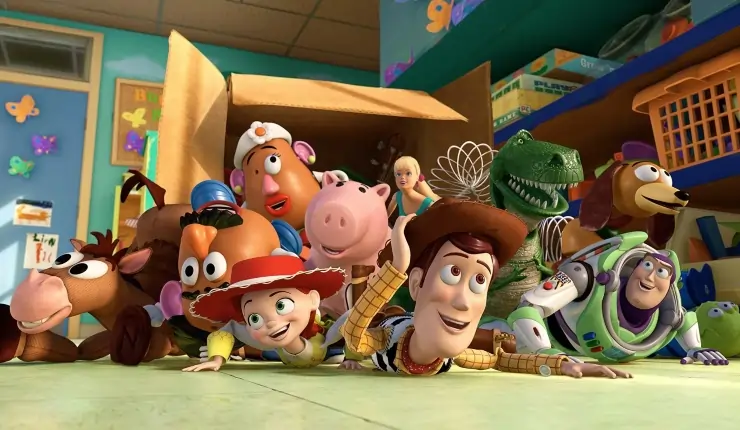
4. Toy Story 3
It’s easy to dismiss those who say “Toy Story should have ended at three” as curmudgeons, but when you watch Toy Story 3, it’s clearly written and structured as a loving farewell to characters we have known for 15 years. Not only is it the best-looking film in the series, but it’s also the one with the biggest emotional heart. The two films that followed had their strengths, but this one ensured that the series went out on a high, so any subsequent entries were inevitably going to struggle.
The story sees the toys inadvertently donated to a local pre-school, where they come under the thumb of the embittered Lotso Lovin Bear (Ned Beatty), one of Pixar’s most hissable antagonists. It’s a simple story, but a very emotional one, and it’s full of set-pieces that sear themselves into your memory. Woody’s escape from Sunnyside, the epic opening set-piece, that unbearably tense furnace sequence, and of course, Andy’s goodbye.
As someone who grew up alongside these characters, from the moment he describes Woody as “He’s brave, like a cowboy should be,” it’s impossible not to be swept up by emotion. Pixar has produced many endings that bring tears to the eyes, but there aren’t many as perfectly earned as this one.
3. Coco
Quite possibly the last truly great original film from Pixar, Coco combines breathtaking visuals with one of the studio’s richest, most unique stories. It’s also the closest Pixar has come to making a full-blown musical, with songs that feel integral to the story rather than simply accompanying it.
Miguel (Anthony Gonzalez) is that rare thing, a child protagonist who is wilful, stubborn, and single-minded in his dream of being a musician without ever becoming irritating. His quest for validation from his family leads him into the vibrantly animated Land Of The Dead, where his deceased family try to catch him and send him back to the land of the living. It’s a success on all levels, from the family conflict, which never feels manufactured, to the representation of Mexican culture, and the songs are all incredibly catchy.
The final 20 minutes are perhaps the most sustained emotional finale the studio has ever attempted, from the moment Miguel begins singing “Remember Me” to Mama Coco, all the way to the end credits. If Up breaks your heart in the opening scene, Coco punches you in the gut at the end.
2. Monsters Inc.
The reason Monsters Inc. still endures isn’t simply the sophisticated animation – impressive though it is, with every one of Sully’s hairs individually animated – but the meticulous world-building, the ingenious premise, and the enormous beating heart beneath it all.
What really elevates the film, though, is the relationship between Mike (Billy Crystal) and Sully (John Goodman). The two actors have incredible chemistry, and when the characters fall out, both viewpoints are completely understandable – neither is wholly unreasonable. Modern conflict in films like this can sometimes feel contrived or overwritten – here it is all entirely true to the characters and their respective worldviews.
This is also arguably Pixar’s most outright funny film, packed with sight gags that reward repeat viewings. Yet for all the comedy, it’s most memorable for the touching bond that grows between Sully and Boo. It’s a gentle, touching relationship, and their inevitable farewell is up there with the most heartbreaking moments Pixar have ever created. Add to that the ensemble of memorable characters like Ros, Celia, Mr Waternoose and Randall – and you have one of the richest, most fully-realised worlds Pixar has ever created.
1. Wall-E
The main criticism that gets thrown at Wall-E is that it peaks during its extraordinary opening act, using near-silent storytelling, before losing momentum once the humans arrive, but I’ve never really bought this argument.
The opening is undeniably a masterpiece of visual storytelling, but the rest of the film expands that foundation into something even richer. At its heart, Wall-E is Pixar’s purest love story, and the gentle romance between Wall-E and EVE unfolds with a sincerity and a joy that is evident in every frame, from the La Vie En Rose montage where Wall-E awkwardly tries to impress the locked-down EVE, to the sequence where the two dance weightlessly in space.
Of course, it helps that Wall-E is the most adorable animated character since Dumbo, but crucially, while he is unendingly sweet, the film itself isn’t. It’s not a cloying, overly sentimental film, and it puts Wall-E through genuine suffering. The sight of this adorable character getting crushed and broken remains deeply upsetting, even after countless viewings.
The film is also sadly prescient – nearly 20 years later, its environmental warnings and observations about humanity’s dependence on technology feel even more relevant than they did on release. Technically stunning, emotionally overwhelming, and with a real message that has gone sadly unheeded, Wall-E isn’t just Pixar’s greatest film; it’s one of the greatest animated films ever made.
All the films on our list are now streaming on Disney+.

Discover more from
Subscribe to get the latest posts sent to your email.
About the Author


You must be logged in to post a comment.