Why Na Hong-Jin’s Hope Is The Antidote To Stale Hollywood Sci-Fi
Na Hong-jin’s Hope premiered at the Cannes Film Festival this year to some fairly divisive reactions, but even that is underselling the overarching sensibilities of this film; it is far more than a polarising product begging for discourse to be had about it; it begins as an electric game of extraterrestrial paranoia, before morphing into an indescribable and vastly compelling piece of video game cinema aimed at taking a stab at the fulfilling qualities of the Western science-fiction film. This is the last thing I’d expect to play in Cannes Competition, especially given that the rest of this year’s lineup was heavily skewed toward superficial European dramas, nearly devoid of non-Western representation.
I don’t think it’s any secret that Hollywood is obsessed with finding and applying meaning in the smooth ‘perfection’ of their image-making; this chase for the grandiose and the sleek is often seen in their science fiction products, as a constant search for gratification, answers, and even marketability takes over. Directors seem destined to texture their images with little other thought than trying to be pretty. Take director Denis Villeneuve: his latest film Dune: Part Two was directed in a way that makes me think he cares only about how many people are gonna make any one shot the background wallpaper of their laptop, or even a vertically cropped one on their phone. Composed with little thought other than the ‘perfection’ of any one still, completely disjointed from any shot before or after it, hoping that maybe it’ll end up in a Pinterest mood board because it simply looks nice.
It is smooth because it has little going for it, no friction between its form, language and environment; a display of tacky commercialism where the images you point to can’t naturally exist in its state; it has to have clarity and total sense about it. Lord and Miller’s Project Hail Mary is another one that I have a damning aversion to; a film that is destined to play as a tech demo for those showroom TVs because it showcases many colours. This isn’t to say that context shouldn’t exist on the precipice of one’s images; it nearly always does, but there’s a big difference between unnaturally applying text in a film that doesn’t want to cooperate with such a way of working, and being able to string together something meaningful through various means.
In Hollywood, your sci-fi movie always has to be about something: destiny, trauma, character retrospect; they’d probably kill you if it didn’t have an eventual resolution either.
Read our EIFF review of the film →
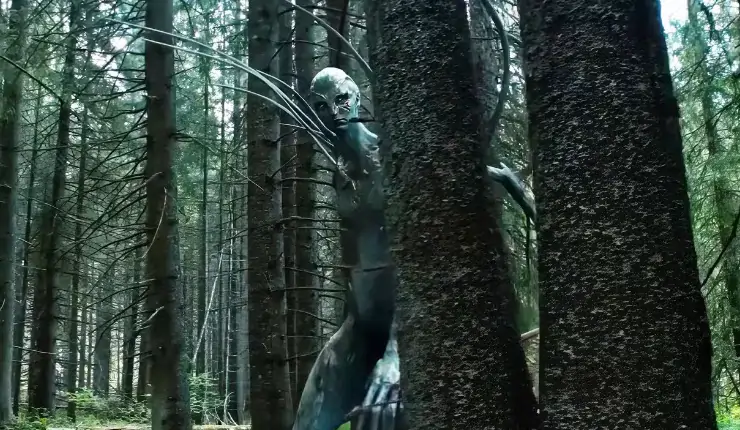
The reason Na Hong-jin’s newest, and outright bewildering hit functions so well is because it resembles an antidote to this stale moment of Hollywood sci-fi; this isn’t because it is doing everything in a totally new manner, but because it is able to ironically utilise some of those generic qualities to form a sea of juxtapositions between its form and its genre trappings. Probably the biggest talking point out of Cannes was the film’s CGI aliens, and by seamless standards most people would point out that yes, they do look sketchy, and yet I don’t think I would have it any other way.
Three of our main extraterrestrials here are played by Alicia Vikander, Michael Fassbender, and Taylor Russell, all of whom are notably big names, and yet Na’s idea for the appearance is one of comical brilliance: three Hollywood actors are wreaking havoc in a rural South Korean seaside town, and they look like digital monstrosities; incredible. What makes it even funnier is that they only speak in fictional alien language, with their facial features just about recognisable in relation to what many would have hoped to have seen, when they see three names like that strapped to its marketing.
Na is trolling with the identity of Western media, and he knows it all too well.
Video game movies, or adaptations, are the hot ticket in many ways. Cinematic realisations of old games make money, but as far as most go, they never possess anything more than a handful of functional qualities. Hope is not an adaptation of a video game, yet it harnesses the physicality and digitalisation unlike anything I’ve ever seen, especially in comparison to its genre counterparts. Na imagines a world where humans can interact with aliens that have come from inside a video game; these awkward, CGI beings attribute an extra dimension to this film’s formalities: uncanny, computerised figures crash-land in the middle of the real world, as barriers are broken down, and lengthy interactions are had.
If this film had the flawless CGI that the big studios possess, its most potent qualities would nearly vanish. Whilst you could point toward budget restrictions rather than something wholly intentional, the act of perfect digital transformation bores me.

Western science-fiction has frequently only managed to emulate the existence of the video game archetype in a single dimension, unable to account for its position and unpredictability in the hands of whoever is holding that controller, or pressing those buttons; it doesn’t always have to either. But Na exploits the wonderfully playful motion of his monsters in a way that no one over the sea would even attempt. They run at full speed, launching themselves into any building or tree that would break their fall. In moments, it appears to our eyes as if these creatures are running on the spot in certain chase sequences; the imperfect model as content and personality.
Our heroes are frequently treated like rag dolls, yet continue to stroll on, as if the health bar of our avatar is just hidden beyond our vision. It places the old PlayStation narrative physicality within our world in a manner that never feels like a simple copy-and-paste, but rather a piece of lost media defined by its genre, undiluted gameplay, and feasible otherworldly antagonists. The world has grown increasingly comfortable with the futile hyperreal resemblances in media, and has turned us into believing in the ‘perfect’ image.
Here, Na showcases his strengths as an unmatched action filmmaker, before deciding to pull the rug out after an hour and make the most random and equally compelling prank of the year. Our characters are all but arc-less; they have no notable past or any change in persona across its runtime, and he doesn’t spend any time wasting away at faux attribution of subtext within their existence. The film’s humour strikes a wonderful balance between that and its formal chaos. And for many, the film’s most challenging component is its ending; my biggest hope is that a sequel will never happen; the last-gasp dip into plot moment is, to be honest, a hilarious play on the state of narrative significance within the studio picture, as characters decide to discuss their destiny, both past and present, mere minutes before the film concludes.
It stands out because this sense of silly purpose had been adrift throughout the film. I’m aware a sequel is written, but there’s comfort in all this film’s ungainly characteristics, and tactility toward false, ironic destiny, as it implodes before our own eyes. At the same time, it still finds the odd moment to be a be a convincing movie on the Korean DMZ.
Hope is in UK cinemas now.

Discover more from
Subscribe to get the latest posts sent to your email.
About the Author


You must be logged in to post a comment.