The Devils Director’s Cut Review (2026 BFI London Film Festival)
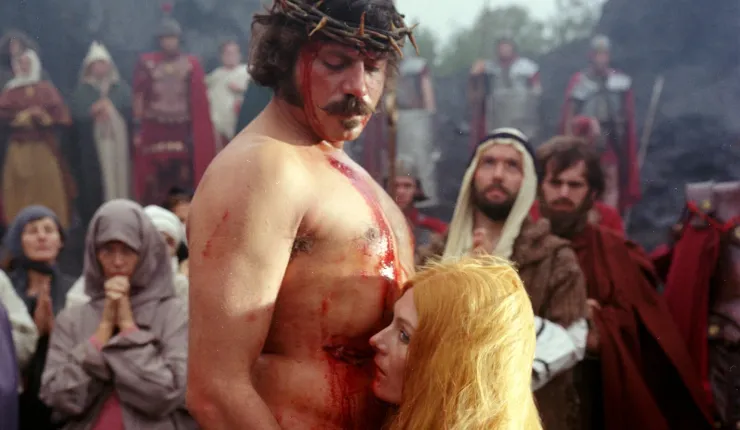
Image courtesy of Warner Bros. Clockwork
Like the proverbial demon that pursues its victim from one place to the next, Ken Russell’s film The Devils has been a thorn in the side of distributor Warner Bros for decades. Originally released to an enormously controversial reception in 1971 (let it be said, Russell also won the Best Foreign Film award at the Venice Film Festival), the film was inevitably butchered and truncated in a manner that sorely compromised the director’s original vision.
For those who weren’t there at the time (the same incendiary year that A Clockwork Orange and Straw Dogs were also released), one can only imagine the cinematic firecracker that went off in the face of early-seventies audiences, entirely unprepared for the film’s lacerating dissection of church and state, not to mention its uncompromising take on religious scapegoating.
In a historic first, the director’s cut of The Devils, now restored in 4K, is enjoying a mainstream theatrical release, following a successful and much-vaunted screening in the Classics section of the 2026 Cannes Film Festival. Don’t go mistaking Warner Bros for having had a change of heart: The Devils now comes at us as the first film from speciality offshoot label Warner Bros Clockwork, in conjunction with the BFI, and has restored the two notorious scenes originally stripped from the 1971 release.
Barring an isolated 2004 screening in London, the uncut version of the film, long championed by film critic Mark Kermode, who discovered the apparently lost footage in a Los Angeles vault, has never been shown, and is shrouded in all kinds of anticipatory mystery. One almost approaches it with the timidity that Indiana Jones approached the Ark of the Covenant in Raiders of the Lost Ark. Of course, to fully reconcile with the movie, one approaches it fully divested of the media hysteria that has surrounded the project for decades. The film primarily stands as a complex technical and storytelling achievement as opposed to a glib, froth-inducing exercise in pearl-clutching, much though its reputation suggests otherwise.
Make no mistake, The Devils has lost none of its infernal power in the intervening 50 years. In fact, it’s arguably gained added potency in this deeply troubled modern era of misinformation, suppression, and upper-echelon corruption, which is saying something, given it was originally released mid-Vietnam, post-Civil Rights, and pre-Watergate. Those willing to engage are encouraged to do so: if one is open to the idea of cinema holding truth to power, holding a mirror up to perversity and evil in intelligent, though non-exploitative form, as opposed to offering platitudinous homilies, then there’s a lot to admire here, if not necessarily enjoy in the strictest sense of the word.
Based on true events, The Devils is adapted from John Whiting’s play of the same name, itself adapted from Aldous Huxley’s dramatic reportage book The Devils of Loudun. Said French town is the setting of the horrific events that ensue: we find ourselves in the early 17th century, post the religious wars and with Catholic-led, anti-Protestant sentiment running high. The foppish King Louis XIII’s (Graham Armitage) Catholic chief advisor, Cardinal Richelieu (Christopher Logue), is looking to consolidate his political power by divesting regional towns and fortresses of their devolved authority by demolishing their fortified walls.
The plague-ridden town of Loudun is, however, something of a political hot potato, its proud walls unofficially defended by the licentious priest Urbain Grandier, played in commanding fashion by Russell regular Oliver Reed. Lusty in his sexual appetite and eloquent in his anti-Richelieu rhetoric, Grandier has already got Philippe Trincant (Georgina Hale), daughter of the local prosecutor Louis Trincant (John Woodvine), pregnant, something that will come back to haunt him. He then sets eyes on, and marries, the seemingly virtuous Madeleine (Gemma Jones), telling her that Christ’s teachings never dissuaded his disciples from doing the same thing.
Read more of our LFF 2026 coverage →
Concurrent with these events is the point of view of hunchbacked Ursuline convent nun Sister Jeanne, played with genuine disturbing ferocity by Vanessa Redgrave. Ostensibly of the cloth, she harbours illicit desires for Grandier, which manifest as startling, sexually charged and blasphemous black-and-white sequences akin to a Carl Theodor Dreyer movie turned far more monstrous. Believing herself to have been spurned by Grandier’s marriage, Jeanne becomes a fulcrum in the political battle to depose and expose him. Said to be possessed by demons, Jeanne’s psychological state is co-opted by Richelieu’s right-hand man, the Machiavellian Baron de Laubardemont (an excellent Dudley Sutton), and witch-finder Father Barre (Michael Gothard) as a pretext to blame Grandier and place him on trial in a farcical kangaroo court where he is accused of demonically seducing the abbey sisters.
Before long, the entire convent has descended into apparent demonic hysteria, yielding the now-infamous and freshly reinstated ‘Rape of Christ’, nun-led crucifix desecration sequence. Quite apart from being shocking on its own terms, it is a marvel of editorial cross-cutting, balancing calm quiet outside the city walls with the eye-widening, libidinous chaos going on within it. In Russell’s world, so-called ‘normality’ is but a veil that can be, and is, torn down at any given moment.
As a horror story that speaks to the relentless human need for scapegoats, The Devils transcends its archaic setting to become a disquieting commentary on any period in our history. This is superbly augmented by Derek Jarman’s modernistic production designs, whose odd angles, colour schemes and intentional anachronisms dislocate our sense of time and place. It reminds us that the story may be an old one but the emotional principles underlying it certainly aren’t.
It’s also a powerful statement on pervasive, all-consuming performative hypocrisy, from Madeleine’s desire to marry Grandier to get sexually closer to him, to Sister Jeanne blithely crossing herself with a religious text while exposing the less-than-salubrious origins of her religious order. The scheming Laubardemont deliberately stokes Barre’s demented fervour in pursuing Grandier because he understands that zeal is more seductive than fact in the defeat of one’s enemy. Murray Melvin’s watchful Father-Canon Jean Mignon is one of the players who helps set in motion Grandier’s downfall, onanistically enjoying the spectacle of the writhing nuns only to later develop a moral compass at the prospect of Grandier being innocent.
Everyone in the story is playing a role while in thrall to a higher power, be it corporeal or otherwise. Grandier himself is nominally a pious man but sets in motion his own god-forsaken downfall via a toxic mixture of ill-judged rhetoric and sexual desires. He’s not an innocent man, but he is innocent of the crimes with which he’s presented, setting in motion an appalling, inflammatory endgame that still has the capacity to leave viewers stunned, not least with the reinstatement of another long-excised and notorious scene involving a femur.
For all the furore over these infamous deleted scenes, one has to wonder why and how the distributor was more complacent about the film’s many other horrifying moments, including a misogynistic exorcism-via-enema scene that is stomach-turning in the extreme. That it’s drawn from the historical record (with some embellishments here and there) only makes it all the more despairing.
The film presents itself as a moral pendulum, forever swinging our expectations back and forth and all the while highlighting Russell’s technical flair, from David Watkin’s mist-laden-meets-splash-of-blood-red cinematography to Peter Maxwell Davies’ dissonant score that churns and writhes in the manner of a tormented nun’s sexual repressions. By no means is it an easy film to consume, but it is a commendably brave one, showcasing fidelity to the shocking events outlined in Aldous Huxley’s book while lacing it with more than a dash of Ken Russell camp.
Indeed, at times, the movie appears to be verging on Monty Python territory (note the bizarre Terry Gilliam-esque opening Birth of Venus Renaissance ballet sequence). The Devils is ultimately a fascinating mixture of utmost seriousness and more than a touch of theatrical absurdism, contradictory in the extreme, but destined to be remembered for all that.
★★★★★
In cinemas in the UK and Ireland from October 30th/ Oliver Reed, Vanessa Redgrave, Gemma Jones, Dudley Sutton, Murray Melvin, Michael Gothard, Graham Armitage, Christopher Logue / Dir: Ken Russell / BFI and Warner Bros Clockwork / 18

Discover more from
Subscribe to get the latest posts sent to your email.
About the Author



You must be logged in to post a comment.