The Blue Trail Review
Dystopian films often lean towards being bleak or overtly apocalyptic, but The Blue Trail presents its world very differently. Gabriel Mascaro imagines a society where Brazil, facing economic crisis and an ageing workforce, enforces a mandatory retirement law, but it is never framed as extreme. It is simply an accepted part of daily life, and that subtlety is largely what makes it land with an unusual levity for the subgenre.
The Blue Trail introduces Tereza (Denise Weinberg), a 77-year-old woman living independently and working a manual labour job in a caiman abattoir. Early on, she returns home to find a commemorative “gift” from the government installed on the side of her house: a large gold wreath and plaque marking her as “living national heritage”. Despite the worker’s insistence that she should be pleased, Tereza sees it for the invasion and removal of agency that it truly is.
That loss of agency quickly becomes even clearer through bureaucracy. After a government announcement lowers the age of independent living from 80 to 75, Tereza is informed she now falls under state care. She is placed under her daughter’s temporary custody before being relocated to a colony, where the elderly are sent to “rest”, have their needs taken care of, and live out their final years. No one is particularly disturbed by this. There is some surprise, as Tereza expected to have three more years of living alone and working, but also acceptance. This is a law in Mascaro’s dystopian society that has been in place for some time and is one that most follow without question.
The reasoning behind the law is presented as purely practical. It is about thanking older generations for their contribution to their communities, while also allowing younger people to work more efficiently, without needing to train or accommodate those who may struggle with newer systems or physical demands. It is framed as care, but it is clearly control. While this is obviously fictional, it is not really that far removed from the very real attitudes towards ageing and retirement. The Blue Trail has just made those sentiments more visible.
Tereza is encouraged to see the positive side, for example, her friend tells her she now has the free time to do whatever she wants. The issue for Tereza is that she has spent her life as a working, single mother. Her own wants and needs were never a priority. On a whim, she says she wants to fly a plane. What follows is a journey through the Amazon, as she tries to hold onto some semblance of freedom before it is stripped from her.
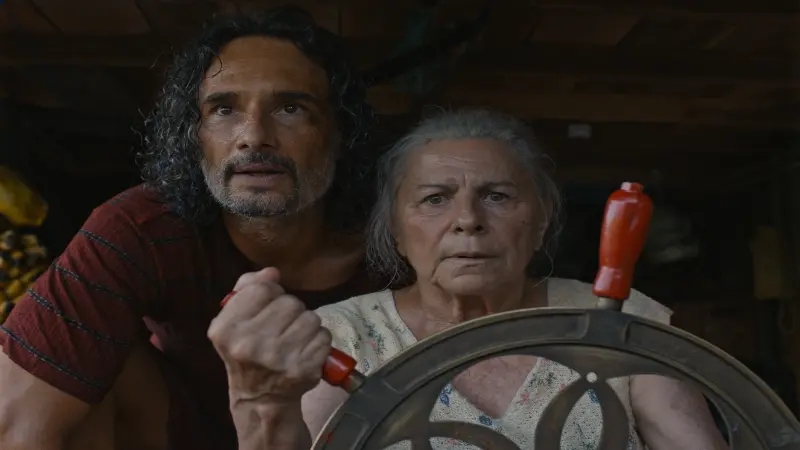
As she travels along the river with Cadu (Rodrigo Santoro), the film opens up visually. It is the sweeping shots of the Amazon that are undoubtedly the film’s strongest feature. Cinematographer Guillermo Garza crafts a landscape that is lush, evergreen, and expansive, with the camera moving deftly between wide overhead shots, more traditional character framing, and moments from Tereza’s own point of view inside the boat. Environmental concerns are also occasionally woven in without being heavy-handed. At one point, they pass a stretch of discarded rubber tyres lining the riverbank, remnants of products made from felled Amazonian trees that now sit useless and out of place. It is through Tereza’s interactions with Cadu that many of the film’s themes begin to emerge. In one exchange, when he asks if she wants to know her future, she responds, “Since when does an old woman have a future?”
The film deals with themes that could easily be played as severe in another director’s hands, but the tone never veers in that direction. The humour is understated and constant, present in simple lines and small human interactions rather than larger set pieces. Tereza, referring to the police vehicle as the “wrinkle wagon”, or the exchanges she has with the eccentric people she meets on her adventure, gives the film a lightness that runs alongside its more thought-provoking ideas.
That approach carries through to some of The Blue Trail’s most uncomfortable moments. When Tereza is eventually found and processed for transport to the colony, she is given a backpack containing essentials, including a mandatory adult diaper. She insists she does not need it, but is told it must be worn regardless. The scene is demeaning, but it is presented without melodrama. This interaction is treated as routine, just another step in a system that has normalised the loss of dignity. The same is true of the workers enforcing these rules. Some are indifferent, some quietly sympathetic, but most simply accept that this is how things work, rather than actively fighting against this totalitarian regime.
Denise Weinberg is central to why the film works so well. Tereza is an unexpected protagonist for a dystopian story (an elderly woman from a rural community), but Weinberg carries the film with ease. She has a magnetism, a natural comedic timing and wonderful chemistry with each person she meets. The journey is made up of these encounters, each moving the story forward in a way that is restrained and gentle, rather than building towards one singular climactic, world-ending event.
The structure is loose, and the film is not particularly concerned with driving towards a clear resolution. It moves from one moment to the next, allowing space for observation rather than explanation. That may not work for everyone, especially those who prefer their dystopian societies to come with more world-building, but it feels very much consistent with the film’s overall approach. This is a rare, character-driven sci-fi tale, rather than one propelled by plot or spectacle.
The Blue Trail is a dystopian film that does not rely on extremes to make its point. Instead, it focuses on something much more human: the gradual removal of independence, and the ways in which we justify and normalise it. In following Tereza’s journey, it finds something more hopeful. A sense that autonomy, strength and desire do not simply disappear with age, even if the system around you insists that they should.
★★★★ 1/2
In UK cinemas on April 17th / Denise Weinberg, Rodrigo Santoro, Miriam Socorrás, Adanilo / Dir: Gabriel Mascaro / MetFilm Distribution / 15
Discover more from
Subscribe to get the latest posts sent to your email.
About the Author