Sunshine Women’s Choir Review
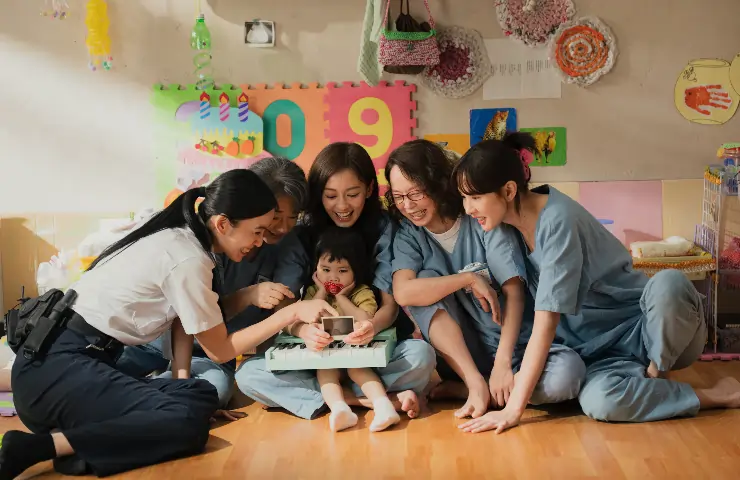
In what might be a surprising revelation, given that most of my film career has been spent discussing East Asian cinema and anime, I adore Sister Act. Its comedic brilliance and heartfelt moments are elevated by those magical musical sequences. It’s a film that shows how music can bring the most unlikely people together and spark genuine joy. So, while watching Taiwan’s highest-grossing local film, Sunshine Women’s Choir (a remake of the 2010 Korean film Harmony), I felt that same sensation again. It blends that spirit with touches of 2024’s Sing Sing, resulting in a heartfelt, joyful film that resonates far beyond its premise.
Taking place in a women’s prison, the film opens with a birth as inmate Li Hui-Zhen (Chen Yi-Han) welcomes a baby girl. Sharing a cell with three other women, she’s allowed to keep her daughter with her until the child turns three. As time passes, however, her daughter is diagnosed with an eye disease that can only be treated outside the prison. Noticing her little girl’s love of music, Li Hui-Zhen wants to form a choir so her daughter can have a meaningful final send-off before they’re separated. But the path forward is far from smooth, especially when a newcomer arrives and tensions flare among the cellmates.
Unity is at the core of Sunshine Women’s Choir. While the film presents an idealistic view of the prison system, one focused on rehabilitation rather than feeding a cycle of reoffending, it’s still a genuinely heart-warming narrative to watch unfold on screen. The choir brings together the unlikeliest group of women under a shared purpose. Through music, they’re able to connect and set aside their differences, recognising that doing something meaningful for Li Hui-Zhen matters far more than debating whether they should form a dance group or a choir.
Li Hui-Zhen is making the biggest sacrifice of anyone there. She’s giving up what little time she has left with her daughter so the child can receive the treatment she needs. Early on, we see a newcomer, Liu You-Xin (Ho Manxi), make underhanded comments suggesting that the girl will grow up hating her mother. Yet as the story unfolds, we learn that Li Hui-Zhen and Liu You-Xin are more alike than they first appear. Sunshine Women’s Choir walks a delicate line, recognising that not everyone in prison is there because they’re a heinous monster; many are victims of circumstance. Some struggle to keep food on the table and turn to illegal means, while others are trying to escape abuse.
Despite being an ensemble piece, Sunshine Women’s Choir does an effective job of fleshing out the core cellmates and select members of the choir, giving them dimension beyond simple archetypes. Yang Yu-Ying (Judy Ongg), affectionately known as Grandma, is the most fully realised of them, with a genuinely moving narrative arc. A once-famous singer imprisoned for killing her husband and child, she emerges as a flawed yet sympathetic figure who gradually becomes deeply lovable. By the film’s conclusion, her emotional payoff lands with real force.
Huang Pei-Yang and Chiu Hsiu-Lan, while not as fully developed, are still more than one-dimensional figures and help illuminate the darker side of prison life, particularly through their hazing of Liu You-Xin. The prison staff also avoid falling into clichés or simple narrative function. The main prison chiefs, though strict, to keep the audience aware that this is still a prison, are willing to stand up for the choir when they know the women are innocent. What truly allows the film to work, however, are the performances. Sunshine Women’s Choir is deeply character-driven, and even a single weak link could dilute its emotional impact. Instead, the entire cast is exceptional, with Chen Yi-Han, Judy Ongg, and Ho Manxi delivering the standout performances.
Director Gavin Lin does a great job guiding the film, delivering both its emotional core and its musical sequences with precision. It’s a film that may leave you in tears more than once. Some viewers may find the emotional beats a little heavy-handed, but most of them worked for me. And it’s hard to deny just how fantastic the choir scenes are. Much like Sister Act, I found myself bobbing my head along to the music with a huge grin on my face. These sequences are the film’s highlight, and they’re used to great effect throughout.
However, one aspect of Sunshine Women’s Choir that I found distracting is its structure. At several points, the story flashes forward to 2025, presumably to tease what’s to come, but these moments unintentionally spoil key plot revelations that occur later. This becomes especially frustrating because the opening scene hints at a major reveal that would have been far more impactful had it been saved for the film’s final moments.
Sunshine Women’s Choir is a heartfelt and genuinely joyful film. Despite its prison setting, it’s filled with a sense of hope that people can do better, and they can come together for a common good. With strong performances and moments that may have you reaching for tissues, it’s a film that resonates emotionally without losing its optimism. Sunshine Women’s Choir is a great film and truly worth seeking out.
★★★★
In UK cinemas from 17 April / Chen Yi-Han, Judy Ongg, Ho Manxi, Sun Shu-May, Amber An / Dir: Gavin Lin / Central City Media / 15
Discover more from
Subscribe to get the latest posts sent to your email.
About the Author