Scarlet Review

Mamoru Hosoda, compared to his contemporaries like Makoto Shinkai, Masaaki Yuasa, or Naoko Yamada, has never truly moved me or produced an anime that reshaped how I view the medium. That isn’t to undermine his work; films such as Summer Wars and Wolf Children are wonderful, but there are countless titles I would recommend long before I arrived at Hosoda’s filmography. Scarlet should have been the film to challenge that belief: a dark, Hamlet-inspired fantasy epic aiming for a distinctive visual style, not quite 2D animation but not full-scale CGI either. In theory, it’s a recipe for success. In execution, it’s at best unpolished and at worst simplistically dull.
We follow the titular Scarlet (Mana Ashida) in 16th-century Denmark. Her youthful smile and bright pink hair light up whenever she is with her father, King Amleth (Masachika Ichimura). However, her life changes forever when her uncle Claudius (Kôji Yakusho), with the support of Scarlet’s mother, Gertrude, overthrows Amleth, who is executed for treason. Seeking revenge, Scarlet trains and prepares to avenge her father. Her attempt fails, and she is poisoned instead and is transported to the Otherworld, where past and future collide. There, she learns that Claudius has also entered this realm, and she continues her pursuit of vengeance in a world reminiscent of hell.
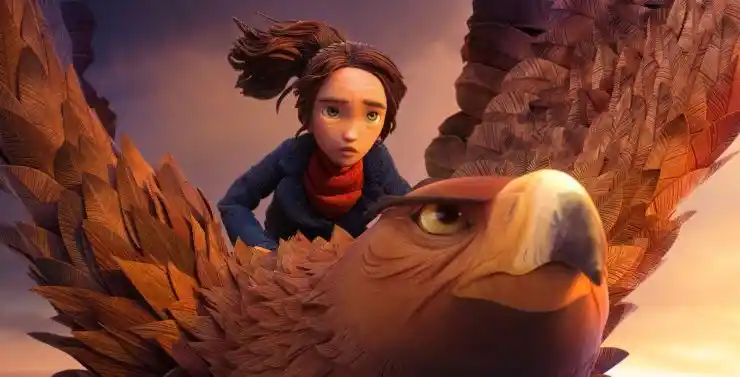
Visually, Scarlet ranges from breathtaking to flat-out ugly. The opening sequence, where the camera gradually descends into the Otherworld, its landscape haunting with its ground resembling roots embedded in the surface, is a moment of genuine fantasy wonder. Even the sky resembles a dark sea of waves as a mythical dragon flies overhead. It’s stunning, and it showcases how far Japanese CGI has come. But mere moments later, we see Scarlet walking, and the immersion collapses. Throughout the film, the character animation and background art are so uneven in quality that they constantly undermine each other.
Many moments feature breathtaking CGI backgrounds, almost photorealistic in a way I’ve rarely seen in anime, but they’re paired with either traditional 2D character animation reminiscent of Studio Chizu’s previous works or weightless, bland 3D models. The contrast is jarring and constantly pulls me out of the film. What makes it more frustrating is that the 2D animation looks gorgeous, far surpassing the 3D animation. I wouldn’t have minded the stylistic contrast if there were a consistent visual language, the Otherworld rendered entirely in 3D and the human world in 2D. But Scarlet doesn’t commit to this idea, and several scenes in the Otherworld unexpectedly revert to 2D, breaking any sense of cohesion.
That isn’t even considering a bizarre musical sequence that is, frankly, a visual eyesore, but also narratively feels out of place. In a strange turn of events, Scarlet’s narrative is also incredibly simplistic, idealistic, and hollow in meaning. Mamoru Hosoda’s previous film, Belle, also relied on simplistic themes and idealistic messaging, particularly in its handling of abuse. However, Scarlet attempts to grapple with a much larger and more morally complex issue: conflict itself. While the film also touches on forgiveness, its final moments revolve around conflict and the dream of a world where it no longer exists, a world where we speak with our neighbours instead of fighting them.
In an ideal world, this should be a message of hope; wanting a world without war or conflict is something many, even I, strive for. However, Scarlet takes place in a world where Claudius, once he becomes king, starves his citizens while the wealthy feast, hoards power for himself, and is willing to sacrifice anyone to maintain it. I’m not going to delve into the moral and ethical debates surrounding war and conflict, but when your villain is this inherently evil and entirely plausible in our current political climate, pairing that with such simplistic, idealistic views on the subject ends up undermining the film’s message.
Even then, the Otherworld makes little sense on a narrative level. This is supposedly a place where past and future converge, yet 99.9% of what we see feels rooted somewhere between the 16th and 19th centuries. Apart from Hijiri (Masaki Okada), who is from modern-day Japan, and perhaps one background character, the character designs remain oddly consistent with that earlier period. While I don’t want to slip into CinemaSins style of nitpicking, there’s a moment that genuinely pulled me out of the film: when Hijiri explains the meaning of the characters in his name to Scarlet, a Dutch girl from the 16th century. The scene plays as though she fully understands what he’s talking about, and I found it unintentionally hilarious.
The film also suffers from lacklustre drama, making it difficult to care about the characters. Scarlet and Hijiri are one-dimensional, with little to offer beyond their assigned traits. This applies even more to Hijiri, whose pacifist ideology is essentially his only defining characteristic. Scarlet’s thin emotional arc is at least supported by a strong voice cast, who do a commendable job elevating the material, and there are a few isolated scenes that land on an emotional level. Unfortunately, they’re too few and far between to justify the film’s egregious length.
I wanted more from Scarlet, a film that had the potential to be something unique, a genuine breath of fresh air within anime, but it ends in a whimper. Hollow in its narrative, inconsistent in its visuals, and flat out boring, Scarlet is a misfire: a perplexing, often clumsy film that left me feeling absolutely nothing by the time the credits rolled.
★1/2
In UK Cinemas Now / Mana Ashida, Masaki Okada, Masachika Ichimura, Kôji Yakusho, Yuki Saitô / Dir: Mamoru Hosoda / Sony Pictures / 15
Discover more from
Subscribe to get the latest posts sent to your email.
About the Author