Revolutionaries Never Die Review (2026 Locarno Film Festival)
There are some filmmakers whose work shines wider than their own self-proclaimed brilliance. Oftentimes, they cultivate their private ideas like journalists seeing a world of connections, and they veer towards documentary-like work, not limited by runtime, but expounded through an actively engaged life.
Such is the case with the late Beirut-born and raised Jocelyne Saab, the subject of Revolutionaries Never Die. Her overarching work was not executed merely through the camera, but because of it. Her life stands as a direct testament to a political cause becoming a personal imperative. The film springs from an invitation for a collaboration sent by Saab to Mohanad Yaqubi in 2018. For reasons of coincidence (or a dramaturgical whim of fate), Yaqubi was just too late in reacting, and Saab’s fatal illness prevented the conversation from moving forward.
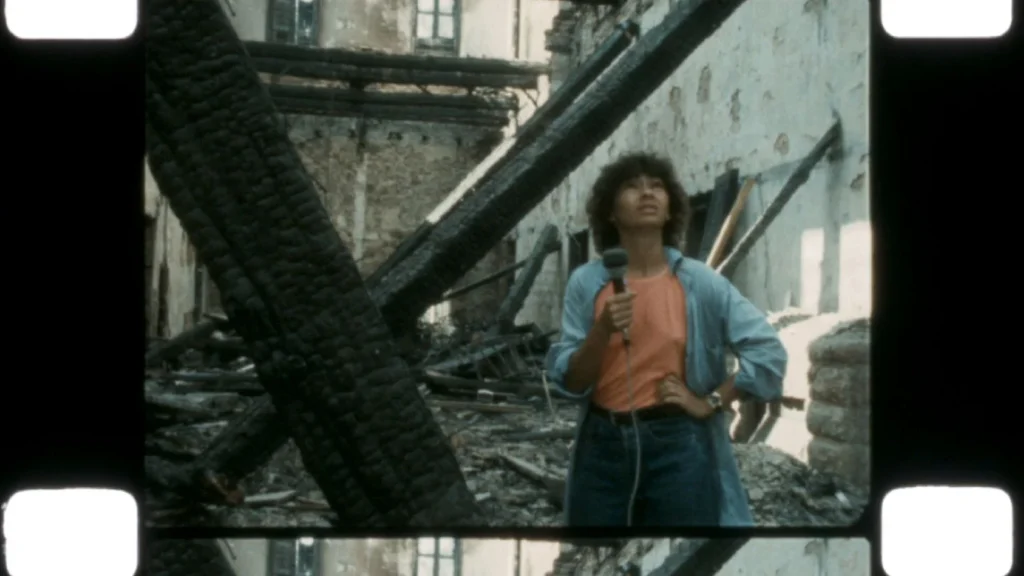
Nevertheless, this digital invitation brought her oeuvre to the attention of the Palestinian director Yaqubi. In turn, and with all inquiring and delicate intentions, Yaqubi constructed an undetermined biopic, utilizing archival footage from the camera of Saab. What’s a more honoring way to spotlight someone’s life work if not by staying with it, and making space for it to awaken and breathe for a final short while?
Unlike conventional turnarounds, the director does not insist much on the triggering facts of his films; this, I reckon, amounts to creative interest in tandem with acknowledgment of existing material of similar onsets and unassuming considerations for the emotional intelligence of the viewer. Saab is, anyhow, an exalted filmmaker, and the director treats her with utmost respect. He converses with the found footage mainly via selection and composition. Over brief written sentences on screen, with yellow, unobtrusive letters, he lets his thoughts occur, but none really prevail.
While seeking an answer to what collaboration could be formed through the film reel archive, he composes the material into thinking tryouts, and he finds a story to tell. Interestingly, he seems to step back to say it, attesting to his qualms of whose story it is and who is entitled to narrate it. Even more interestingly, this aligns with a question he encounters on the way, the paradox of one’s rights in a land, explored anew. Naturally, some time is alloted to the Palestinians’ fights to resist domination and secure a future in the land they inhabit. This space is dedicated to asserting how, in the face of colonial dominations, histories of suffering are one.
Yaqubi resurfaced some shocking, unexpected footage as well. Beyond the fighting female presence (which is a rarely prioritzed image in Western memory) fragments of Saab’s street interviews evince a society wrecked, in essence, from the horrors that have tested these populations. Her questions feel like stabbing knives at the heart of war when war is resting. What future can there be, if children can only think of either shooting or being dead?
The legacy of Saab is a vast filmography that ranges from documentaries to feature films to video essays. A list of titles that, with a quick glance, reveals a vigorous, militant, and highly intentional artist. Her work further seems to situate a strong female voice within a society that does not hold back, albeit constantly threatened, and, as it appears, unmoored. Her footage is full of female energy, which somehow seeped into the film of Yaqubi. It’s telling: Revolutionaries Never Die is not framed as a film or a documentary, but as a letter.
★★★★
Premiered at the Locarno Film Festival 2026, in the Filmmakers of the Present competition section. / Dir: Mohanad Yaqubi / Producer: Sami Saeed / Idioms Film, Sourat Films, / Escautville / Palestine, Belgium, Qatar
About the Author