Resurrection Review
Why do we love film as an art form? As a visual medium, it allows us to experience and understand societal issues we might otherwise never encounter. Films like Blindspotting or Han Gong-ju absolutely shattered me and made me see the world through a different lens. Film can also entertain and thrill us, leaving a massive smile on our faces. Watching The Furious and Detective Conan: One-Eyed Flashback had me grinning from ear to ear and craving more. No matter the subject, no matter the intended response, when you’re in an auditorium and the lights dim, and images are projected onto the silver screen, it becomes a dream-like experience.
Dreams are like movies for the mind, fantasies or horrors unfolding as cinema within us. They are constructs of creativity rooted in our realities. While many of us may never enter creative fields, you could argue that we are all creators of that realm. Dreaming is just as vital as film, after all, what would life be without dreams or cinema? I know that without film, my life would feel, in some way, meaningless. Without it, I wouldn’t have experienced joy, sadness, or laughter. Film has also been a way for me to connect with like-minded individuals and bond with relatives.
For Bi Gan, films and dreams are interchangeable. In his latest film, Resurrection, he envisions a world where those who do not dream live forever, while those who do, referred to as deliriants, bring chaos to that world. A select few are tasked with stopping people from dreaming by entering their visions and disrupting them. However, one deliriant is monstrous and mysterious, residing in the dreamworld of film, a realm a woman is able to enter. What unfolds is a true odyssey and a love letter to cinema.
Resurrection unfolds across six chapters, each representing one of the senses as well as the mind. Every chapter serves as a love letter to cinema, whether through homage to silent film, 1940s detective noir, or experimental cinema. Narratively, the film establishes all its key plot points within the first chapter. From that point on, the story progresses only between segments. The woman who enters the deliriant’s dreams provides narration during these transitions, marked by the burning of a candle on screen. While it may appear narratively light, it is rich in texture.
As the film unfolds, it perfectly captures the dream-like experience, true to Bi Gan’s belief that films are a form of dreams. Without film, there are no dreams, and vice versa. There is an art to watching this film; one does not simply understand Resurrection, you experience it. It’s hard not to become enamoured with the visual and auditory spectacle unfolding before you, but if you try to decipher every aspect, you’ll lose your way. While watching, I concluded very early that the audience is also delirious, people who choose to get lost in the dream world rather than live forever. We are just like the monster the woman is trying to uncover.
People who would rather dream than live in reality. There’s a meta element throughout Resurrection that is exemplary. Yet the true power of art lies in how we respond to it. In a way, Bi Gan wants you, by the time the credits roll, to at least react to his film. Who would want to live in a world where cinema doesn’t exist? While dreaming may bring chaos, the world is a darker place without dreams. Without film, there is no light. There’s something truly mesmerising about this message that captivated me from the moment the film began.
With every shift in time, from silent film to 1940s noir, Resurrection transforms, whether through aspect ratio, colour grading, set design, or overall tone. Every element becomes a true sensory experience, fittingly so, as each chapter is meant to represent a different sense. No chapter mirrors the last; each tells its own unique story. Whether it’s uncovering an evil monster, solving a murder, deceiving with magic, or falling in love at the end of the world, the film offers a kaleidoscope of narrative styles. As with any film structured around distinct chapters, preferences may emerge, but each segment floored me with its beauty and craftsmanship.
Related Posted: Interview: Bi Gan on his Cinematic Odyssey Resurrection
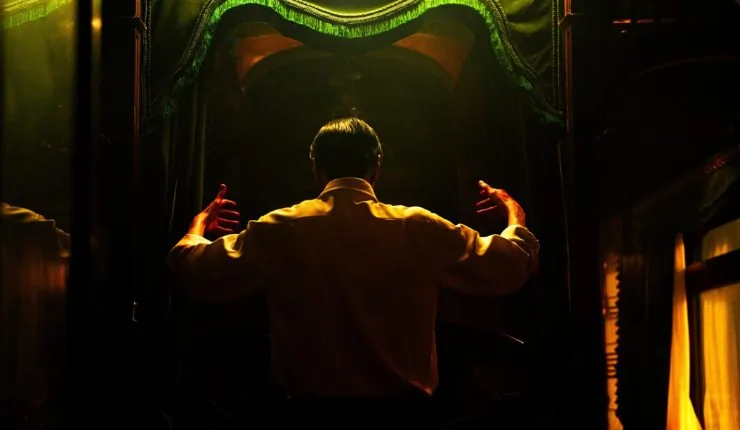
Bi Gan’s previous film, A Long Day’s Journey Into Night, was a true technical marvel. Seven years later, he has created a work that surpasses even that achievement. Every frame is a thing of beauty, capturing locales like a bustling train station, a snow-covered temple, or the chaos of Y2K with vivid precision. Yet the film’s true marvel lies in the extraordinary one-take sequence during the Y2K chapter. Lasting 30 minutes, the camera captures every moment with astonishing precision, the camera shifting from an observer to a first-person perspective, bathed in red colour grading, before returning to its detached view. It’s a moment of pure cinematic wonder unlike any other.
To accompany the dreamy visuals is an immaculate score, a transcendent experience for the ears. The performances are equally exceptional. Jackson Yee is truly remarkable in the multiple roles he inhabits across the chapters, and the rest of the cast is just as compelling. Their strong performances make it easy to become invested in each chapter, even when the context is minimal. Clocking in at over two hours and forty minutes, Resurrection unfolds with pacing that feels truly dreamlike. While watching, I thought only an hour had passed until the credits suddenly rolled.
Resurrection is a film like no other, a love letter to cinema and a true out-of-body experience. China has produced countless remarkable films over the decades; however, it will stand as one of the finest ever to emerge from the country, and one of the greatest films of the century. A true masterpiece of cinema.
★★★★★
In UK cinemas 13th March 2026 / Jackson Yee, Shu Qi, Mark Chao, Li Gengxi, Huang Jue / Dir: Bi Gan / Trinity CineAsia
This is a repost of our 2025 BFI London Film Festival review | original review
Discover more from
Subscribe to get the latest posts sent to your email.
About the Author