Little Odessa (Criterion Review)
Directorial debuts can be funny things. Usually a little rough around the edges, they often feel like a bit of a mission statement for filmmakers, offering a taste of what they can do without necessarily possessing the polish of their later work. Take Blood Simple, Following or Sex, Lies & Videotape: all great films in their own right, but each a long way from their director’s best work.
All of this is to say that Little Odessa, the directorial debut of James Gray, doesn’t feel like a debut. Across all levels, it feels like the work of a seasoned filmmaker, with startlingly assured direction, measured pacing, lived-in performances and masterful cinematography. Drawing on his own Russian Jewish heritage, though plainly not autobiographical, Gray constructs a family drama of operatic proportions, filtered through a conventional gangster narrative. It’s sombre, bleak and occasionally downright nihilistic, but never feels like a slog, with Gray finding beauty and pathos in the most brutal moments.
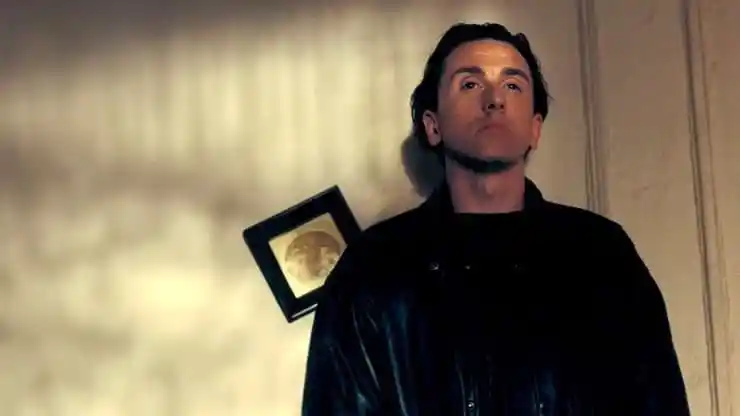
Tim Roth plays Joshua, a stone-cold hitman, whose latest assignment sends him back to his family home in Brighton Beach, Brooklyn. While there he attempts to reconnect with his estranged family: his idealistic younger brother Reuben (Edward Furlong) and his ailing mother (Vanessa Redgrave) despite the protests of his domineering, traditionalist father (Maximilian Schell). Unsurprisingly, old resentments quickly resurface, while Joshua’s criminal activities bring further danger to the family.
Two years after his breakthrough role in Reservoir Dogs, Roth is the epitome of restraint, giving a cold, controlled performance that nevertheless remains deeply human. He makes Joshua an emotionally shut off character, whose impassive demeanour only occasionally falters, in a violent confrontation with his father, and surprisingly tender moments with his mother and brother. In one scene, he gives Reuben a dead-eyed stare until his brother breaks his gaze, when the briefest flicker of amusement crosses Roth’s face. It’s as though he is observing normal human emotions from the outside.
There are no contrived or cliched scenes of brotherly bonding. More often, the affection between the two brothers is shown through small gestures: Joshua affectionately punching Reuben’s arm, or racing him back to the apartment, before retreating back behind his emotional armour. Furlong, then at the height of his career, gives one of his most nuanced performances as the younger brother who simultaneously idolises and distrusts Joshua. Reuben is impressionable but intelligent, fascinated by cinema and mythic heroes, inevitably putting his brother up there with the stars from the silver screen.
Gray himself steers clear of any kind of fetishisation of the hitman. Joshua is decidedly not noble or heroic, like Leon or Le Samourai. On the commentary for this release, Gray states that he wanted to make a movie that was “anti-cool speak, anti-nifty violence,” and this comes across potently. The killings are depicted with a startling matter-of-factness, closer to Alan Clarke’s Elephant than the stylised violence that would become increasingly fashionable in the wake of Quentin Tarantino. This casualness makes the killings all the more disturbing. The only concession to those expecting a different kind of film is Roth’s haunting last words to his victim, after confirming that the man believes in God: “Good. We’ll wait 10 seconds and see if he comes to save you.”
Elsewhere, Schell gives a remarkably nuanced performance as Joshua’s father, one that goes beyond the usual archetype. He’s more than just an abusive father, as shown in the surprisingly touching scene with his mistress where he waxes lyrical on sons ever-shifting opinions of their fathers. Redgrave doesn’t have much dialogue, but her presence casts a large shadow over the film, and her non-verbal interactions with her sons are incredibly touching. All four of the film’s principal performances are strikingly different, and yet they all somehow coexist without any of them feeling out of place.
Gray’s direction is impressive without ever feeling showy. The gorgeous shot compositions, Gordon Willis-inspired top lighting and slow, measured camera movements give the film an almost Godfather-like gravitas, which is a frankly mad thing to say about someone’s first film. Combine this with the eerie choral score, including pieces by Arvo Pärt, and you have a melancholy, haunting modern masterpiece that acts as a mature counterpoint to the aesthetic of Tarantino.
Little Odessa is an an elegant, subtle, character-driven film, that immediately marked Gray as an exciting new director – an impression borne out by his subsequent work. The overwhelming impression is of a maturity that is remarkable for a first time director – a sentiment echoed by Roth on the commentary. Little Odessa doesn’t feel like a young director trying to prove himself; it feels like someone who already knows exactly what kind of filmmaker he wants to be.
Special Features | It’s yet another sparse release from Criterion here, and it’s a little disappointing that this appears to be the new norm. The restoration is incredible, but there is only one new feature: an interview with Gray conducted by film critic Sean Fennessey. Otherwise, there are just a couple of features carried over from previous releases – a Making Of documentary and an admittedly interesting commentary from Gray and Roth, but which was recorded in 2000.
★★★★
________________________________________________________________________
Continue Reading
Discover more reviews selected by the editors at The People’s Movies.
› Alice Doesn’t Live Here Anymore Review
› Charade Review
› Body Heat Review
Browse all Home Entertainment Reviews →
Out on 4K UHD on September 7th / Tim Roth, Edward Furlong, Maximillian Schell, Moira Kelly / Dir: James Gray / The Criterion Collection / 15

Discover more from
Subscribe to get the latest posts sent to your email.
About the Author



You must be logged in to post a comment.