Alice Doesn’t Live Here Anymore (Criterion Review)
Warner Bros
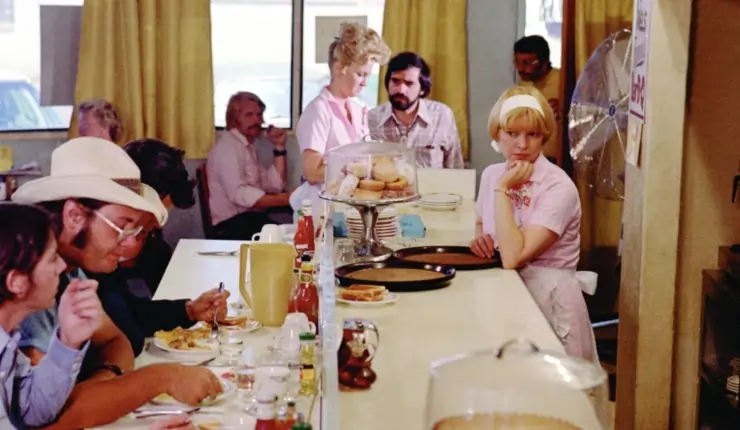
From the very first frame of Alice Doesn’t Live Here Anymore, Martin Scorsese stamps his own personality on the film as vividly as he did with the ‘Be My Baby’ opening of Mean Streets. The stylistic choices may fade as the film goes on, but his direction never falters – it simply can’t contend with a towering central performance that rightly earned Ellen Burstyn a Best Actress Oscar.
Burstyn plays Alice, a mother widowed early in the film who is determined to realise her lifelong dream of becoming a professional singer. Selling her possessions, she heads to Phoenix with her son Tommy (Alfred Lutter). Still, when a romantic relationship goes wrong, she is forced to move again, eventually finding work in an Arizona diner where she meets rugged rancher David (Kris Kristofferson).
What’s interesting about Alice Doesn’t Live Here Anymore is that this wasn’t an original Scorsese project. Conceived as a vehicle for Burstyn, she sought out the director after seeing Mean Streets. Scorsese himself was drawn to the project as a response to critics who claimed he “couldn’t direct women” (a bizarre assessment after only three films, two of which feature women in prominent roles). If nothing else, this film silenced those critics, with Burstyn delivering one of her defining performances.
More than any other Scorsese film, this feels indebted to John Cassavetes. It’s unapologetically character-driven, with Burstyn as the anchor around which everything else gravitates. It’s hardly news to anybody who has seen The Exorcist, The Last Picture Show or Requiem For A Dream, that she is an extraordinary actor, but this was the first film built entirely around her performance, and she makes it look effortless. Like Gena Rowlands (her main competition ition at the Oscars), she goes big when required, but her greatest moments come from nuanced reactions and subtly devastating micro-expressions. Her audition scene, where she sings with a faltering, hesitant voice, is agonising to watch, and more than a little reminiscent of Claire Trevor’s big scene in Key Largo.
Her chemistry with Lutter is incredibly natural and lived-in, with Alice humouring her son’s endless jokes in one scene, yelling at him in the next, while remaining fiercely protective at all times. Lutter himself is great playing a specific type of precocious child. However, he is acted off the screen by Jodie Foster, who plays his newfound friend in Arizona (in the commentary Foster refers to this as her favourite Scorsese film, and she seemed to have a ball making it – her cheery “so long suckers! as she exits the film apparently reduced Scorsese to fits of giggles every take).
Read more on The Criterion Collection and Physical Media Releases here.
Other supporting roles are similarly memorable. Harvey Keitel is terrifying as a volatile love interest, Kristofferson is his usual laconic self, and Diane Ladd and Valerie Curtin are both excellent as Alice’s coworkers at the diner. Ladd brings a wonderfully bawdy energy to her role, while Curtin proves adept at physical comedy as the more withdrawn, clumsy waitress. Both would go on to reprise their roles in the TV adaptation, but Ladd in particular gives one of her finest performances. Her loud, expletive-laden outbursts are brilliant, but it’s the quieter, more intimate moment between her and Burstyn that sticks in the memory, a beautifully observed scene that she called her favourite scene of her career.
The film itself is a strange mix of styles and approaches, and in truth, never quite coheres. The opening anticipates David Lynch in its portrayal of lush, Douglas Sirk-ian technicolour cinematography, presenting an idealised existence that contrasts with the more downbeat realism that colours most of the film, more closely resembling the films of Cassavetes, Peter Bogdanovich and Bob Rafelson.
Where it struggles is in the lack of a strong narrative throughline – the film meanders episodically without sticking with a conventional storyline, and the initial suggestion that Alice’s singing career will drive the story is quickly abandoned. In truth, Mean Streets has a similar problem, but Scorsese’s own personality shines through that one so vividly that the looseness becomes part of the appeal. Here, despite some directorial flourishes, the director’s presence is more restrained.
This restraint is also part of what makes the film so interesting, though. Alice Doesn’t Live Here Anymore may not have the intensity of Scorsese’s later work. However, Burstyn’s deeply humane performance means that the film still feels potent today, despite the sometimes meandering narrative. It speaks to the legendary filmmaker’s maturity as a director that he was confident enough to allow character to take precedence over style.
Special Features
It’s another fairly light release from Criterion, with an old commentary featuring Scorsese, Burstyn, Ladd, Kristofferson and Lutter but recorded separately. It’s a bit of a dry experience to be honest – only Jodie Foster sounds like she’s enjoying the film, and the highpoint is Diane Ladd delightedly pointing out her daughter Laura Dern in a brief cameo, proudly declaring: “She’s a natural method actress!” Rounding out the package are a making-of documentary and interviews with Burstyn, Ladd and editor Marcia Lucas.
★★★★
Out on 4K UHD on June 27th / Ellen Burstyn, Kris Kristofferson, Diane Ladd, Harvey Keitel / Dir: Martin Scorsese / The Criterion Collection, Warner Bros / 15

Discover more from
Subscribe to get the latest posts sent to your email.
About the Author

You must be logged in to post a comment.