Josephine Review (2026 BFI London Film Festval)
TW: sexual assault.
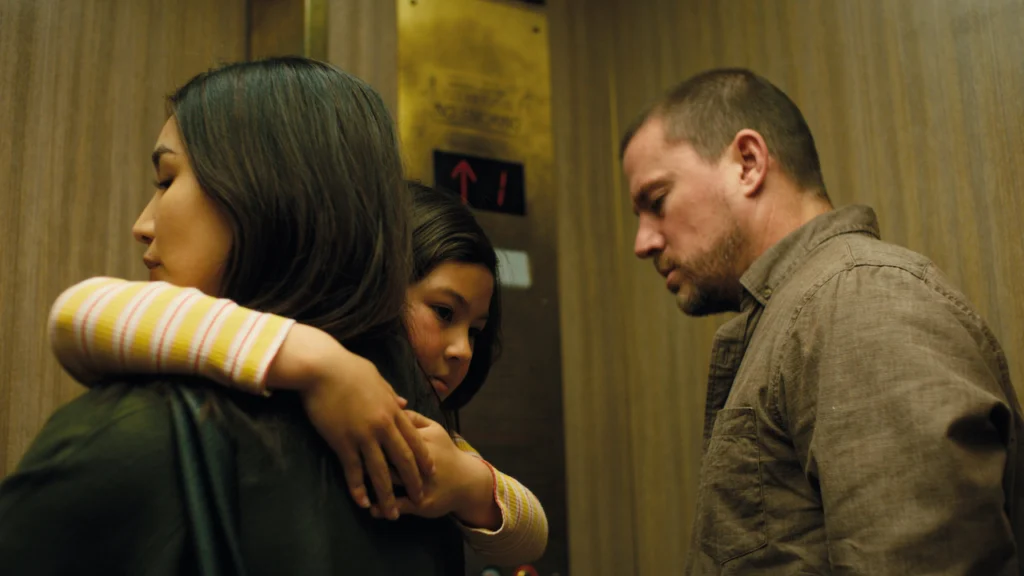
Brazilian writer and director Beth de Araujo has created a masterpiece with her film Josephine. The film follows 8-year-old Josephine and her parents, Damien and Claire, whose lives change after she is the sole witness to a sexual assault. Immediately, Josephine is thrust into a world she never asked to be a part of, filled with trauma, paranoia and uncertainty, and this film explores the impact that witnessing this crime has on both Josephine and her parents.
The film opens through the eyes of Josephine, or Jo, as her parents call her. It’s a Sunday morning, and she and her dad are gearing up for their usual routine: running to their local park to practice football. The dynamic between this father-daughter duo is quickly established as playful and close, with their love of sports and exercise a mutual passion. While at the park, Jo stumbles into a clearing, alone, where she witnesses a man attack a woman out jogging. It’s a deeply uncomfortable and distressing scene, but an important one that establishes the themes of the film.
Jo sits in this uncomfortable grey area where the lines between childhood innocence and adult discovery become increasingly blurred. Each time Jo is an active participant in this dark adult world, something reminds us of her youth. She overhears her parents discussing the rape, and innocently searches the definition of ‘raiped’. When asked by the psychiatrist to recall what she saw in the park, Jo giddily describes seeing the man’s ‘ding a ling’. She makes shadow puppets in her room and kisses her crush, Felix, through the classroom window. In the presence of detectives, she blows raspberries and sticks her tongue out at them. She agrees to attend self-defence classes to stay strong as her dad wipes doughnut sugar from her face; all devastating reminders of her youth.
As a result of her crucial role in this investigation, Jo begins to act out. She becomes wrapped in caution about boys and men, including her own dad. She misinterprets love for harm, reinforcing her desire to take a stand in scenarios where she need not. But Jo isn’t the only one the incident and investigation affect. Her trauma seeps into the lives of her parents, making them question everything. Channing Tatum and Gemma Chan offer a stunning portrayal of two parents teetering on the very edge. Tasked with the impossible challenge of navigating this traumatic incident while not having witnessed it themselves, they clash over their difference of opinion in how they want to support Jo.
Claire wants Jo to see a psychologist to talk through her feelings, leading with care and emotion. Damien, on the other hand, simply wants his family to ‘move on’ from the incident. He assures Jo that an assault like that will never happen to her, to which Claire tells him: You cannot say that. This scene is a striking commentary on making decisions based on your gender rather than logic or practice. It serves to remind you that when it comes to gender based-violence, women often have no choice. They can’t simply ‘move on’ from such a traumatic, life-altering incident the same way a man who incites this can.
Read more from the 2026 BFI London Film Festival →
Araujo’s decision to have this conversation play out around the dinner table is incredibly effective. It’s such a casual setting for such a significant conversation, making the emotional weight feel far heavier. This difference of opinion also raises an important question: Should parents shield their children from the bad in the world? Or is it safer to warn them about the dangers that exist? Should children discover on their own that not everything is sunshine and rainbows? I suppose Araujo’s point is that not every child is offered that choice.
What is clear is that Jo’s inability to be courageous while witnessing the assault haunts her, the cause of her anger and perhaps, most tragic of all, her regret. The film focuses heavily on finding Jo’s courage and strength, which is what her parents want for her. And yet, Jo achieving this is held back by the attacker, played by Philip Ettinger, appearing as a figment of her imagination, following her everywhere: ‘the ghost’. His presence causes her no real harm, but inhabits Jo’s mind as a reminder of her lack of courage.
Mason Reeves delivers a hauntingly beautiful debut performance as the titular Josephine. Reeves is a remarkable talent, perfectly balancing the innocence of childhood with a circumstance that catapults you into adulthood, maturity and impossible burdens. Reeves grapples with some incredibly difficult themes placed upon her character, and does so with serious gravitas. If international acclaim does not follow her as a result of this performance, this industry is a scam.
As expected, this film builds to a trial after Jo courageously agrees to stand and testify. The trial is equal parts powerful and sickening, but asserts itself as an incredibly important piece of contemporary cinema. Its tension feels reminiscent of 12 Angry Men, just with a different context. The emotional turmoil that this family experiences transcends the screen, summoning its audience to feel it. The evidence is there: tears, sniffles and shock grab hold of the audience, forcing them to confront this devastatingly realistic tale.
Josephine is a masterpiece in storytelling, anchored by Araujo’s writing and the astonishing performances which bring this delicate and difficult tale to life. The cinematography captures the magnitude of this family’s trauma in striking tandem with the beauty of San Francisco. I implore everyone to watch this film; a shatteringly significant film and crowning achievement for all involved.
Playing at the BFI London Film Festival on 13th, 15th and 17th October / Gemma Chan, Channing Tatum, Mason Reeves, Philip Ettinger / Dir: Beth de Araujo / Curzon / 15

Discover more from
Subscribe to get the latest posts sent to your email.
About the Author



You must be logged in to post a comment.