Heat of Madness Review (Sitges Film Festival 2026)
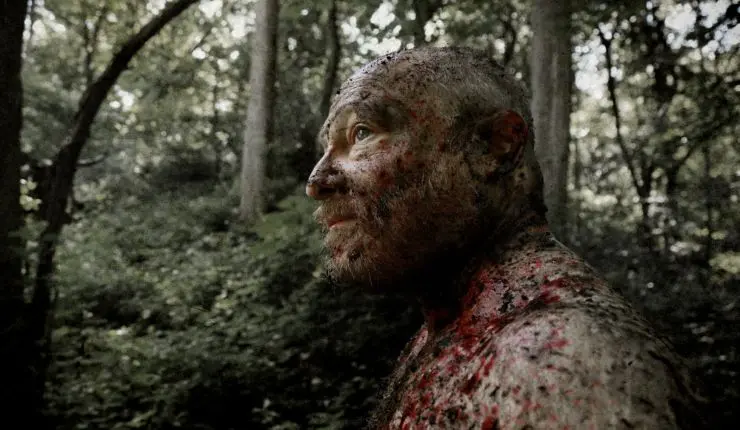
Iconoclastic auteur Karim Ouelhaj doubles down on the social-realist horror of Megalomaniac (2022) in this toxic revenge thriller with cinematography to die for.
Expectant father Scola is balls deep in trouble after he loses track of 3 million in stolen diamonds. Hunting down those responsible for double-crossing him, his anger and desperation cause him to question if he is even alive. During the ensuing carnage, he meets a mysterious muse called Petite Pomme who tries to guide his conscience while defecating Granny Smiths and occasionally blinking through space with her knees tucked to her chest.
Scola slips into a self-destructive mental state that sucks him into the realm of the flawed soul, trapped between hell and eternal paradise. He craves redemption; however, he thirsts even more for revenge. Ouelhaj’s latest transgressive barrage is a major head fuck on several fronts. Its sudden bursts of ultra violence and punishing soundscape tenderise the senses before jamming them into a pulping machine of academic surrealism. Pictorialism and purgatory converge in a relentless stream of tableaux vivants, regurgitating classical art with a grainy aftertaste of grim solipsism and tipping-point psychosis.
Examples include the dreamlike tenebrism and minimalist melancholy of psychological symbolist Léon Spilliaert, deployed here to accentuate Scola’s painful soul-searching, and the gently atmospheric skies and earthy naturalism of Jean-François Millet, designed to merge man and rural terrain. The enigmatic illusions and playful paradoxes of René Magritte are weaponised to illustrate the impregnable fortress of Scola’s narcissism and fucked up morality. Magritte’s signature motif is mischievously echoed in Petite Pomme’s bizarre tendency to jettison apples from her anus, shining a beam of absurdist humour into the nihilistic darkness.
Read more of our reviews →
Arguably, the most pivotal artistic influence comes from Friedrich August Moritz Retzsch. Specifically, his work Die Schachspieler, which depicts Faust and Mephistopheles Playing Chess. It not only feeds directly into the film’s obsession with Dante’s Purgatorio, but clearly casts Petite Pomme as an angel in its composition, if only by proxy. This is a crucial element in attaining a tangible mooring in Scola’s nightmarish descent, refreshing in its simplicity.
Scola may or may not be suffering from Cotard’s delusion, also known as walking corpse syndrome. This psychiatric condition forces a person to believe they are already dead, bereft of vital organs, nervous system, or even a soul. Denial of existence and immortality delusions manifest in almost equal measure within the illness, a god-tier paradox that perfectly illustrates the film’s challenging nature.
Such complex artistic and literary bedfellows might have conceived a cold husk of a film. A withering trudge into pretentious homage, expelled from the stifling womb of Dante’s Catholic doctrine. However, Heat of Madness is so staggeringly fucking gorgeous it totally justifies its lofty aspirations.
The imagination and careful planning poured into depicting Scola’s deteriorating psyche are outrageous. Framing, spatial awareness and time-dilated imagery merge seamlessly in a quest to find compositional elegance in the grotesque. Cinematographer Bernard Vervoor, who has addressed Magritte’s oeuvre previously in documentary form, amplifies Ouelhaj’s recurrent ethos of coaxing beauty from blemishes with mesmerising results. This visual tour de force benefits from a commanding lead performance from Olivier Picard. A car crash turn of barely contained aggression and childlike confusion that offers a lifebelt of verisimilitude in a raging tempest of surreal misdirection.
Ouelhaj’s aggressive approach to cinema is destined and intended to be polarising, even more so here due to ardent experimentalism. He does, however, possess a lightness of touch that sets him apart from his progressive peers such as Lars von Trier and Gaspar Noé. He doesn’t flinch from onscreen violence, but refuses to make it the centrepiece. Instead, he commands the raw power of philosophy and art to bulldoze viewers into whimpering submission.
This pungent new offering, premiered at Sitges, suggests an acceleration in an already daring trajectory. A sullen valentine to the purity of expressionism as a conceptual guide determined to scribble fuck you on every page of the cinematic rule book. Essential viewing for anyone who loves being transported by the visual poetry of film and those exhausted by the platitudes of mainstream tedium.
★★★★
World Premiere at Sitges Film Festival 2026, Oct 14th / Olivier Picard, Julie Carroll, Claudio Dos Santos/ Dir: Karim Ouelhaj / Media Move

Discover more from
Subscribe to get the latest posts sent to your email.
About the Author

You must be logged in to post a comment.