BFI London Film Festival 2026: Smaller Highlights In The Lineup
It’s always exciting to see all the big films included in the BFI London Film Festival lineup each year, wondering what acclaimed hit might be playing in the Royal Festival Hall next, with the hundreds of people you experience it with. This year we will see the world premieres of Brad Bird’s newest animated film Ray Gunn Still as well as Laika’s Wildwood. Also playing in the biggest venue will be James Gray’s Paper Tiger, Luca Guadagnino’s Artificial, Danny Boyle’s Ink and many more.
That being said, quite often, the gems of the programme are found away from the galas and the main venue, hidden in the smaller cinemas where not so many care to look. Here are five acclaimed films from this year’s LFF lineup, outside the main presentations, to add to your watchlist.
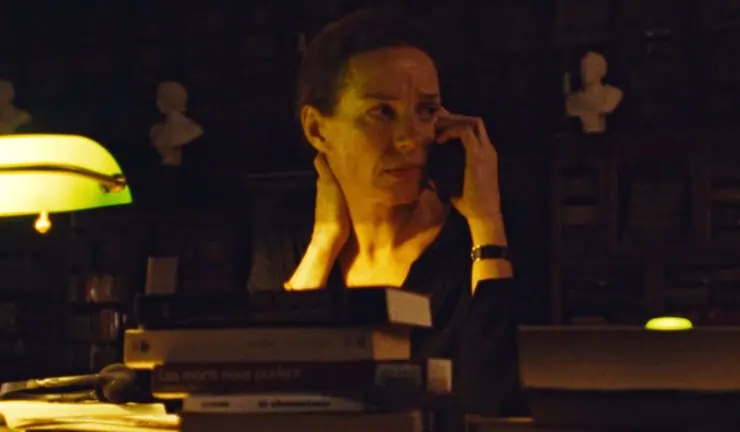
Chronovisor
Synopsis: “A French academic is seduced into a world of untold histories in her scholarly quest to uncover the mystery of a history-capturing camera-like machine created by clandestine Benedictine monks. An academic-noir, armchair mystery in the lineage of Jorge Luis Borges and Umberto Eco.”
Chronovisor debuted at the Rotterdam Film Festival back in January; it is the feature film debut of co-directors Kevin Walker and Jack Auen. In his review for The Film Stage, critic Leonardo Goi said: “In a work that’s pitched along the nebulous border between fact and fiction, nothing in Chronovisor is as magical as the power Auen and Walker bestow on books, and nothing more exhilarating than the belief this film insinuates in those willing to adjust to its strange, hypnotic rhythms—that there are secrets and mysteries everywhere around you. You just need to know where to look and what to ask.”
Read our review here.
Moonglow
Synopsis: “In 1970s Manila, a jaded police detective, who, unbeknownst to her colleagues, is the mastermind behind a successful heist, is paired up with her former lover, an obsessively truth-seeking detective, to crack the very crime that she orchestrated.”
Moonglow is directed, written, produced, and edited by independent Filipino filmmaker Isabel Sandoval, who also plays the lead role in the film. In her review for In Review Online, Lé Baltar describes the film as “Sly, sultry, and sinister, Moonglow is Sandoval returning to her roots in an evolved form. Here, she unabashedly references the movies that made her, but not to the point of surrendering her singular cinematic voice. It’s an undeniable extension of the entrancing Sandoval effect, one that attempts to attract a wider and broader crowd, even if it seems destined to be polarising; it’s the arthouse brand of cool, perhaps.”
The Blood Countess
Synopsis: “The Blood Countess and her maid embark on a quest for the red elixir of life and a book that threatens the vampire realm. Hot on their heels are a police inspector, two vampirologists, a vegetarian nephew and his therapist.”
This film is directed by the German, avant-garde filmmaker Ulrike Ottinger and stars the iconic Isabelle Huppert as a vampire. In their review for Screen Daily, Johnathan Romney described it as: “A jovial confection that plays both as an ironic compendium of Austro-Hungarian history and as a sort of hyper-refined Carry On Screaming!”
Everytime
Synopsis: “A tragedy brings a mother, daughter, and teenage boy together. Struggling with blame and forgiveness, the unlikely trio take a trip to Tenerife for a family holiday that never happened. Under the glow of the sun, past and present quietly start to overlap.”
The film won the Un Certain Regard prize at Cannes this year and is directed by Austrian filmmaker Sandra Wollner. In a brief statement, the chief Indiewire film critic, David Ehrlich, said the film was “the most haunted, knowing, and mysterious new movie I’ve seen about grief since Aftersun. I’ll be thinking about this film — and certain shots in it — for years and years to come. Nothing better than being reminded that the movies are still being invented.”
The History of Concrete
Synopsis: “After attending a workshop on how to write and sell a Hallmark movie, filmmaker John Wilson tries to use the same formula to sell a documentary about concrete.”
This documentary-comedy hybrid premiered at the Sundance Film Festival earlier this year, with John Wilson taking us through a concrete journey in his debut feature. In their review for The Guardian, arts writer Adrian Horton said, “As a standalone film, The History of Concrete is consistently laugh-out-loud funny, compelling and surprising, if 20 minutes too long. And, of course, about much more than just concrete. It is about languishing in periods of transition, the difficulty of convincing yourself to move forward. It’s about trying to keep making documentaries in this era of vanishing budgets and media consolidation. About false feelings of security, haunting impermanence and moving forward, gum stains and all. You know, the real hard stuff.”
The 70th BFI London Film Festival runs from October 7th to October 18th 2026.

Discover more from
Subscribe to get the latest posts sent to your email.
About the Author