A Silent Voice: The Most Important Anime of the Century and the Film That Saved My Life

Content warning: This article tackles themes such as suicide, bullying and depression.
One of the greatest failings of modern society is the way we downplay and address mental health. According to statistics from the World Health Organization (WHO), one in four people—particularly one in seven adolescents—will experience an episode of mental distress in their lifetime. This is a horrifying statistic, especially considering that mental health struggles can snowball into many other serious issues, ranging from transient global amnesia to suicide. The harsh reality is that we must care for our minds just as we do our physical health; neglecting mental well-being can lead to tragedy.
A Silent Voice is a masterclass in powerful storytelling, tackling this issue head-on while addressing so much more. It is a deeply moving journey that conveys a profoundly impactful message. Personally, I found its depictions of bullying, depression, and the process of forgiving oneself for past actions to be both authentic and deeply resonant.
The film opens with teenager Shōya Ishida (voiced by Robbie Daymond) as he prepares for what he believes will be his final days, symbolized by a ripped calendar hanging on his wall. In the days leading up to April 15th, he sells his futon and video game collection, quits his job, and leaves 1,700,000 yen under his mother’s pillow. On April 15th, Shōya heads to a bridge, contemplating ending his life. However, just as he is about to act, a firework explodes in the distance, snapping him back to reality.
As he walks home, we flash back to his childhood to see how he arrived at this moment. Set to My Generation by The Who, we watch Shōya and his friends playfully jumping into a river from a small bridge. He leads a typical school life as a mischievous child. However, everything changes when a deaf girl, Shōko Nishimiya (voiced by Lexi Cowden), transfers to his school. What unfolds is a relentless barrage of bullying. Shōya starts by screaming into Shōko’s ears, mocking the way she speaks, and even repeatedly ripping out her hearing aids. Encouraged by his friends—and, to some extent, overlooked by the teachers—he continues to torment her, with some of his classmates joining in on what they see as “fun and games.”
The dynamic shifts when the principal steps in, and Shōya is singled out as the sole culprit. To his so-called “friends,” he becomes the new Shōko—someone they now perceive as weaker than themselves—making him the target of their cruelty.
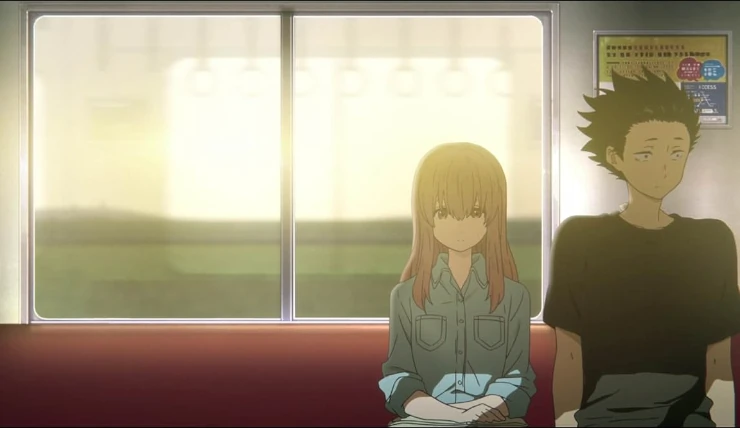
As we return to the present, Shōya, now a teenager, attends class and unexpectedly crosses paths with an older Shōko. Determined to atone for his past mistakes, he takes the first steps toward making amends. From there, we witness the gradual growth of their new friendship, which, in turn, leads to connections with both familiar faces from the past and new acquaintances. Yet, beneath the surface, something lingers—something unseen and unheard, but undeniably present.
From the very beginning, we are left to ponder how a once-playful act can later take on such a dire meaning. The contrast between the carefree leap of childhood and the bleak jump that could end Shōya’s life is not lost on those who have struggled with depression. I find myself reflecting on my own life, questioning the events that shaped who I am today. When I was in primary school, my love for rugby and the way I coped with the emotional turmoil of my parents’ separation seemed monumental at the time. Now, those struggles feel almost trivial, yet each moment of my youth played a role in shaping my emotions and identity. The film’s pre-title sequence is nothing short of a masterclass in storytelling. In an ideal world, no one would ever have to wrestle with their darkest impulses—but for those of us who have, it is impossible not to feel a deep connection to Shōya’s journey.
Shōya’s plan for his final days, while different from my own, was eerily similar to thoughts I once had when the darkness threatened to consume me. My plan was to jump from my mum’s bedroom window—the highest drop in the house. Watching A Silent Voice for the first time in 2017, at a time when I was slowly finding my way back to mental stability, made Shōya’s pain feel harrowingly relatable. Growing up without a real father figure since the age of five is now just a fading chapter of my life, but at fifteen, I couldn’t understand why I didn’t have a male role model—someone who enjoyed video games as much as I did, someone to connect with. So many factors from my childhood rippled through time, shaping my mental health in ways I didn’t fully grasp until later. A Silent Voice understands this truth: our past does not simply stay behind us—it echoes forward, influencing the future in ways we often don’t realize until much later.
Beyond its powerful opening, A Silent Voice is, at its core, a film about how we communicate our emotions. The English title, A Silent Voice, is a localized version of the original manga’s title, Koe no Katachi, which translates to The Shape of Voice. This translation highlights the film’s central theme: communication takes many forms, whether through speech, sign language, or the unspoken expressions conveyed through body language. The English title also reinforces this idea, as signing and body language are silent yet deeply expressive means of communication.
The film masterfully conveys emotions through movement and expression. Small yet powerful gestures—like Shōko cupping her ear in the hope of improved hearing or characters forcing a smile to hide their pain—add depth and nuance to the story. These moments feel universally relatable. I know I’ve forced a smile more times than I can count just to avoid confronting how I truly feel.
Sign language plays a crucial role in the narrative, becoming Shōya’s way of seeking Shōko’s forgiveness. One change from the manga that I believe strengthens the film is the removal of Shōya’s thought bubble from the past, where he muses, “Talk with your hands? That sounds fun.” Omitting this line adds more weight to his decision to learn sign language, making it feel like a conscious step in his journey toward redemption rather than a passing curiosity.
Narratively, the film makes several changes to the manga, ultimately solidifying itself as the definitive way to experience this story. The manga portrays an even greater level of cruelty, from Shōya’s internal monologue expressing his hatred for Shōko to his later belief that he hasn’t been punished enough for his past actions. The way bullying affects individuals—both physically and mentally—is brutally unfiltered. As someone who has personally experienced bullying due to my weight, these aspects cut deep, reopening old wounds. The cruel words and actions that were just a joke to my tormentors still linger within me. The image of a glass Irn-Bru bottle being thrown at me and the smug suggestion that I should slit my wrists in a bathtub filled with bleach—though they never physically harmed me—left lasting psychological scars.
The film does an immaculate job of being deeply affecting without indulging in Shōko’s suffering or becoming triggering for those who have experienced similar hardships. By softening some of the cruelty, it also makes Shōya’s journey toward redemption more relatable. I know for a fact that I will never forgive the vile perpetrators who spewed hatred at me. So, if the film had been as cruel as the manga, it would be much harder to believe that Shōko could forgive Shōya.
In that sense, the decision to remove the full-page illustrations of Shōya openly declaring his hatred for Shōko is a perfect choice for the adaptation. It’s disheartening to acknowledge, but the only person Shōya should hate is himself—for the actions of his past. This shift allows his transformation from perpetrator to victim to feel natural and justified. Shōya’s so-called “friends” began bullying him because they saw him as weak, an easy target. At the end of the day, bullies single out those they perceive as vulnerable. Just as I was targeted for my weight, Shōko for her deafness, and Shōya for being the sole scapegoat for the group’s bullying, we were all seen as prey. These key changes from the manga make the film superior in every way.
Beyond its narrative changes, writer Reiko Yoshida and director Naoko Yamada bring a mature subtlety to the storytelling and character emotions. As mentioned before, much of the film’s emotional depth is conveyed through facial expressions, but it also extends to the way characters move, walk, or even how the camera frames a scene from their perspective. This is particularly evident in how the film portrays Shōya’s anxiety. When walking through school, the camera frequently focuses on the floor, mimicking his discomfort. The sea of Xs covering people’s faces serves as a visual manifestation of his mental barrier, allowing him to isolate himself. After all, why would anyone want to associate with someone who once bullied a deaf person? He allows the voices in his head to dictate his self-worth, convinced that his past actions will forever shape how others see him.
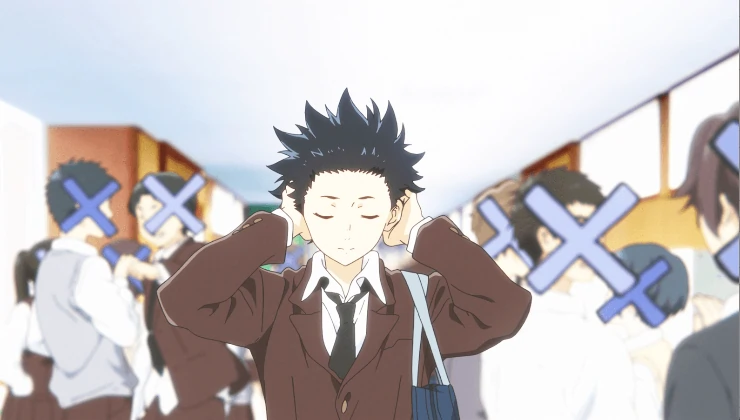
So, when Shōya meets Tomohiro Nagatsuka (Graham Halstead) and the X falls from his face as he forms a new connection, it is a truly powerful moment. Other than Puss in Boots: The Last Wish, I have rarely seen a film so accurately depict what it’s like to suffer from anxiety—how our minds create barriers that prevent us from forming lasting friendships. I found Shōya’s friendship with Tomohiro particularly moving, especially as someone who, in high school, had friends but struggled to build lasting relationships due to my own mental barriers. A Silent Voice acknowledges that the people you think will be in your life forever may only be there for a certain stage. Eventually, you will find your people. This message resonated deeply with me, as it echoed what my mum always told me throughout high school.
Tomohiro is just the first of many side characters we meet in the film. Each brings their own dynamic to the friendship group, along with their own themes and personal struggles. Naoka Ueno (Kira Buckland), Shōya’s friend from elementary school, clings to the past, refusing to grow up and move on. Miki Kawai (Amber Lee Connors), another former classmate, enabled bullying while never taking responsibility for her actions, instead shifting blame onto others. At first, it might seem like the film juggles too many characters and subplots, but everything is beautifully interconnected, reinforcing the central narrative of Shōya and Shōko’s relationship and the overarching themes of forgiveness.
While accessibility for disabled people has improved over the years, society still falls short—a reality A Silent Voice portrays heartbreakingly through Shōko. The reluctance of those around her to learn sign language makes communication needlessly difficult. Schools fail to make accommodations, preventing her from fully following along in class. These barriers compound until she internalizes the belief that she is the problem. She convinces herself that her disability is a burden to others and that she is responsible for Shōya’s isolation. Shōko’s struggle is a grim reminder of how society continues to fail its most vulnerable members and the devastating toll that neglect can take on mental health.
As I’ve grown older, the film’s depiction of disability has become even more personal to me. My mum struggles with mobility issues—walking and standing for long periods are incredibly difficult for her—so I’ve witnessed firsthand how inaccessible many places still are. The lack of lifts, the long distances required just to queue, and the sheer difficulty of simple tasks or nights out often turn everyday experiences into a logistical nightmare. You would hope people would be more considerate, yet I’ve lost count of the number of times someone has mindlessly bumped into my mum, despite her grey walking stick practically being an extension of her arm.
A Silent Voice explores heavy, deeply real themes, yet it does so through a visually stunning, brightly colored world. In a way, this contrast makes its portrayal of depression even more authentic. Our perception of the world and the world itself are not always aligned. Natural beauty can still exist even when someone sees life as a dark, nightmarish landscape.
This ties back to the idea of “the shapes of voices.” A single frame of the film might make it seem like a lighthearted, colorful slice-of-life story, but beneath the surface, it delves into raw and painful emotions. Just as someone can appear bubbly and joyful in public while struggling internally, the film masks its heavier themes under Kyoto Animation’s signature breathtaking visuals. True to their reputation, they have once again delivered a flawlessly animated film, with A Silent Voice being no exception.
Now, in what might be considered a controversial take within the anime community, I firmly believe that A Silent Voice’s English dub is superior to the original Japanese version. Lexi Cowden’s performance as Shōko is nothing short of mesmerizing, made all the more powerful by the fact that she herself is deaf. Casting a deaf actress in this role was a fantastic and genuinely inclusive decision, bringing an unparalleled authenticity to the character. There are no awkward moments of a non-deaf actor attempting to replicate how a deaf person speaks—it is simply real. Robbie Daymond is also exceptional as Shōya, delivering a performance that perfectly balances the character’s troubled past with his genuine desire for redemption. His portrayal makes Shōya’s journey all the more powerful and affecting
One of the film’s most outstanding elements is its soundtrack. Composed by Kensuke Ushio, it is nothing short of immaculate. The muffled sounds mimic how Shōko may hear the world, but they also reinforce the film’s core theme of voice. When the sound is muffled, one could say we are not truly hearing the soundtrack—we are not truly listening to its voice. However, when characters open up and express their true emotions, the score comes alive, allowing us to hear its full voice at last.
Before A Silent Voice, Naoko Yamada was best known for directing the slice-of-life comedy anime K-On!—a series that is the complete opposite of this film, filled with lighthearted humor and even jokes about a bowl of rice. A Silent Voice gave her the opportunity to fully showcase her directing talents, and she delivers an incredible, emotionally resonant experience.
In an industry still predominantly male-dominated—where the most well-known anime directors are names like Hayao Miyazaki (Spirited Away), Makoto Shinkai (Suzume), and Mamoru Hosoda (Belle)—it is refreshing to see a woman helm what could be regarded as one of the most significant anime films ever made. Very few anime, let alone animated films in general, tell stories as beautifully and expertly as A Silent Voice. Every frame is meticulously crafted, serving the film’s narrative and themes with breathtaking precision.
A Silent Voice is a deeply personal journey for anyone who has experienced depression or anxiety. Naoko Yamada proved herself to be one of the best anime directors working today, but the film’s success is the result of a perfect storm of talent. Reiko Yoshida’s incredible screenplay, Kyoto Animation’s stunning visuals, and Kensuke Ushio’s hauntingly beautiful score all come together to create something truly special.
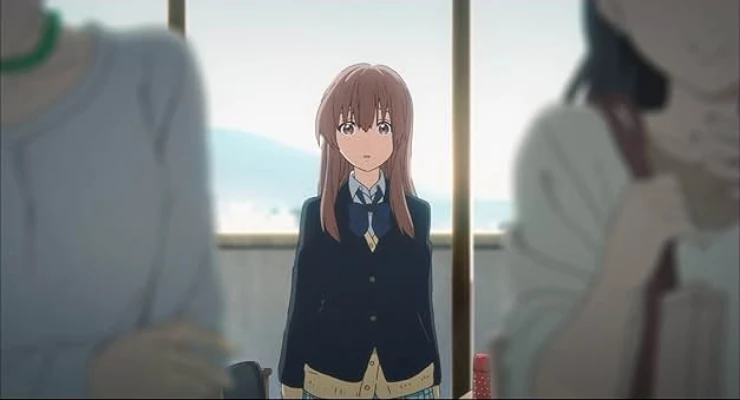
I left the cinema in tears back in 2017. Sitting in my mum’s car in the parking lot near my local Cineworld, I let the emotions overwhelm me. While I can’t remember every word I said that night, one thought has stayed with me ever since: I could relate to Shōya. Watching someone else struggle with isolation during high school resonated deeply—it truly moved me. However, as time passed, I came to realize that my experience was actually a blend of both characters. During primary school and early high school, I identified more with Shōko; by the end of high school, I saw more of myself in Shōya.
When I first watched A Silent Voice, I was seventeen—lost and isolated. But as the credits rolled, I felt something shift. I realized that, one day, my life would find its path. This is why I believe the film saved my life. It was the first piece of media that authentically reflected my reality. Even now, during my most recent rewatch, small moments that once seemed like simple story beats have taken on new meanings, as I have lived (and hopefully conveyed) how those moments unfolded in my own life. Although I did not cry this time—as I am now a better version of myself—that seventeen-year-old needed this film. And perhaps, others will discover and connect with its magic just as I did.
No film has ever moved me the way A Silent Voice has. Even now, I wonder how different my life would have been if I had never seen it. From the moment I first watched it in 2017, I considered it a masterpiece. And even now, in 2025, I still believe it is perfect. It will be remembered as one of the greatest anime films of the century—and it will hold a special place in my heart forever.
★★★★★
Available on DVD and Blu-ray / Robbie Daymond, Lexi Cowden, Graham Halstead, Kira Buckland, Amber Lee Connors / Dir: Naoko Yamada / Anime Limited / 12
Discover more from
Subscribe to get the latest posts sent to your email.
About the Author