2014 Bradford International Film Festival roundup

By Ian Schultz
I started the Bradford International Film Festival (BIFF) by going to see Before The Winter Chill (dir.: Philippe Claudel), a rather mundane but perfectly watchable French middle-class melodrama. It stars Kirsten Scott Thomas, who is completely wasted as her role as the wife of Daniel Auteuil’s doctor, despite both giving good performances. The film ends with an implausible twist that ruins the slow burn of the film’s first 80 minutes.
BIFF shows its more “cult” films during its After Dark strain, and this year it started with the massively disappointing Escape From Tomorrow (dir.: Randy Moore) It wanted to be a Hitchcock-Polanski-style thriller with a bit of David Lynch thrown in—the main figure is a father who is also a voyeur checking out young women, and the premise is that all of the Disney Princesses are actually  prostitutes for rich Japanese businessmen. But while the opening, in which everything starts going weird in “It’s A Small World,” along with the first 20 minutes is promising, it soon falls apart. The fact that they actually shot it at Disneyland is impressive, however.
Manhunter followed, in a rare 35mm outing for Michael Mann’s cult classic. It was a beautiful print despite some distracting damage. This was a part of the festival’s tribute to Brian Cox, who received a lifetime achievement award. Cox, the original Hannibal Lector and one of the best character actors of all time, is also known for his roles in Rushmore, Zodiac, Adaptation, Rob Roy, Braveheart and X-Men 2. BIFF also showed a rare BBC dystopian film he did for the BBC in the 60s called The Year of the Sex Olympics. Cox did a very funny and insightful screen talk about his career.
One highlight was the documentary Double Play, about the friendship filmmaker Richard Linklater has had with avant-garde filmmaker Richard Benning over the years. Benning is known for his films which normally consist of long-takes of oceans, deserts, people smoking etc.. It’s a good, 70-minute documentary and well worth seeing. Linklater also has a film poster collection to die for. BIFF’s strand of independent American films was devoted to the work of Benning this year, and he was spotted around the festival frequently. Benning also gave a masterclass at University of Bradford later in the week.
Sadly, I was disappointed by Blue Ruin (dir. Jeremy Saulnier), although it was a smash at Sundance this year. It has been compared with the Coen Brothers’ Blood Simple. At root it’s just a revenge thriller, and without enough odd quirks and humour to really meet the comparison. But while it may not live up to the ★★★★/★★★★★ hype it’s been getting, it’s a solid indie film on a standard topic.
 The next film was Calvary (dir.: John Michael McDonagh), which I liked very much. It’s a really funny Irish black comedy from the brother of the director and playwright Martin McDonagh. The key character, Father James Lavelle, is a good priest played by Brendan Gleeson. His life is threatened during the confession of an unknown man who reveals that he was molested by a priest—and who now wants to kill a good priest for vengeance. It has a great supporting cast, with Dylan Moran and Isaach de Bankolé, amongst others. If you can imagine a cross between “Father Ted” and In Bruges, that would be close. The last 20 minutes don’t work as well as the first 80, but it’s still a good total package.
The next thing I saw was the Dodge Brothers score for the film Hell’s Hinges (dir.: Charles Swickard, tk). Film geeks will know that the Dodge Brothers features critic Mark Kermode on bass and silent-film-piano specialist Neil Brand (who made the wonderful BBC recent doc on film music). This stars one of the first big-screen cowboys, William S. Hart. The score opened with a version of “Satan is Real” and worked very well with the film. It’s a strange Western where a minister is sent into a sinful town that hires a gunman to get rid of him. Hart was also in the famous Broadway version of Ben Hur (the one with live horses on stage).
The Dirties (dir. Matthew Johnson), picked up by Kevin Smith Movie Club, revolves around two high-school best friends who are movie geeks and making a film about getting bullied in their school, when one takes the production a bit too far. It’s a compassionate view of two misfits in a school, despite the school-shooting theme, and considerably better than some others that have tried to address this story line (e.g. Gus Van Sant’s Elephant). It’s partly a found-footage film, but doesn’t suffer too much from the mockumentary trope that can be associated with. It does owe more than a bit to the fantastic French mockumentary Man Bites Dog.
I then saw one of the worst films I’ve ever seen in my entire life: The Strange Color of Your Body’s Tears, directed by a French couple, Hélène Cattet and Bruno Forzani. The film is a homage to the Italian giallo films (not my favourite genre anyway), and the closest thing it has to a plot is the first half hour, in which a man’s wife disappears. The next hour is a psychedelic kaleidoscope of images, without a narrative, that eventually becomes annoying. It brings style over substance to a whole new level. It’s ridiculously repetitive, to an obnoxious degree, including a soundtrack that will drive you mental.
Bad Milo!, a silly horror-comedy in the vein of Basket Case, was about a guy who has ass and stomach problems, after which a strange character called Milo emerges from his rear end. The intestine-dwelling Milo then proceeds to kill a lot of people who annoy him. It’s a got a great supporting cast of character actors, including Mary Kay Place, Peter Stormare as a psychiatrist, and Stephen Root. It’s short enough that it doesn’t outstay its welcome, and has a cool special-effects creature.
Next up was Locke (dir. Steven Knight) staring Tom Hardy, one of the finest actors working today, and for almost the entire film he’s the only actor you actually see since most of the “action” takes place over the phone. Hardy’s character has had an affair with an older woman, who gets pregnant and decides to keep the child. He decides to be there for the birth, but on his way he needs to deal with problems at work and telling his wife about the situation. Hardy uses a strange Welsh accent that doesn’t quite work (in 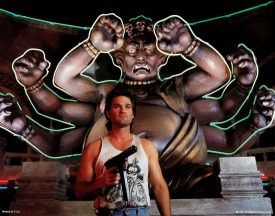 fact, he sounds almost Polish) and was a bit irritating. Visually the film is a bit lazy—lots of images of traffic over Tom Hardy’s face—and drags quite a bit for an 85-minute film as the main character is not very sympathetic. Another critical favourite that isn’t as good as everyone seems to think.
This gets us to the Wide-Screen Weekend, where BIFF shows older films projected at 70mm or Cinerama (as far as I know, the Bradford National Media Museum is the only place in Europe that can show films in that format, with the famous three-panel curved screen). The film film I saw was The Big Blue by Luc Besson, his first English-language film. It stars Jean-Marc Barr, Jean Reno and Rosanna Arquette, and is about two deep-sea divers who were childhood friends but lost contact after an accident. Reno’s character has become the world free-diving champion and sends for Barr so he can contest the title. It has some beautiful undersea photography and builds to a tragic finale.
I then saw Big Trouble in Little China (dir. John Carpenter), which was an absolute riot on the big screen with a beautiful print in very nice condition. You can read my full review of the recent Arrow Blu-Ray here.
My last screening was City Heat (dir. Richard Benjamin), which was an occasion to be pleasantly surprised. It’s a throwback 30s crime comedy with Burt Reynolds and Clint Eastwood. The film was originally to be directed by Blake Edwards (Pink Panther, Breakfast at Tiffany’s and other classics). Edwards did not get ion with Clint or Burt, and left the film. Edwards retained an “anonymous” writing credit under the name Sam O. Brown (check the initials). It’s a un crime comedy, and the leads actually have a lot of chemistry—Reynolds’ private eye and Eastwood’s cop interact with great character actors like Rip Torn, Jack Nance from Eraserhead, and Richard Roundtree. It’s a perfectly watchable film that was one of the last in which Reynolds was still a bankable star: a quality light crime caper with good cinematography.
I then went to see Terminator 2: Judgment Day, and having just re-watched the original the previous week, the sequel annoyed me to no end. It lacks the grittiness of the first film and is simply a bombastic, over-the-top rehash of the first film with some dated early-90s humour that doesn’t work at all. Although Edward Furlong has ended up becoming a really good actor, he was utterly obnoxious in this one. The key line in the film has become James Cameron’s motto: “Let’s spend money.” It’s easily half an hour too long, and the fact that Arnold is now the good guy simply doesn’t work. The fact people consider it one of the best sequels ever made is baffling.
About the festival itself: Bradford’s International Film Festival is one of the best small film festivals in Britain, offering a very diverse range of films and some insightful talks. If you’re able to attend, be sure to attend at least one full day to get a real flavor of the whole rather than just attending a few high-profile films.
Discover more from
Subscribe to get the latest posts sent to your email.
About the Author