The World is a Banana Skin: A Brief History of Slapstick Cinema
 Safely sat at home on my couch last night, I happened across the latest blinkbox commercial – a witty dig at ramblers, nature-lovers, and anyone else who might not be predisposed to streaming movies almost as soon as they’re available. According to the ad, the world outside is a vicious carnival of man-eating squirrels and threatening lambs, and the hapless rambler – assaulted by Mother Nature at her most callous – ends up with both his dignity and his trousers in tatters. Certainly not the kind of thing that’d happen in the safety of a cinema.
Of course, the movie house has never been any kind of safe haven. The blinkbox ad itself is merely the latest reimagining of that most dangerous of cinematic genres: slapstick. Sure, the protagonist manages to avoid any genuine banana skins, but he embodies the genre’s key directive: that the audience be allowed to delight in the indignities and degradation of a fellow human being. It has been that way since the beginning, and so it shall remain.
Not that anyone can agree on when the beginning was, of course, but it obviously predates cinema. In truth, slapstick has been a part of life since the first time a group of people laughed in unison at the physical misfortunes of one of their number, but European art historians often point to Pucinella, a gruesome, bullying character dating from 17th century Italy, as a key figure in the genre’s development. Indeed, the word ‘slapstick’ itself has identical origins in renaissance Italy, where it was known as the ‘bataccio’ and used to make a whip cracking sound as a soundtrack to an arse-kicking.
On film, however, the first example of this miserable hilarity is thought to be the 1895 Lumière Brothers clip, “The Sprinkler Sprinkled”. Not only the first slapstick film but quite possibly the first suspense movie, too, the brief snippet shows a cheeky hooligan standing on a garden hose in anticipation of the gardener looking right down the barrel to see what the problem is. The pay-off is entirely predictable, but hilarious nonetheless, and the timing is everything – that very brief moment of tension before the gardener gets a drenching is a huge moment in cinematic history.
The Sprinkler Sprinkled, 1895:
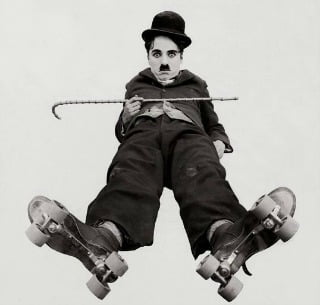
Of course, once the hose trick had been rinsed dry, directors needed a new stick with which to slap their leads. Enter the eternally popular pie-in-face routine, first performed on film by Ben Turpin in his 1909 short, “Mr Flip”. Slapstick superstar, Charlie Chaplin, is credited with the first pie fight on film (“Behind the Screen”, 1916), but it’s unlikely he’d have done it quite so successfully without the pioneering work of Mabel Normand, the undisputed queen of pie-in-the-face tomfoolery. So good at hurling pies in faces was she that she was given free rein to direct her own clips and experiment, eventually settling on the cream pie as the perfect prop. Along the way, she gave big breaks to Buster Keaton, Charlie Chase and Charlie Chaplin himself – the latter’s tramp character made his first appearance in Normand’s 1914 short, “Mabel’s Strange Predicament”.
Mable’s Strange Predicament, 1914:
No self-respecting blog on the history of slapstick comedy would be complete without some mention of Buster Keaton’s own pratfall abilities. Chaplin may have done it with the technical and physical grace of an in-prime ballerina (for the perfect example, watch how the famous cog-in-the-machine clip from “Modern Times” plays out), but Keaton must be credited for sheer daring, most astoundingly demonstrated in “Steamboat Bill Jr” (1928) and the cyclone sequence. The moment at which the house front collapses around him is perhaps one of cinema’s best-loved moments, but witness the rest of the scene to see a slapstick genius at work.
Steamboat Bill Jr, 1928:
By this point, a simple pie in the face had long-since ceased to be enough, and slapstick moments had far more currency when built into a something more lengthy and choreographed. Timing had to be spot on, and few timed it as perfectly as Laurel and Hardy in the “Pants-Off” scene from “You’re Darn Tootin’” (1928) – two minutes of genius that begin with a simple kick in the shin and end up with the whole town trouserless and squabbling, while the clumsy protagonists make their shuffling exit. Studios that specialised in this kind of caper were clearly on the money, and slapstick quickly began to permeate other cinematic art forms – in its 80-year history, Looney Tunes has relied on little else.
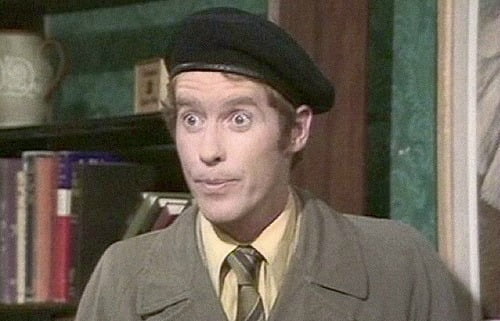
It’s easy to see slapstick as something that belonged predominantly to the silent movie era, but it continued to flourish throughout the ’50s, ’60s and ’70s, in part due to a fondness for it on British shores. In the pre-rock’n’roll years, The Goons found plenty of room for it on their radio shows, perhaps best demonstrated in their “Napoleon’s Piano” sketch from 1955. Of course, The Goons went on to influence the Monty Python troop, who combined slapstick with surrealism to come up with gems like 1971’s “Fish-Slapping Dance”, and the likes of Michael Crawford, whose extremely physical (and brave) work as Frank Spencer is up there with anything Keaton or Chaplin ever managed – take a look at the roller skating sequence from this 1973 episode of “Some Mothers Do ‘Ave ‘Em”, should you require proof:
Some Mothers Do ‘Ave ‘Em, 1973:
Much is made of how a proliferation of health and safety laws made slapstick harder for studios to produce in the ’80s and ’90s, but the onscreen success of Rowan Atkinson and Jim Carey would suggest otherwise. Of course, it could be argued that slapstick was taken to its absolute extremes in the last decade by the Jackass team, in which case I’m not sure I agree with the blinkbox idea that it’s safer indoors at all. Frankly, the offer of an afternoon in a room with Johnny Knoxville in charge would have me running for the hills.
Jon Wilks
                                                                        <!--START MERCHANT:merchant name blinkbox from affiliatewindow.com.-->
                                                                                                <a href="http://www.awin1.com/cread.php?s=156754&v=2481&q=91785&r=129522"><img src="https://www.awin1.com/cshow.php?s=156754&v=2481&q=91785&r=129522" border="0"/></a>
                                                            <!--END MERCHANT:merchant name blinkbox from affiliatewindow.com-->
Discover more from
Subscribe to get the latest posts sent to your email.
About the Author