The Thing with Feathers Review
Megan Hilborne 20 November 2025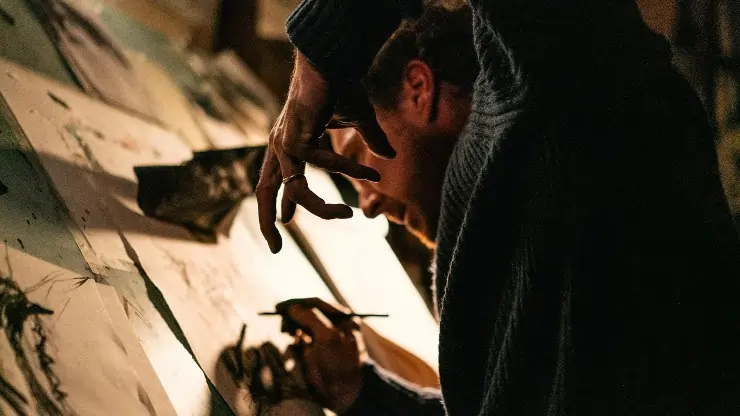
Max Porter’s 2015 novella Grief Is the Thing with Feathers was a love letter to his father who he lost when he was six-years-old. His book captivated readers with its inventive exploration of loss, using a boldly experimental form in which the text bends, swirls, and scatters across the page. Its unusual structure creates an arresting, immersive reading experience unlike anything in a conventional novel. Unfortunately, The Thing with Feathers film adaptation struggles to capture that same magic. Thing with Feathers, unfolds as an intimate, unsettling portrait of a family reeling from loss.
Benedict Cumberbatch delivers a haunting turn as a graphic novelist and newly widowed father whose world collapses after the sudden death of his wife. Struggling to raise his two young sons, he begins to lose his grip on reality, shadowed by a menacing, crow-like presence that embodies his spiralling grief. The film navigates the raw, disorienting terrain of mourning, blurring fantasy and reality as it traces one family’s chaotic path toward healing.
Because film is a visual medium rather than a textual one, I tried to approach the adaptation with an open mind, curious to see how it would translate the book’s unconventional form. The film mirrors the novel’s three-part structure -Dad, Crow, Boys- and embraces a non-linear narrative, presumably in an effort to echo the book’s sense of chaos. Yet despite this ambition, it falters emotionally, struggling to make the audience truly care about the family’s ordeal. There is little sense of build-up: we are dropped abruptly into the life of a newly widowed father and his two sons. Although their pain is immediately apparent, the film’s starkly British tone and the inherent unlikability of Cumberbatch’s character leave the story feeling emotionally distant. Still, this detachment does contribute to the film’s heavy atmosphere and reinforces its central theme of grief.
Where some book lovers may find the shift to a visual medium jarring, the film does benefit from certain stylistic choices. The persistent use of close-ups and the constricted 4:3 aspect ratio create a claustrophobic intimacy, as though the viewer is confined within the family’s grief. Charcoal-like crow sketches, paired with moody, low-key lighting, lend the film a sombre, almost gothic tone that contrasts effectively with the mundane rhythms of everyday parenthood. These artistic decisions deepen the film’s weight, even when its emotional core doesn’t fully land.
The performances are unquestionably the strongest element of the film. Benedict Cumberbatch, now firmly established as one of Britain’s most reliable screen talents, delivers exactly the calibre of work audiences have come to expect. As a newly widowed artist struggling to raise his two sons alone, he brings a raw, understated authenticity to the role. One early scene captures this perfectly: armed only with soy milk (much to his sons’ disgust), burning toast, and frayed nerves, he flounders through breakfast. The fragmented, frenetic camerawork, paired with blaring radio noise and the boys banging their cereal bowls. turns an everyday moment into a portrait of total domestic collapse. It’s also refreshing to see a film that foregrounds the emotional reality of single fatherhood, a perspective far less commonly depicted on screen.
Cumberbatch’s portrayal of grief and his character’s increasingly maladaptive coping mechanisms is compelling and often carries the film. The young actors Richard Boxall and Henry Boxall, playing the sons, deliver similarly impressive performances. Their bond feels strikingly genuine, no doubt helped by the fact they are real-life brothers, and they navigate the emotional terrain of loss with maturity and nuance.
Another standout is David Thewlis as the voice of Crow. Though never physically seen, his vocal performance is commanding—rich, eerie, and steeped in an almost folkloric quality. His presence deepens the film’s gothic undertones and imbues every scene he inhabits with an unsettling, poetic weight. Where the film falters most is in its costume design for Crow. The character’s appearance feels overly theatrical, almost pantomime-like, to the point of being unintentionally amusing. This undermines the film’s emotional gravity and introduces a tone that feels slightly disingenuous. Even so, David Thewlis’s exceptional vocal performance manages to redeem the character to some extent, lending Crow a presence and intensity that the visual design unfortunately lacks.
Overall, the film offers an intriguing, folk-tinged exploration of a family navigating the aftermath of losing their wife and mother. Yet it ultimately falls short of capturing the singular, boundary-pushing quality of the book. That said, viewers coming to the film without prior knowledge of the source material may find themselves responding to it in an entirely different-and perhaps more generous way.
★★★
In cinemas November 21st / Benedict Cumberbatch, David Thewlis, Henry Boxall, Richard Boxall / Dir: Dylan Southern / Vue Lumière, Film 4 / 15
Discover more from
Subscribe to get the latest posts sent to your email.
About the Author

Megan Hilborne
Author
Megan is a freelance writer and film critic based in Portsmouth. She graduated with a degree in Film in 2020 and has continued her study of the medium in her day-to-day life. She takes particular interest in indie, horror, feminist and queer cinema. Some of her writing credits include an interview with Academy Award winner Sean Baker and Time’s 2025 Most Influential People inductee Mo Abudu.