The Straight Story Review (StudioCanal Re-Issue)
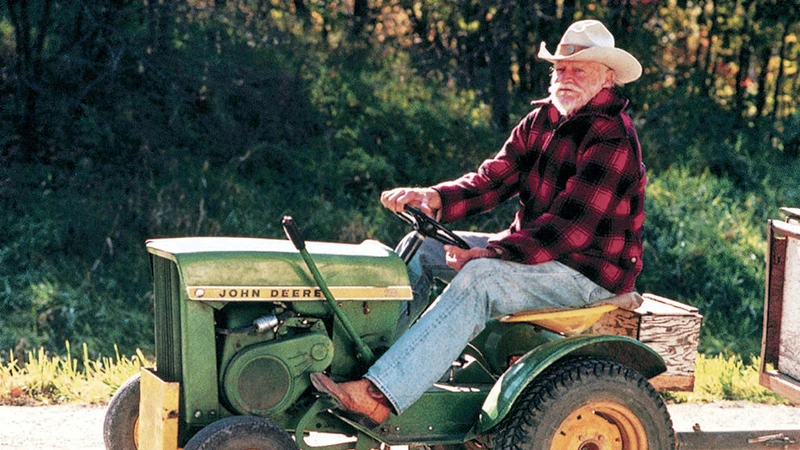
Often described as the least Lynchian David Lynch film ever made, The Straight Story is a film that is both oddly conventional and entirely appropriate for a filmmaker renowned for some of the most disturbing arthouse films in cinema history. His only family-friendly film, and distributed by Disney, it’s at once an outlier within the director’s body of work and a quietly perfect expression of it.
Based on a real-life story, the film follows the elderly Alvin Straight (Richard Farnsworth) living a modest, increasingly constrained life with his daughter Birdie (Sissy Spacek) in Iowa. Alvin is grappling with the slow erosion of independence that comes with old age – failing eyesight and unreliable legs. When he learns that his estranged brother Lyle (Harry Dean Stanton) has suffered a stroke in Michigan, Alvin decides to embark on a cross-country odyssey to Michigan, with a battered old lawnmower as his only means of transport.
As different as it may appear to his other work, though, the entire tone of the film is unmistakably Lynch. He always had an affection for the nostalgic view of idyllic Americana, the white picket fences and sunlit lawns, etc. Usually, though, this serves as a prelude to revealing something rotten lying just beneath the veneer of wholesomeness, be it a dead girl wrapped in plastic or a human ear discovered in the garden. Almost as a nod to this, The Straight Story opens in a very similar way to Blue Velvet, with a peaceful suburban garden interrupted by a character collapsing. There is a similar sense of dread, too, as the fall happens offscreen, with the camera panning slowly towards the window. The difference here is that there really isn’t anything sinister going on – Alvin is found lying on his kitchen floor, unable to get up, but pretty cheerful, and exchanging good-natured banter with the neighbours who come to help him.
This being Lynch, though, there is an ominous tension in every scene. In his review of the film at the time, Roger Ebert said he “kept waiting for the other shoe to drop,” for the curtain to be pulled back on something dark and seedy, but it never does. There is a certain sense of something unsaid, of something not quite right, but it’s never clear if this is within the film or the expectations of the audience. There’s a tragedy to the characters, especially Alvin and his daughter, and what is implied about the accident that separated her from her children.
Lynch was never cynical in his films – he would use irony and absurdity to devastating effect, often in contrast to more sinister elements, but he was always completely sincere in his approach. Think about the humanity on display in Blue Velvet – in just about the most disturbing scene of the film, where the school bullies are instantly cowed by the appearance of Dorothy, or the scene with Treves’ wife in The Elephant Man, or the genuine emotion on display in Twin Peaks. Most of the time, this is present, and the trauma comes from the fact that this horrible stuff is happening to characters we really care about. In The Straight Story, this is all on the surface, and all the way underlying the film. At every turn, where you might expect a little bit of cynicism or snark to sneak in, Lynch opts for a much more wholesome, empathetic approach.
The lady who has an emotional breakdown after hitting yet another deer with her car could easily be played for laughs, and there is something funny about it here, but what sticks with you after is her obvious distress, feeling terrible about hitting 13 deer in seven weeks. Similarly, the suburban yuppie types Alvin encounters could easily be portrayed as cynical or dismissive, but instead Lynch shows them to be caring, generous, and humane. His penchant for melodrama and broad comedy is present, but it never comes at the expense of characters’ humanity. The dramatic zoom on Spacek’s face as she enters the film is beautifully done, and the malapropisms from Alvin’s neighbours are broad and funny (“What’s the number for 911?”)
Irvin Kershner once said, “There’s nothing more interesting than the landscape of the human face,” and in The Straight Story, Lynch manages to have his cake and eat it. There are some breathtaking wideshots of sweeping Midwestern landscapes, thanks in no small part to Freddie Francis’s stunning cinematography (he previously worked with Lynch on The Elephant Man), but the closeups of Farnsworth’s craggy, weathered face are just as evocative. Farnsworth is remarkable here, delivering one of the great late-career performances in American cinema. Having begun his career as a stuntman for the Marx Brothers and Ben-Hur, Farnsworth brings it to a close here with astonishing restraint and grace. It’s a softly spoken performance of subtlety, of world-weariness and wisdom, without ever tipping into overt sentimentality. Rewarded with an Oscar nomination, at the time the oldest actor to ever receive one, this would be Farnsworth’s last film, and it’s a true tour de force. The scene where he recounts a traumatising encounter in WW2 is all the more devastating for his restraint – there’s no hint of artifice or “acting.”
The supporting cast is largely populated with unknowns, but Sissy Spacek is particularly great as Rose, playing her as an open book, happily chatting to people, and yet there is a melancholy to her performance too, which is only partly explained later in the film. The scene of her in the supermarket, trying to connect with the cashier, is beautifully observed and an economical way to sum up her guileless, slightly eccentric character perfectly. Her stutter too, never feels mannered or performative; it’s simply part of who she is. Harry Dean Stanton, meanwhile, is incredible in his one scene – doing more with 30 seconds than many actors manage in a whole runtime. His sad, mournful eyes tell the entire story of the brothers’ fractured relationship, with the barest dialogue.
The reason for the brothers’ estrangement is never explained, and Lynch wisely leaves it that way. It’s not the cause that matters, but the Herculean effort taken by Alvin to remedy it. That understated and profoundly moving ending, which quickly and economically sums up the relationship between the two, is just about perfect – it’s essentially the entire reason for the film, and Lynch sticks the landing beautifully.
Alongside The Elephant Man, this is Lynch’s most straightforward film – but that doesn’t make it any less idiosyncratic. You could argue that it was a strategic move, proof that he could deliver a conventional narrative before embarking on the labyrinthine Mulholland Drive. I prefer to take it on face value, though, and see it as a genuine passion project: a different facet of the same artistic sensibility.
The Straight Story is one of the most heartwarming and beautifully crafted road movies of the nineties. It might be “straighter” than his usual fare, but it remains a singular film from a singular director. Nobody else could make a film this gentle, this strange, and this quietly profound, and indeed, Lynch would never make a film like this again.
Special Features
This release is full of extras, including an audio commentary from Peter Tonguette, and a spate of featurettes all of which include puns on the word “Straight” – these include: Mark & Bob Tell It Straight; Straight & Narrow: Inside the film; Far & Wide: Inside The Score; Straight Talking: A Making Of Interview with David Lynch and The Straight Story: On Set With David Lynch.
★★★★★
Released on 9th February / Richard Farnsworth, Sissy Spacek, Harry Dean Stanton / Dir: David Lynch / Studiocanal UK / U
Discover more from
Subscribe to get the latest posts sent to your email.
About the Author