The Idiot(s) Review (2026 BFI London Film Festival)
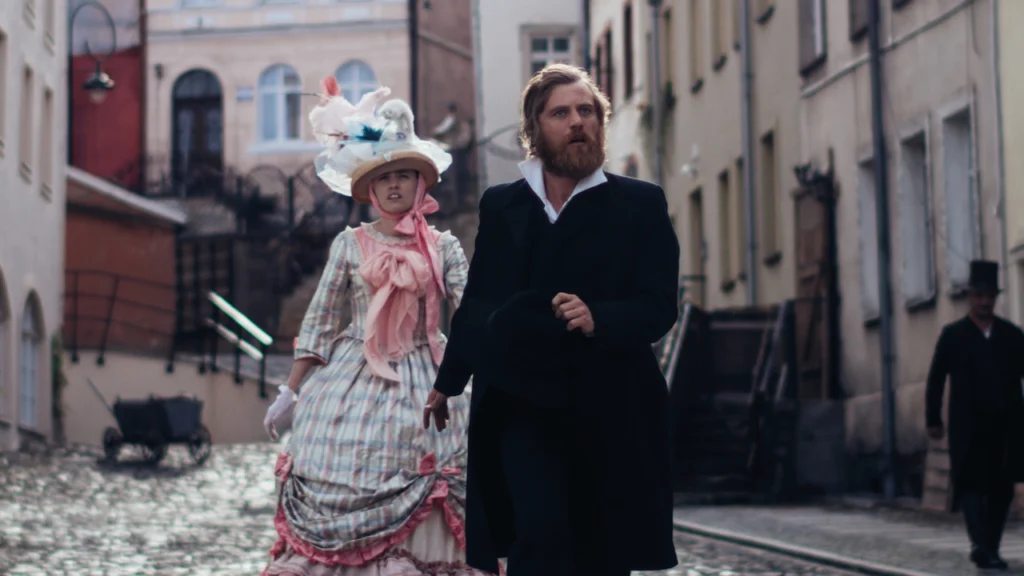
Małgorzata Szumowska and Michal Englert are back co-directing their fourth feature, The Idiot(s), based on Andrew D. Kaufman’s novel The Gambler Wife. Kaufman’s novel draws from Anna Dostoyevsky’s diaries, which describe the evictions, poverty, and addictions she and her husband faced. Szumowska and Englert present these hardships in exaggerated caricatures and nonsensical scenes. Divided into five parts, The Idiot(s) is a delightfully funny insight into Fyodor Dostoyevsky’s marriage and the making of his 1869 novel The Idiot.
Fyodor and his wife, Anoushka (Anna), move from Russia to Baden-Baden in Germany; penniless, in self-exile, and seeking inspiration for his next novel after the success of Crime & Punishment in 1866. At first, the dynamic between the couple is ambiguous. On arrival in Germany, Anna appears nothing more than Fyodor’s maid, then his kink mate, before it is revealed that she is his wife. They encounter the usual marital issues, bickering over food and flirtations, but it is their lack of money that is their biggest issue. It follows them from Russia to Germany, lingering like a bad smell.
At first, this film seems to be nothing more than a silly, comically exaggerated interpretation of Anna’s diaries and the eccentric Dostoyevsky’s. The Idiot(s) doesn’t appear to have much depth to it, but as the film unravels, so do its themes, and the core theme explored in this film is the human condition. The Dostoyevskys are poor, trying to make a living, and in exile from their home country. Although their portrayal is comical, their struggles are impossible to ignore.
Anna adheres to the role of a dutiful wife, encouraging Fyodor to write his new book, selling personal belongings to stay afloat, and sticking by him despite his wandering eye. Fyodor, on the other hand, indulges this wandering eye. He has a fascination with a French woman, and falls into gambling, which he insists will inspire him to write. With their livelihoods reliant on the success of Fyodor’s writing, the couple consult unconventional methods to succeed – and to survive.
Johnny Flynn gives a knockout performance as the eccentric, self-proclaimed ‘best writer in Russia’, Dostoyevsky. His character is chaotic, dramatic, and utterly attention-seeking, evidenced by his fish-like seizures when he’s not getting his way. Speaking in an English accent while portraying a Russian writer is ironic at worst and hilarious at best. Similarly, Aimee Lou Wood shines as the loveable Anna. She brings humour and a real warmth to her character, depicting the reality of what it means to be a woman in these conditions.
Flynn and Wood have a wonderful and very entertaining dynamic. Their characters are in a constant battle of who can behave in a more unhinged manner. (Spoiler: it’s Fyodor). Anna’s birth scene is particularly memorable for showcasing their dynamic; chaotic but laugh-out-loud funny. Vicky Krieps, Christian Friedel, and Raphael Roger Levy additionally add entertaining layers to the story in their supporting cast roles.
An unspecified amount of time passes in this film, and honestly, I have no idea how long the Dostoyevskys stayed in Baden-Baden. Anna’s pregnancy, which comes much later in the film, is the only true marker of time passing. She jumps from finding out she is pregnant to being visibly pregnant in a matter of scenes. However, the unspecified timeframe does nothing to take away from the heart or humour of this film.
Read more of our LFF 2026 coverage →
Additionally, Szumowska and Englert use a clever, discreet tactic to accelerate the story and provide important context. Each ‘part’ contains a single shot of a sign or newspaper, existing almost as Easter eggs. These fleeting shots feature a headline about War arriving in Russia, while another reports on the Tsar’s death. They establish important socio-political context and guide our understanding of why Fyodor and Anna can’t return home.
Despite its 1860s setting, this screenplay is peppered with amusing nods to contemporary culture. There’s a cat called Miu Miu, a character who performs a rendition of A-ha’s ‘Take On Me’, and a reference to ‘the fucking 1%’ when Anna and Fyodor receive the bill for their coffee. It’s a very well-crafted script and certainly doesn’t skimp on humour.
However, one artistic choice that feels at odds with the rest of the film is the dream sequences. They offer realistic scenarios that blur reality, such as Fyodor being executed for being a chauvinist and a narcissist. I suppose it could be something sitting in the couple’s conscience, but the dreams seem randomly placed and unnecessary. If their significance were clearer, it might fit better into the structure of the film.
Englert’s cinematography is striking, and the style, set and shots feel somewhat reminiscent of Poor Things. There are some wonderful shots that capture the dynamics of the characters, including the heart, tension, and humour. The film makes everything feel theatrical, from its division into five parts to the dramatic absurdity of its characters. However, what you come to realise is that this film is not about Dostoyevsky or those around them, but about Anna and how her actions ultimately save Fyodor from a dramatic downfall. The Idiot(s) renders itself a sharply funny film with a brilliant cast, bordering on the absurd.
★★★
Playing as part of the 2026 BFI London Film Festival on October 14th, 16th and 18th. / Johnny Flynn, Aimee Lou Wood, Christian Friedel, Vicky Krieps, Raphael Roger Levy / Dir: Małgorzata Szumowska and Michał Englert / Gold Rush Pictures
 #
#
Discover more from
Subscribe to get the latest posts sent to your email.
About the Author


You must be logged in to post a comment.