Godzilla Minus Zero Review (2026 BFI London Film Festival)
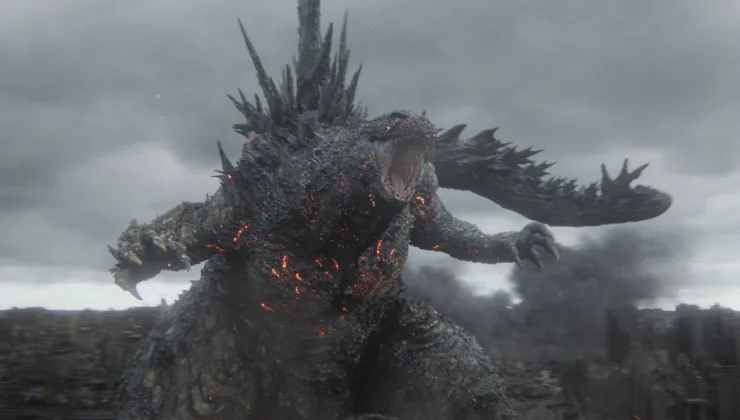
Takashi Yamazaki cannot seem to escape nationalism. The writer and director of the surprise hit Godzilla Minus One has faced criticism for the nationalistic themes present throughout many of his films. The late Prime Minister Shinzo Abe, a known denier of the Nanjing Massacre, even defended one of Yamazaki’s previous films, The Eternal Zero. You would hope that, heading into his latest kaiju extravaganza, Godzilla Minus Zero, he might have learned from those past criticisms and delivered a less nationalistic film. However, it seems that Yamazaki still cannot escape his revisionist portrayal of post-war Japan.
To delve too deeply into the film’s narrative would risk spoiling the journey, as the biggest surprise happens within the first 30 seconds. What I will say is that the core cast from Minus One are brought back into the fray when a new threat and Godzilla’s return wreak havoc on Japan. For die-hard Godzilla fans, the new kaiju will come as no surprise, given that its iconic roar and lightning powers are prominently featured in the trailer. However, I do want to be vague given its presence is merely teased. The kaiju-driven chaos is the true highlight of the film and worth the price of admission. The opening sequence is a true highlight, throwing audiences straight into the destruction through an impressive pseudo-long take that is nothing short of mesmerising.
The rest of the Kaiju chaos, while not as emotionally impactful as its predecessor, is still undeniably rad. However, Yamazaki appears not to have learned from the criticisms levelled at Minus One. Doubling down on what many will view as revisionist history. The film paints the US as villains for dropping the atomic bombs while also suggesting they are eager to seize Japanese technology that could ultimately lead to an even more dangerous weapon than the bombs. Essentially continuing the cycle of pain and suffering caused by war.
Read more of our LFF 2026 coverage →
What happened in Hiroshima and Nagasaki was horrific. I have witnessed the lasting impact those events had on Japan firsthand, having visited several museums and the iconic A-Dome during a trip to Hiroshima last year. However, for the film to completely ignore Japan’s own imperialist actions, which saw the country control more than 3.25 million square miles of territory across East Asia. Is nothing short of politically repugnant. The same criticism applies to the film’s portrayal of the US.
It starts by ignoring what occurred due to a snowball effect started by Japan. To summarise history quickly, Japan’s occupation of French Indochina prompted the US government to freeze Japanese assets and impose an oil embargo on Japan. This was viewed as escalating tensions, which ultimately contributed to Japan’s attack on Pearl Harbour. This finally led the US into direct conflict with Japan.
From 1945 to 1952, Japan was governed by the Allied powers, with the US taking the lead. In this period, the US played a direct role in reshaping Japan, including helping to draft the country’s constitution. Yet the film largely ignores the US presence in Japan, aside from a few military bases. One character even claims that Japan is a pawn of the United States, a bizarre line of dialogue given that Japan was effectively a US territory.
Ignoring history to construct a narrative that portrays its characters, and by extension Japan itself, solely as victims trapped in an endless cycle of conflict is morally and politically repulsive. Political negatives aside, the original cast (consisting of Ryunosuke Kamiki, Minami Hamabe, Hidetaka Yoshioka and many others) do their best to elevate the paper-thin material. Delivering solid performances that match the quality of the previous instalment.
It is with the new characters that the film begins to waver. Masami Nagasawa is a welcome addition as weather expert Makoto Aoyama, while Min Tanaka’s biologist, Kanji Murakami, proves to be the complete opposite. His character is also responsible for the film’s most bizarre and needlessly violent sequence, which sticks out like a sore thumb compared to the rest of the film.
Naoki Satō’s score remains impressive and builds upon the excellent work he delivered in the previous instalment. The opening moments and all the Kaiju scenes are perfectly punctuated by the score. Creating a series of tense and thrilling sequences that immediately draw the audience in. His updated arrangements of the iconic Godzilla themes are nothing short of spectacular, giving the climactic battle a truly seismic sense of scale.
Godzilla Minus Zero should have been a natural improvement on its predecessor, but instead it is, for better or worse, more of the same. Its nationalist approach to kaiju storytelling may be, but the monster sequences are undeniably spectacular, surpassing anything currently being offered by the American incarnation of the franchise. While I did not hate what I was watching, I was nevertheless taken aback by the nationalism on display.
★★★
Playing at the 2026 BFI London Film Festival on October 14th and 16th / Ryunosuke Kamiki, Minami Hamabe, Hidetaka Yoshioka, Masami Nagasawa, Min Tanaka / Dir: Takashi Yamazaki / Anime Limited / 15

Discover more from
Subscribe to get the latest posts sent to your email.
About the Author




You must be logged in to post a comment.