Silent Friend Review (2025 BFI London Film Festival)
Silent Friend, the latest film from Ildikó Enyedi, attempts to communicate with unknowable life forms. A vast and intricate web of flora and fauna surrounds us so completely that it often fades into the background of daily life. We take it for granted, forgetting that we are not only immersed in this hidden world but entirely dependent on it for survival. Through the lens of science, Enyedi probes the natural world, crafting a film that seeks to understand our relationship with plant life in much the same way Spielberg’s Close Encounters of the Third Kind approached human curiosity with alien life: with curiosity and yearning to connect across the unknown.
At the heart of Silent Friend stands a large, ancient ginkgo tree, rooted in the grounds of the Philipps University of Marburg in Germany. This tree becomes the film’s only constant across three distinct timelines, as a series of solitary outsiders form meaningful connections with it.
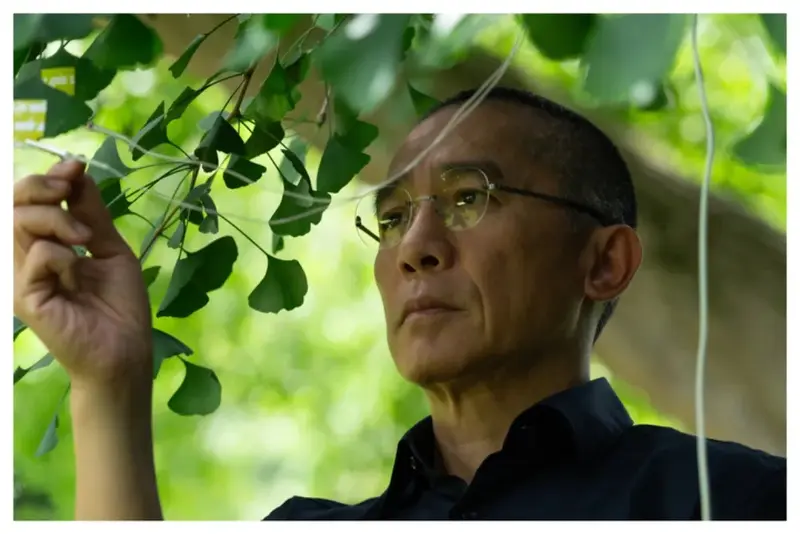
In 2020, stranded by the pandemic’s global lockdowns, a Hong Kong neuroscientist named Tony (Tony Leung), whose work typically focuses on infant brain development, finds himself adrift in the near-empty university. However, his attention drifts toward a more speculative frontier, and he begins a botanical experiment, seeking to initiate a form of communion with the ginkgo tree itself. Tony finds companionship with a grumpy groundskeeper, intrigued into a reluctant friendship and in video calls with a French researcher and plant expert (Léa Seydoux), who helps him establish his relationship with the tree.
We drift back in time to 1908, as the university accepts its first female student, Grete (Luna Wedler). We meet her, impressing an all-male interview panel with her botanical knowledge, despite their best attempts to make a fool out of her. To support herself, she takes a job as a photographer’s assistant, and through the lens of her black-and-white photography, she begins to uncover and make sense of the rhythms of life encoded in the natural world.
Another thread, set in 1972, follows a rebellious young scientist named Gundula (Marlene Burow) who develops a primitive machine to measure the subtle energy shifts in plants, specifically her cherished purple geranium. When she leaves to take a trip with her friends, she entrusts her plant to the care of her besotted housemate Hannes (Enzo Brumm). She leaves him with strict instructions on how to care for the experiment and their lush shared garden, and as the days pass, Hannes begins to think of the flower not as a specimen, but as a friend. As Hannes and Gundula’s relationship intensifies, Enyedi illustrates the consistent role the natural world plays in our everyday lives. In one such scene, camping in the forest with their friends, Gundula munches on a fire-roasted potato and smokes pot while Hannes stares longingly at her across the flames.
The film’s three-pronged structure is made even more distinctive by Enyedi’s use of specific visual styles for each era. Grete’s patriarchal world is rendered in crisp 35mm black-and-white, echoing the formalism of early photography. Hannes’s 1970s timeline drifts by in a sunny, grainy 16mm, evoking the tender memory of infatuation. In contrast, Tony’s present-day solitude is captured with clinical digital precision, reflecting the sterility and isolation of the COVID era. In these shifting visual landscapes, we see the world around the ginkgo tree change while it stays rooted through time, the same as it ever was, a silent observer to the world around it. The sections are interconnected by an array of visual effects and digital flares, including patterns and pops of coloured light. These moments evoke scientific exploration and an otherworldly transcendence, suggesting that the experiments in each of the stories reflect not only data, but an immersurable emotional evidence too.
Enyedi is determined to demonstrate the symbiosis between man and plant. Her three narratives are richly detailed and brimming with emotion, demonstrating the richness of individual experience. Her characters are bound in time through the tree, and the steadfast role it plays within each of their lives. Enyedi’s storytelling is patient and evocative. Her scenes linger indulgently, accumulating slowly like layers of fallen leaves. The film moves at a soothing, meditative pace. Yet this unhurried rhythm never feels aimless. The care she takes to capture the vividness of the lives of her characters lends the film its gentle momentum.
Tony Leung is exceptional and perfectly cast as Tony. His presence within the film feels like spending time with an old friend. When the film’s two historical segments begin to meander or risk becoming too abstract, Enyedi instinctively knows when to bring the story back to Tony, where he corrals her themes into something tangible.
Silent Friend is a gentle and meditative film. The kind you have to sit back and enjoy patiently, letting it unfold around you. Enyedi paints upon a wide canvas, creating deeply beautiful reflections. Her vision challenges the viewer to reconsider how we perceive plants as passive scenery and to see them instead as active, even emotional, participants in our shared existence. Like Robert Altman’s Short Cuts, Silent Friend is so intelligent and lyrical that she could have easily added another eight hours to the runtime without losing her grip.
★★★★★
Screening at the 2025 BFI London Film Festival / Tony Leung Chiu-wai, Luna Wedler, Lea Seydoux, Marlene Burrow, Enzo Brumm / Dir: Ildikó Enyedi / Film’s Boutique
Discover more from
Subscribe to get the latest posts sent to your email.
About the Author