Rose Of Nevada Review

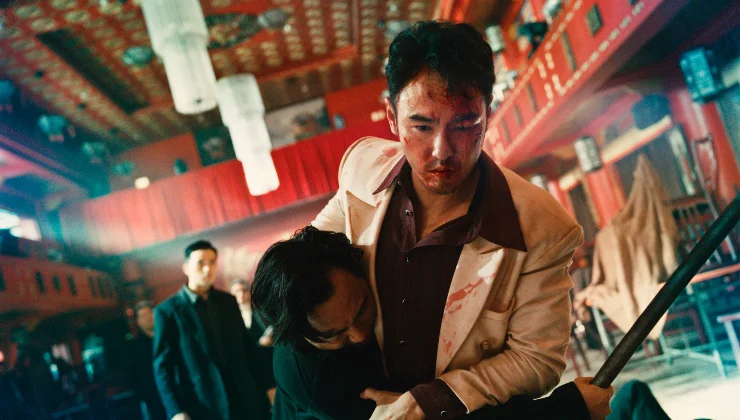
In a forgotten fishing village, a boat mysteriously appears in the old harbour. The Rose of Nevada, lost at sea with all hands 30 years ago, has returned. For the few who remember, it’s a sign the boat must go back out again. Nick (George MacKay) takes a job aboard in an attempt to provide for his young family. Alongside him, newly arrived Liam (Callum Turner) joins the crew, desperate to escape his past. They head out to sea and, after a successful trip, return to harbour—but something is wrong. Time has shifted. The villagers greet them as if they are the original crew.
The film is beautifully shot on film and presented in a 4:3 aspect ratio, which gives it that gritty, arthouse aesthetic that Mark Jenkin has become known for. He’s one of the most distinctive auteur directors working today, and this film is another strong example of his visual style and storytelling. There’s a clear influence from early 2000s British cinema – think Danny Boyle’s work from that era. Director Jenkin’s use of tight, fixed camera shots creates an eerie and unsettling atmosphere throughout, strongly supporting the story he’s telling. This is further enhanced by the sound design, which blends score with natural ambient noise to give the film a raw, realistic feel.
That sense of unease carries through the entirety of The Rose of Nevada, particularly in the unsettling sounds coming from the boat’s radio and the flashes of haunting imagery as Nick comes to terms with what is happening and tries to understand the new life they’ve seemingly inherited. Jenkin’s storytelling also encourages the audience to question what’s real, prompting you to wonder whether the rest of the community is somehow in on the mystery, especially given how they behave across both timelines.
The Cornish setting is not only beautiful but vital to the film’s identity. It reinforces the isolation the characters experience, while also reflecting the haunted nature of the story and its impact on the community. There’s an interesting idea at play here: the contrast between a town struggling due to a lack of fishing and one overwhelmed by abundance. Jenkin seems to suggest that either extreme can be destructive, with the village itself almost becoming a character in its own right.
In the third act, the film strongly evokes Robert Eggers’ The Lighthouse, particularly in its use of sound and descent into something more surreal and intense. A standout performance comes from MacKay, who brings a powerful intensity to the role, often communicating more through expression than dialogue.
My main issue with The Rose of Nevada is its pacing. At times, it feels slower than it needs to be, and I did find my attention drifting in places. Additionally, the story leans heavily on imagery rather than dialogue. While this works in many moments, there were points where I felt like I was filling in too many gaps, especially with some of the time jumps. Overall, though, I really enjoyed the film, and I’m excited to see what Mark Jenkin does next, as he continues to carve out a unique space in British cinema with his bold visual style and unconventional storytelling choices.
★★★ 1/2
In UK cinemas on 24th April / George Mackay, Callum Turner, Francis Magee / Dir. Mark Jenkin / BFI / 15
Discover more from
Subscribe to get the latest posts sent to your email.
About the Author