Roqia Review (Venice Film Festival 2025)
Fans of the genre would agree: horror films are at their best when they stay true to intention rather than chasing sensation. When they set aside image sophistication and tidiness in favour of naturalism. When, in other words, they keep it real. All the more so when they respond to sensitive, concealed, yet dominant and deeply potent, affective affairs.
Such is the new film by Algerian filmmaker Yanis Koussim, Roqia. Koussim, a key figure in independent filmmaking in his country, stands for a rising generation of stormy makers willing to do the hard yards and break through traditional gestures of cinema, but also to address the undercurrents that shape collective memory and national identity. Not an easy feat, especially within a political landscape regularly exposed to polarising conflicts and a society veiled by religious impressions and commanding doctrines.
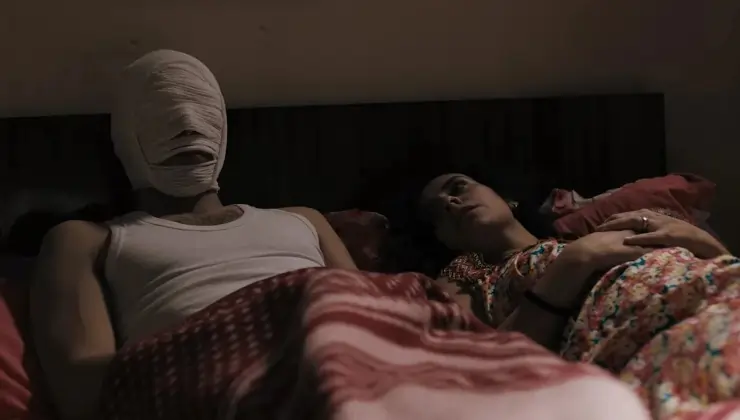
Roqia spans the last 30 years of Algeria’s plunge into violence and the contaminating fear that has infected households and neighbourhoods to this day. The film throws us into a free fall at the core of the unthinkable brutality unleashed during Algeria’s dark decade of civil war, armed men against civilians. Soon after, we land in contemporary times, in a scene of exorcism so daunting and persistent it feels like a salute to the cinematic phenomenon that established the grounds for religious explorations of archetypical evil. Koussim goes a step further, keeping his shots wide enough for us to witness rather than imagine the gruesome succession of evil acts. He reveals the incarnation of the devil without hiding behind tight framing or the familiar tricks of gimmick-driven representation.
As for us, we stay in dark rooms with the devil, left with echoes of fear alongside the few faces that guide us back and forth through the years of proximate and distant war. And although we follow three main characters confronted with possession, the devil in Roqia is not confined to a single body but spreads through small groups, like a virus with expansive politics, finding with confidence its openings in vulnerable or wounded individuals to take hold of peace.
Evil manifested through the perpetual and cross-religious figure of the devil alongside the horrors of war is precisely what Koussim exposes in conjunction. The backdrop is Algeria, and the title specifies the religious environment (Roqia is an Islamic practice of reciting verses of the Koran to manifest the need for protection and to reinforce one’s faith). Yet the reference to volunteer soldiers (Afghan Arabs) who fought in the 1980s anti-Soviet Afghan jihad elevates the story to a universal landscape, with enduring implications for those who fight wars. I am convinced the examination of veterans was not the epicentre of Koussim’s interest, but the juxtaposition of devil and soldier offers a new perspective on post-war psychology, shifting the focus from individual mental frailty back to the responsibility of those in power. The devil here is not a supernatural entity but the bloodshed of war itself. A metaphor that draws on genre (and God) to articulate injustice. A reminder, too, that politics cannot exist without religion, and that religion, beyond moral ideology, functions as a political trope.
That said, many scenes will make a casual viewer uncomfortable with their gory tendencies and unfiltered violence. Koussim is not seeking empathy, but uses realism to speak of horrors. An experience that renders Roqia a rediscovery of the power of script and camera, relying not on the high-end polish of the image but on the dexterous unfolding of characters and events, with pitch-perfect pacing that balances tension with moments to breathe and reflect.
Roqia comes as an argumentative force in international cinema, declaring how stories and the medium can bind complexities with emotional gravity and visual assertion. It may feel intuitive, but I saw it as a bold act of filmmaking.
Roqia premiered at Settimana Internazionale della Critica (Critics Week), Venice Film Festival 2025.
Roqia, 94’ / Dir. & screenplay: Yanis Koussim / With: Ali Namous, Hicham Abdelfah, Mostapha Achour, Abdellah Aggoune / Production: Supernova Films / Co-production: 19, Mulholland Drive / International Sales: Alpha Violet / France, Algeria
Discover more from
Subscribe to get the latest posts sent to your email.
About the Author