Nouvelle Vague Review

Nouvelle Vague marks Richard Linklater’s second film of 2025 after Blue Moon (if we are counting his American release dates). It is a retelling of the making of Jean- Luc Godard’s first feature film- A Bout de Souffle or its English name- Breathless in 1960 amidst the French New Wave movement in France and the directors’ desire to not conform to old Hollywood escapist cinema.
I want to be completely honest and acknowledge that I approach this review with a slight bias. I am a huge admirer of French New Wave cinema, ever since first watching Breathless in college during a film studies class- a viewing that left a lasting impression on me. From that moment on, I became deeply enamoured with the movement and the artists behind it. Because of this, I approached this film with both immense excitement and a fair amount of apprehension, aware that my expectations were high and that it could easily disappoint. I’m happy to say, however, that it far exceeded those expectations, and I absolutely adored it.
The film is shot on 35mm black-and-white to evoke the visual style of Breathless, and it is truly beautiful to look at. I especially appreciated that Linklater chose to pay homage to the films of that era rather than attempting a modern reinterpretation, as we’ve seen in other projects. The only comparable film that comes to mind stylistically is Tim Burton’s Ed Wood, which similarly explores a director’s creative journey- specifically the making of Glen or Glenda– and is also shot in black-and-white to mirror its subject’s work.
Linklater’s approach fully transports the viewer back to this period, giving the film a distinctly voyeuristic quality- almost as if we are members of the crew, quietly observing the filmmaking process from the background. He also recreates several iconic moments and images, which is deeply satisfying and feels like a loving tribute that perfectly scratches a cinematic itch.
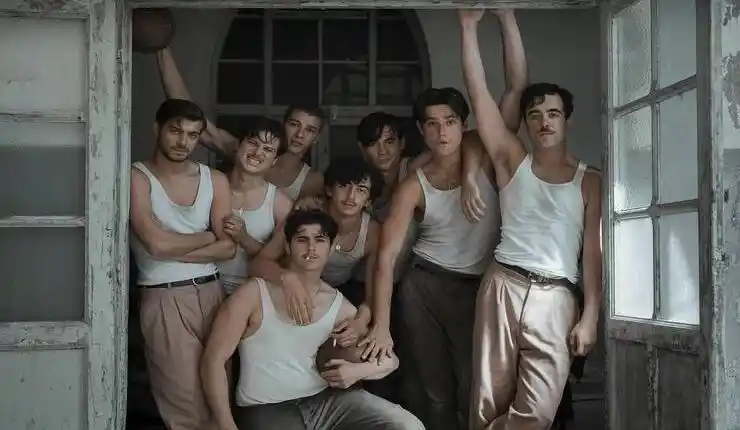
Every time we are introduced to a new character, a shot of the character with a title with the person’s name is added to the bottom which frankly made me feel like a marvel fan getting excited at every cameo made. From Agnes Varda, Franciois Truffaut, Robert Bresson, Jacques Demy– this film has it all. I was also absolutely struck by the likeness that these actors have to the people they are playing. It was absolutely uncanny and made me question whether I was watching a documentary.
As mentioned previously, the performances are exceptional, with the actors fully transforming into the real-life figures they portray. Guillaume Marbeck effortlessly channels Godard’s cool, from his casual detachment and constant use of sunglasses to his habit of quoting others- such as Da Vinci’s “art is never finished, only abandoned.” I also appreciated how the film allows other characters to gently mock Godard’s tendency to quote, adding moments of humour and a sense of lightness that keeps the film from feeling overly reverent.
One performance that particularly impressed me was Zoey Deutch. I had no idea she spoke French, and she does so with remarkable ease. This is unlike any role I’ve seen her in before, yet she completely embodies Jean Seberg and is mesmerizing to watch. One moment that genuinely gave me chills was the recreation of the New York Herald Tribune scene in front of the Arc de Triomphe, accompanied by the iconic score. After this performance, I’ll certainly be keeping an eye on Deutch- I’m eager to see what else she’s capable of.
This film is for cinephiles. The one that relish in art cinema. Those who know about the Young Turks in the Cahier du Cinema. Those who want to create and those who want to know more about this era of cinema. I believe Linklater set this out as a love letter to French New Wave and he certainly succeeded in that- and more.
★★★★★
In cinemas from January 30th / Guillaume Marbeck, Zoey Deutch, Aubry Dullin, Adrien Rouyard / Dir: Richard Linklater / Altitude Films / 12A
Discover more from
Subscribe to get the latest posts sent to your email.
About the Author