MCU’s Thor Nearly Let Up On The Panned Dutch Angles
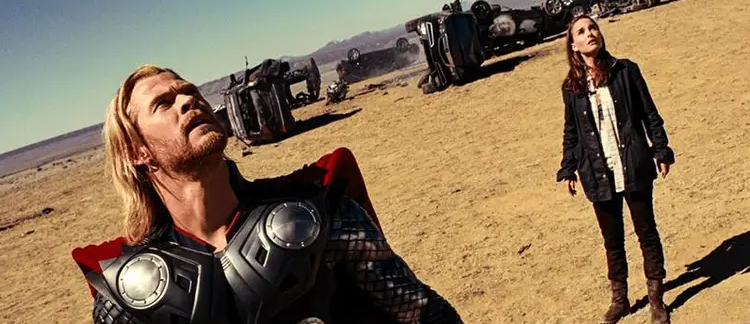
Kenneth Branagh’s 2011 comic adaptation, Thor, starring Chris Hemsworth in the titular role of the God of Thunder turned Avenger, was one of the earliest stones laid to create what would soon become the Great Wall known as the Marvel Cinematic Universe. This is also known as one of the contemporary film world’s most prolific franchises, with a global gross of over $30 billion as of today thanks to thirty-eight feature releases.
It saw the son of Norse King Odin exiled and forced to live upon Earth with the mortals, yet thrown into conflict when his signature weapon, Mjolnir, is captured by S.H.I.E.L.D.
Additionally starring Natalie Portman, Tom Hiddleston, Stellan Skarsgård, Kat Dennings, Clark Gregg, Colm Feore, Ray Stevenson, Idris Elba, Jaimie Alexander, Rene Russo, and Anthony Hopkins, Thor grossed $449.3 million worldwide from a budget of $150 million, earned positive reviews and spawned three sequels: Thor: The Dark World in 2013, Thor: Ragnarok in 2017, and Thor: Love and Thunder in 2022.
However, one aspect of the superhero flick which garnered criticism and confusion was its extensive use of the Dutch Angle, known as a camera shot in which the horizontal is uneven because the frame is tilted to one side, making the vertical and horizontal lines run diagonally and mimicking what you would see if you were to tilt your head sideways. 1906’s Dream of a Rarebit Fiend by Edwin S. Porter is the earliest tracked first use of the camera shot.
A sit-down with Kevin McCarthy saw filmmaker Branagh address why he used the framing device, as well as sharing how Marvel was close to cutting back on the extensive use of Dutch angles in the final Thor cut, yet budget issues led them elsewhere.
“I could never understand why people were so baffled by that choice [to include Dutch angles]. I go back to any run of the comics, but a classic one, the Kirby runs, and just look at the framing,” Branagh explained. “Look at the framing. It’s all canted. It’s all, you know, German Expressionist – which of course already sounds like it’s mega-pretentious – but it was really just more about visual impact.”
Read more Marvel content here
German Expressionism is the influential movement that flourished in, you guessed it, Germany during the 1920s. It saw stylised and remarkable titles such as Robert Wiene’s The Cabinet of Dr Caligari, F.W. Murnau’s Nosferatu, Fritz Lang’s Metropolis and Destiny reject realism in filmmaking to instead immerse audiences in the Surreal, with stark shadows, distorted images, hyper-expressive performances and hand-painted sets aiming to explore subjective states of intense mood and conflict.
The director then added that he found a small sense of inspiration in this Berlin movement as it resonated with his belief of “…what would hit you in a story about gods,” and his acknowledgement of how “You needed to make some things more or less important.”
“I know that there was a conversation at some point in some part of the Marvel universe where they had a conversation about what would it cost to horizontalize this movie,” Branagh added. “And I am glad to say that the cash price for that process was so prohibitive.”
Thor is due to return in Avengers: Doomsday and fully horizontal this time.

Discover more from
Subscribe to get the latest posts sent to your email.
About the Author

You must be logged in to post a comment.