La Grazia Review
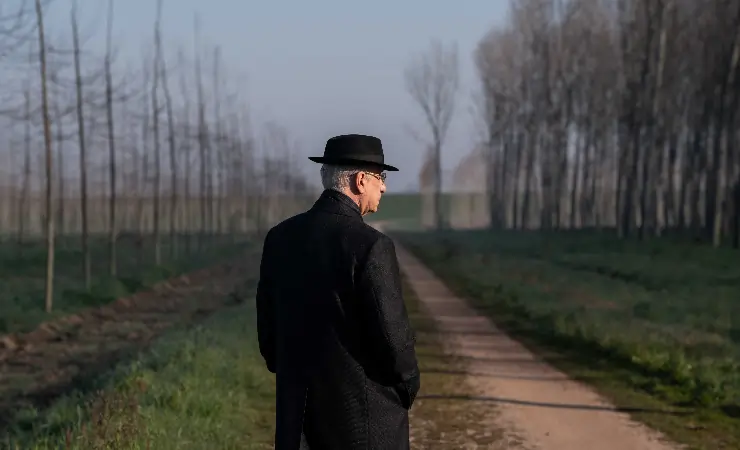
In La Grazia, Paulo Sorrentino’s latest film, Mariano De Santis (Toni Servillo) is beginning his white semester as the President of Italy. This is not only a key moment in his personal life, as it brings significant change from the last few years, but it is also a pivotal moment for Italy, given the importance of his role in the country’s politics. The latter is underlined from the very beginning of the film when a series of intertitles recounting one of the most important articles of the Italian constitution reminds the audience of the key role the President of Italy plays in the Italian political scene.
In his last semester, Mariano finds himself at a crossroads: will he sign into law the new bill legalising euthanasia, which his daughter Dorotea (Anna Ferzetti) fiercely advocates for, or will he oppose it as his friend the Pope (Rufin Doh Zeyenouin) strongly suggests? As the only person who can grant a pardon in Italy, Mariano is also asked to consider two petitions before the end of his term, while also still coming to terms with his own struggles in his personal life and family history.
In fact, Mariano is not just the President of Italy, he is also a father, a husband who lost his wife many years before, and perhaps more than anything else, he is a man who seems unsure about his future, his legacy, and his place in the world. Sorrentino does an excellent job at balancing the two sides of his protagonist, the political figure and the personal study of the man, to reveal a very touching and human portrayal of the fictional President of Italy. With some potential references to the real-life President, Sergio Mattarella, the film also successfully examines this pivotal and rather unique role in the Italian government.
Considering that Mariano is the protagonist, it is perhaps no surprise that Toni Servillo absolutely steals the film with his layered and emotional performance. But the characters and actors around him are just as important and well portrayed in the film, from the eccentric and incredibly funny Coco Valori (Milvia Marigliano) to his strong-willed and outspoken daughter Dorotea. Mariano’s relationship with the latter is particularly interesting to see on screen: their bond is evolving at best and complicated at worst. The older generation may not agree with all the potentially more progressive views of the new one, but Mariano shows us that, while they may not necessarily agree, they can still listen and work together for a more hopeful future for the country.
The movie explores the question of euthanasia, a complicated and thorny issue for the country it is set in. To this day, euthanasia remains illegal and criminalised in Italy despite the various attempts to bring forward a law to legalise it, like in the movie. While there may be a lot of films that have recently focused on euthanasia – Pedro Almodovar’s The Room Next Door naturally comes to mind – Sorrentino considers this very delicate topic from the perspective of a jurist who is asked to make an impossible decision. Mariano has to consider the question from a legal point of view, but also inevitably personal, as this influences his entire last semester and, largely, his political career. This unique perspective not only makes the film especially interesting to watch, but it also relates the narrative to the current political debate over euthanasia and assisted suicide in Italy even more.
With La Grazia, Sorrentino opens a window on contemporary Italy, offering a picture that is hopeful, enigmatic, and sombre at the same time. Overall, it is one of those films that keeps growing on you the more you delve into its intricate complexity and beautiful shots. It combines the beauty of his latest film, Parthenope, with the social and cultural analysis of Italy that was explored in The Great Beauty to create Sorrentino’s most politically engaged movie yet.
★★★★
In UK cinemas from March 20th / Toni Servillo, Anna Ferzetti, Massimo Venturiello, and Milvia Marigliano / Dir: Paulo Sorrentino / MUBI / 12A
Discover more from
Subscribe to get the latest posts sent to your email.
About the Author