La Gradiva Review (2026 BFI London Film Festival)
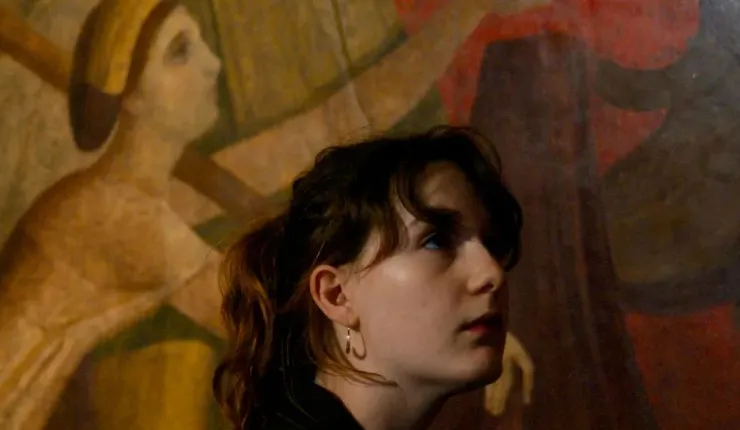
“If you go down the street, there is another city.”
If you’ve seen it, you might never guess that La Gradiva is one of the earliest projects from director, writer and cinematographer Marine Atlan. At its heart, it shows a command of tone here that resembles years of patient experience, breathing a sense of exploration into every member of its vast, youthful ensemble. The film follows a group of French teenagers on a school trip to Naples and the ancient ruins of Pompeii, where sexuality, anxiety and personal fables begin to boil all before their high school graduation and future school prospects.
We open on still vignettes of a marina area and a faded villa hidden amongst shrubbery. The film remains quiet as it sets its scene on a train; we watch two teenagers having sex, with one other, Toni, watching on in suspended voyeurism through the cabin window. In this opening sequence, Atlan points the camera at every face in our group, capturing gestures and the incantations of dialogue, setting the pace for each character intimately, but, importantly, never loudly.
Her Cannes hit embodies many things; on top of being a coming-of-age picture, it is a chase of distant, echoing ancestry, placed on the canvas of a historic catastrophe frozen in time, in a manner that cleverly reflects the limbo state of high school that they are currently in; on holiday that isn’t really a holiday and waiting to be accepted into a school, guiding them toward a currently uncertain future. Toni is seemingly from a Neapolitan family, as he spends much of the film trying to find traces of his family’s mark remaining in the rustic Italian region.
Read more of our LFF 2026 coverage →
So far this festival, I’ve come across a few films that attempt to use their celluloid form to create a tension between the myths of old and the contemporary time it takes place in. La Gradiva is stunning, and it knows it. The grains of images seem stuck in a time zone not of its own, in a way that allows the day-to-day structure of its class schedule to feel intentionally elongated, so that none of these events ever resemble a quick whim.
For much of this film, Atlan allows these characters such a freedom to perform in a remarkably natural motion; the script to match is almost unbelievably spontaneous in nature that you could mistake it for a work of non-fiction, documented by an invisible cameraman able to capture uninterrupted honesty in both word and expression. Prolonged scenes of conversation on class politics and youthful eroticism at dinner and in front of old works of art make this out to subvert the genre we’ve come to know as the drama; it is so unbothered by the concept of momentum it transcends to a special realm of coming-of-age storytelling, always playing with the idea that it could be something else, something more genre-bound. As time goes on, and this arrested development ceases, it cleverly slips into genre form, without even waning in impact.
More than anything, I found that Atlan’s portrayal of the rejection of artistic thought amongst teenagers to be particularly candid. An environment full of tragic art, and there’s a sense of doubt begging to be awakened in these prolonged discussions. In conjunction with that, she really challenges this subjective vs objective divide in mythology, but more importantly, it’s the lack of difference between personal fantasies. “Truth” is falsely actualised for many of our characters in here, with dream sequences and self-mythology taking form, before being disrupted by a more realistic fictionality, as the world’s actuality slowly begins to cast over them: “Everything is dirty”.
Atlan decides to go out on a moment of pseudo-truth, as a voice of omniscience simply provides us a semblance of closure, like something I’d expect in a movie reflecting real events, breaking down this adolescent barrier, yet it still carries a handful of poignant scepticism along with it. A new benchmark for coming-of-age cinema.
★★★★
Playing at the BFI London Film Festival on 9th and 11th October / Colas Quignard, Antonia Buresi, Suzanne Gerin / Dir: Marine Atlan / 1-2 Special

Discover more from
Subscribe to get the latest posts sent to your email.
About the Author