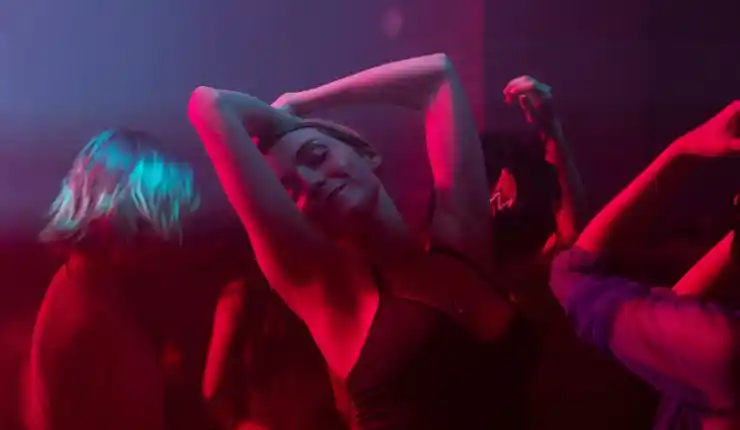
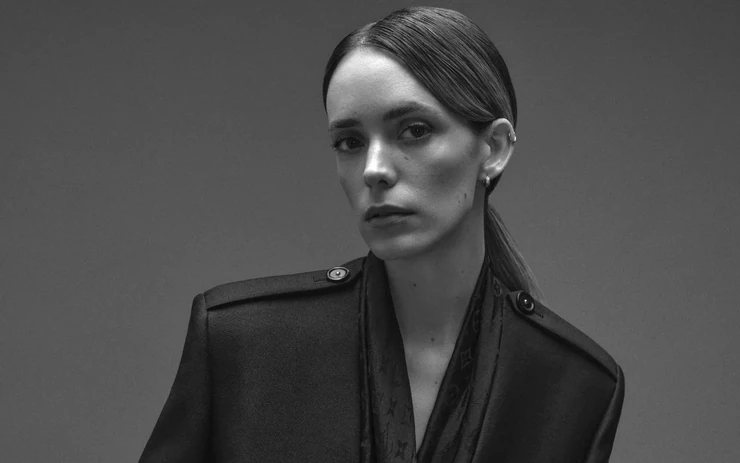
INTERVIEW: Lisa Jackson on staring at the stars and Indigenous colonial histories with ‘Wilfred Buck’ (CPH:DOX 2024)
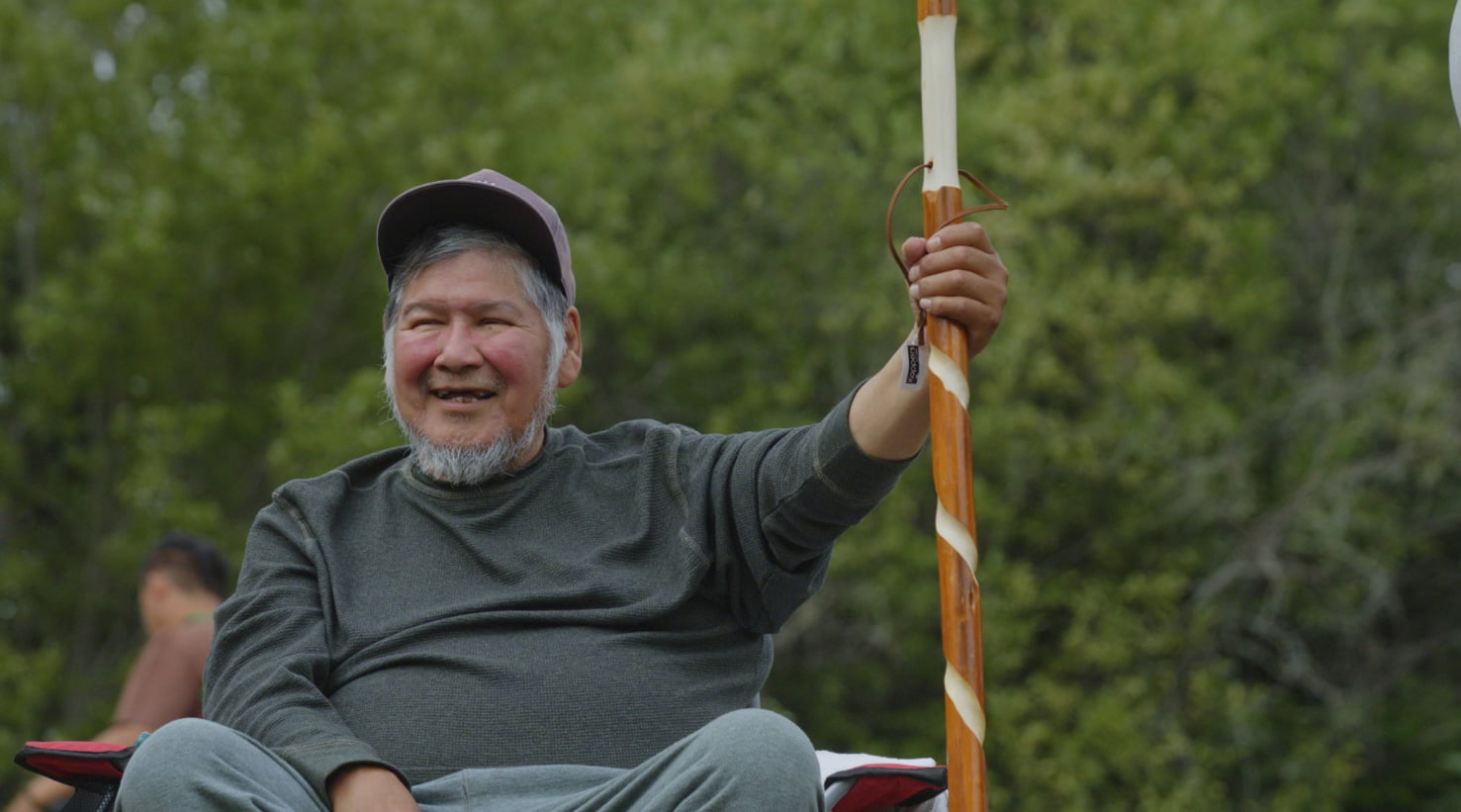
Wilfred Buck is an expert of all sorts. He is a member of Opaskwayak Cree Nation, the offspring of a First Nations family who has been uprooted, and re-rooted by personal will and empowerment under the guidance of the stars. But he is also an academic, rather an unconventional one, who has been propelled by the colonial history that defined him. His dedication to cosmology and astronomy from an indigenous perspective has made him a unique case of a leader for his community. Next to the star teachings and the healing communal rituals that he is often orchestrating, Western science claims interest in deciphering how his methods can update the ways we look at the world.
Director Lisa Jackson made a poetic portrait of this enlightened man. Her camera follows him in this conflicting life between the sterile environment of academia and the spiritual journeys of his communities. She is making good use of excerpts from his memoir in paper, ‘I Have Lived Four Lives’, with archival footage and subtle re-enactments. Footage of a star-lit sky and of meteorites observed through the microscope are the allegorical introductions to the spirituality of this man-and love notes from the director. Eventually, she crafts a story as rich as the man she follows and as sensitive as the tears he generously shares along the way.
But don’t be fooled. Besides the poetics, common as they come, this hybrid documentary raises fingers and poses questions transcending the borders of Canada. Before we think of reparation acts as modes of trauma recognition and decompression, let’s rewind and respond: How fairly are we conversing about colonial histories?
‘Wilfred Buck’ had its international premier at CPH:DOX 2024 in the DOX:AWARD sections. Lisa Jackson picked up the phone and kindly responded to my queries, European and ‘distant’ as they were.
Wilfred, the main character that you follow, represents part of a very painful and probably unresolved communal history related to the Canadian colonial past. What is your connection to such a history?
I’m Anishinaabe, and Wilfred is Cree. We come from neighboring First Nations that are connected but separate. The terminology can be confusing, and the way we talk about indigenous people has shifted over time. In Canada, we mostly use the term indigenous to speak of all the First Nations, Inuit, or Métis. In the US, it’s more Native American, but we don’t use that phrase, and, if we can, we’ll say the exact Nation or Tribe.
Because of my family’s history, I’m mixed. My mother was Anishinaabe, and my father was mixed-settler, which means he was a white Canadian but from a mixed European background. My mother was born in 1940, at a time when we still had the residential schooling system. It was a government program of assimilation. They legally mandated all children at about the age of 5 (sometimes even younger) to be taken from their homes and families and put in church-run residential schools. My mother went to one of these schools from the age of 5 until 15. Most schools were very abusive towards the children, and my mother’s school was no exception. It was very traumatic and difficult. She carried that trauma, which led to a lot of addictions and difficulties, such as mental health issues. That impacted me deeply when I was growing up. I understand what it is like to grow up in a family that has been damaged in many ways by colonial history. My first short film, actually, was about this relationship between my mother and my indigenous identity and the trauma that she experienced that came into my childhood.
Indeed, the film does bring up a sensitivity towards the diverse roots of the First Nations. What was your starting process for delving into the specificities of Wilfred’s story?
I’ve been making films for about 20 years. Many of those have dealt with a lot of the various colonial histories. I’m pretty well-versed in all these different ways that people had their children taken from them, been dispossessed of family and land, and also deprived of economic opportunities. So I didn’t need to do a lot of outside research on the overarching colonial process for Wilfred’s history. But I did a lot of research into the specifics of where he came from. It’s an area (northern Manitoba) that I wasn’t exactly familiar with. Although it’s very brief and only broadly addressed in the film, there is some imagery of a factory and power lines (which is quite poetic) that’s a reference to that area. Wilfred’s area was actually an early developed colonial commercial center.
One of the most prominent narrative lines you introduced is the first person voice-over, which brought a nice balance between the timeline of the events and the indiosyncratic characteristics of Wilfred. Could you explain these editing choices?
I was intrigued when I met Wilfred, but I thought of making a film about him only after I started reading his memoir. The voice that he used was so compelling to me. It was like a beat poet. So many of the scenes within his autobiography just jumped into your mind’s eye. They’re so cinematic.
His story is one of a hero’s; he grew up on a land that got taken from his family. They were forced to move, and then everything that followed threw him into a really dark phase. He pulled himself out and became a leader for his people, educating and creating a community that allows others to maybe follow a healing path. I knew that I wanted to have this shifting in time between Wilfred in the present and Wilfred in the past, which would be accompanied by this first person narration. I adapted the words directly from his memoir, with some amendments, but they’re his words and his story. Then there was the question of how to bring those pieces to life. In my prior film work, I used poetic reenactments that could evoke a certain feeling without being literal. So that’s what I chose to do in this case, with transitions from a young Wilfred to now.
In Wilfred’s case, the story doesn’t end with his healing. He was propelled to share his experience and inspire others. I think that’s a unique indigenous feature—the meaning and importance placed on being part of and contributing to communities—compared to a more individualistic perspective, where it’s all about healing oneself.
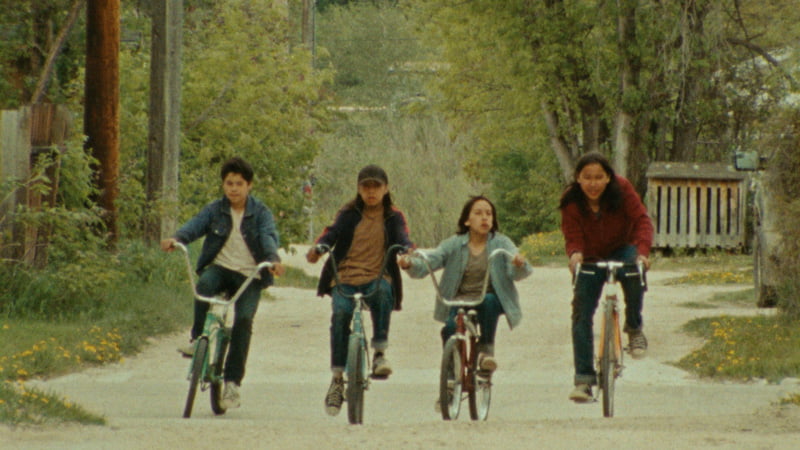
You also used some fascinating archival footage. How did you get access to such material? What challenges did you have when you were working on it?
As a documentary filmmaker in Canada, I’ve been aware of the incredible archive of indigenous communities dating back to the 1950s, many of which are from the 1960s and 1970s. When I read Wilfred’s memoir, I knew that there was material that could evoke the era that he came from. The vast majority of the archive I used was from the National Film Board of Canada, which is a co-producing partner. There is one exception; one of the montages of the film comes from material I found on YouTube, uploaded by someone who had traveled to the town with his family when he was young, made a home movie, and digitized the footage. We use that periodically throughout the film.
When I introduced the story and shared the creative materials with the NFB, they recommended footage based on the themes that I shared with them, and it was a treasure trove. They have incredible archivists. Regarding the challenges of this process, I guess the only challenge was maybe going through all of it to find what I wanted. But it was really beautiful material; not like news coverage (which is so often what you’ll get if you go back to the 1960s and 1970s), but a more vérité documentation of communities. The quality was very beautiful and poetic.
As a documentarist, you observed the reality of a character and started deciphering his life and the impact on the lives of others beyond what a camera can capture. You followed Wilfred to the lectures and presentations he gave at the university and the museum, where he’s explicitly perceived as a brilliant individual who can potentially inspire a new trajectory in the Western academic discourse. It seems that the poetry of the stars is pretty much welcome to infiltrate the sterile, rational academic environment. At least from your film, I start wondering if this is a one-sided relationship or if it’s a reciprocal, insightful connection.
That’s a very insightful and complex question. It brings up a really important and critical conversation that I hope the film sparks.
What you say is true, and it is one of the major things that shifted for me in the making of this film, regarding what I anticipated we would document of the conversation between Western science and indigenous knowledge. The pandemic changed a few things, of course. Wilfred had studied the Western ways, but as I observed, over many years he’s come to see where his path is. What he’s called to do is to actually bring forward the teachings he comes from and share them with his own people and others. He’s extremely interested in that. In the time I spent with him, I’ve seen (what one might call) a cross cultural or cross disciplinary conversation. But in all honesty, what we saw in following him was that maybe that conversation that I thought I would be documenting in more detail wasn’t quite there. The languages that Wilfred and indigenous people speak when they talk about ways of knowing are different than the Western academic world—which is the world we live in. So this film is partially an invitation to dig a bit more into what it means to have a conversation about science, ways of knowing, or knowledge systems that are a little more equal.
I think some more work is needed in this respect, because the danger is, as you say, that it might become romanticized or sort of cliche. The cultural differences between Western academia and indigenous knowledge are too wide, even if we all speak English. We need to get to the depths of what is there; and in many ways, it is about the very frameworks, values, and languages that we use. I would say that was one of the interesting journeys I went on when I was making that film, and I hope that it can provide a jumping off point to have more conversations about what this true dialogue could look like.
I would like your opinion on this gap from a different perspective as well. Why did you choose for the international premiere of a film so interconnected with regional history to happen in the land of Europe? What do you hope this film can do from this land or in this land?
I think it was less about Europe and more about the openness to ways of documentary and storytelling and the expansive view that CPH: DOX takes towards its programming. Although I haven’t screened here before, what this festival embraces made me keen to premiere here.
Regarding the European perspective, I’m not deeply steeped in that. I have been to Europe before, but not extensively. Being in Canada, I am much more aware of the American influence. And since indigenous people are there, the conversation is more accessible than it would be in Europe. Nevertheless, if I have understood correctly, there is a growing sense of reckoning with a colonial past and the way that it is still present in Europe. It may be more advanced in North America, but different countries in Europe have this cultural conversation. At the end of the day, this film looks at the history of dominant cultures and the suppression of knowledge systems. This story is hundreds of years old and has been enacted all over the world. Histories of colonization are everywhere, and Europe is a big center of that. Beyond the story of Wilfred as a charismatic person and the value of the teachings that he carries, there’s a lot of depth and richness in this story. The film doesn’t explain everything. You are expected to engage with it. To view or listen to this indigenous knowledge, to lean into it, to meet with it halfway, and bring your own interpretation.
So, besides the wider implication of colonial cultural histories, this film has Wilfred and his teachings. For me, it was really interesting to think about how a story (which is so specific to Canada and perhaps not unique to North America) speaks to power dynamics and shows the various ways that people wield power over others. I hope that there’s a larger kind of reflection that people can have about what it means, even if they don’t feel connected to northern Manitoba, Canada.
Documentary | Canada, 2024 | Director: Lisa Jackson | Editor: David Schmidt; Co-Editors: Eui Yong Zong, Matt Lyon | Producers: Lisa Jackson, Alicia Smith & Lauren Grant
Discover more from
Subscribe to get the latest posts sent to your email.
About the Author