Helmut Newton: The Bad And The Beautiful

This intimate documentary of the late German fashion and celebrity photographer Helmut Newton is based on a selection of interviews taken before Newton’s accidental death outside The Chateau Mormont in 2004. In Gero Von Boehm’s fascinating documentary, a candid Newton looks back at his remarkable life and career, and his wife, June (formerly the Australian model ‘Alice Springs’) provides snippets of her life with Newton in between the recollections of Newton’s most famous models who posed naked for Newton’s erotic–photos for French Vogue. Raw, sensuous, dangerous and edgy, Newton was cavalier and single-minded in his response to fierce criticism. As a young Jewish boy born and raised in Nazi Germany, Newton was exposed at an early age to the bold, stirring imagery of Leni Riefenstahl’s propaganda films depicting the blonde, blue eyed Aryian model, and their perfectly honed, sculptured bodies. Actress Charlotte Rampling, fresh from her turn in the controversial Night Porter, recalls her sense of empowerment durign her photoshoot with Newton, as a naked model and as one clad in a fur coat, recalling the feeling of “huge power.” Newton claimed to not care about any of his models, or their private lives, and was more interested in penetrating one’s psyche, which is backed by the thoughts of singer Marianne Faithfull whom she says, “captured my soul.” whilst she was living in a squat in Chelsea. 10 million women protested against the startling imagery of the Jamaican model and singer Grace Jones, as a naked black woman clad in anklet chains, but Jones doesn’t feel herself as the victim of racism at Newton’s hands. Recognising that he was “a little bit of a pervert” she realised that his work was “always in beautiful taste” using natural shards of light to cover her private parts on a cot with a knife.
“In beautiful taste” hardly seems an apt description of Newton’s black-and-white photographs of nude or semi-nude women, most of them tall, thin, and big-breasted, in a variety of disturbing positions: one model in a wheelchair and on crutches, another eating raw meat, another with an enormous (artificial) swan in her bed, and one whose torso and head are inside the body of a stuffed reptile. Editor Anna Wintour, who published many of Newton’s photos in Vogue, valued his work for its shock value, as a “stopper” that would cut against the “visions of loveliness” for which her magazine was known.
The documentary is equally hagiographic in its depiction of Newton, a self-described “naughty boy,” as charming: indiscreet, flippant, nonchalant, mischievous, Newton is equally moved by his recollections of his father’s dismissive 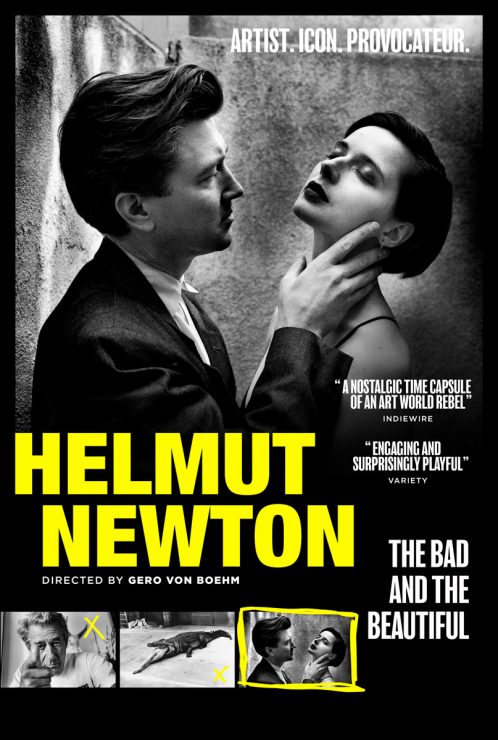 attitude towards his chosen career and his belief that Newton would end up in the ‘gutter’. He also waxes lyrical about his 2 year apprenticeship under the world’s first Fashion photographer Yva (who died in mysterious circumstances in a concentration camp in 1942). Towards the end of his life, there’s a sense that Helmut is relying on his camera to shield him from the harsh realities of life – never more so than when June displays her abdomen scars after an operation and later through his grainy self portraits taken after a spate of heart attacks. Although he long admired the female body, and the role play between the lowly maid and the aristocratic vixen, he proclaimed to have no personal interest in his models or their personal life. The comic elements of his work come to the fore, when a stylist delivers four chickens for Newton to dress them up in high heels, ensuring that the one with ‘the better legs’ gets the modelling assignment. There’s no sense of impropriety in the wake of the metoo movement or any sense of violation from the women. Model and actress Isabella Rossellini recalls how she felt ‘sexy’ as the french maid and leather clad model, but she acknowledges how the camera has portrayed her as a puppet and muse to David Lynch in Newton’s iconic imagery to coincide with her appearance in Blue Velvet. Rossellini argues that Newton’s controversial imagery is more a reflection of the male gaze and their conflicted emotions of being attracted and repelled by the strong woman who they perceive to be looking down on them in disgust. In other words, this portrait of him hardly seems entirely believable. Given his body of work and the power he held (he could make your reputation as a model, says Jones), it seems unlikely that none of his subjects felt used in this unequal power dynamic.
Newton is the guiding light in the documentary which is without any narrative and he is portrayed as meticulous and precise in his attention to detail. He dismisses the idea of good taste, and revels in the story of the fashion house Bulgari, who were appalled at Newton’s shot of a woman preparing chicken with her diamond encrusted hands.
Through these interviews (there is no voice-over, no authoritative narrator), Newton is also presented as an obsessive, creative genius. Obsessive, surely. He was meticulous in positioning his subjects; good photos, he notes, require “hard work” and “pain.” He was obsessive, too, in shaping a body of work that is instantly identifiable as Helmut Newton. Yet there’s a sameness to his staged photographs that suggests his creativity took place within a frame, a frame that emerged from deep in his consciousness (or unconsciousness) and functioned as much to confine and limit him as it did to “open [him] to the world,” as Wintour puts it.
We first saw Newton’s work in Bologna, Italy in 1989. We brought home the exhibit’s poster, had it framed, and today it hangs in our Buffalo apartment. The poster features Newton, a large video camera to his eye, hovering over the body of a blond woman, naked except for high heels, her pelvis thrust towards him. For Dianne, the photograph (which is, of course, not by Newton but was certainly staged by him) is about power and aggression, and it is threateningly (rather than consensually) sexual. The 24-year-old girlfriend of our son, who saw the same show, returned from it upset and angry, recounting several photographs that featured a woman with a gun in her mouth, and another with the same woman with an ecstatic smile as a man appears to tighten a chain around her neck.
You won’t see any of these photographs in German documentarian Gero von Boehm’s 93-minute film, nor, except for some comments by feminist photographer and essayist Susan Sontag—who disliked Newton’s photographs for their misogyny, objectification, and humiliation of women—will you hear much criticism of the man or his work, as controversial as it has been over the years. Newton died in 2004.
The film’s subtitle apparently refers to the “beautiful” bodies Newton photographed and to the “bad” boy who did the work. Unfortunately, there’s little “bad” in von Boehm’s documentary; one can speculate that had something to do with the participation of the Helmut Newton Foundation. This potentially fascinating subject comes across, reputation intact, as a one-dimensional good guy. Not, perhaps, what Helmut Newton would have wanted—or deserves.
Documentary, Art | USA, 2019 | Digital HD, Curzon Home Cinema |BlueFinch Film Releasing | Dir: Gero von Boehm | Helmut Newton, June Newton, Charlotte Rampling, Maryann Faithfull, Grace Jones, Anna Wintour, Claudia Schiffer, Isabella Rossellini
Discover more from
Subscribe to get the latest posts sent to your email.
About the Author


