Heavens Above! Review (StudioCanal Vintage Classics)

“Do you like donkeys, mister?” “I try. God knows I try”
The next instalment of StudioCanal’s celebration of Peter Sellers, in honour of his 100th birthday, comes in the form of the Boulting Brothers’ underappreciated Heavens Above! The brothers’ second collaboration with Sellers, after I’m All Right Jack it’s a flawed but intriguing satire of religion, capitalism, and British parochialism. More earnest than the positively playful Two Way Stretch, it still has a lot going for it, not least Sellers, who gives one of his most nuanced and affecting performances as the well-meaning priest whose presence disrupts an entire community.
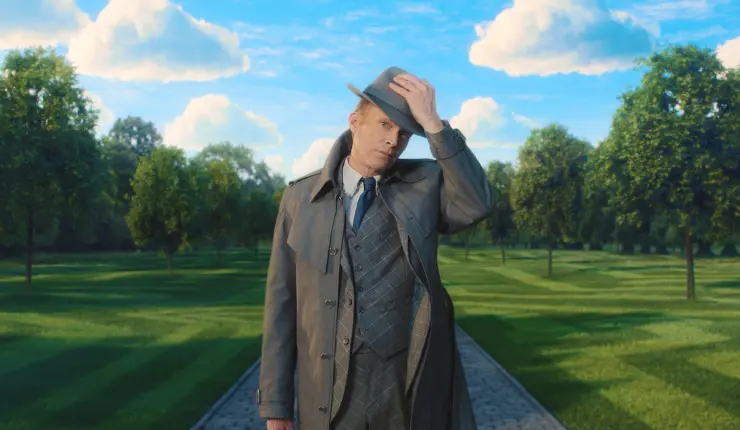
The film is set in the fictional location of Orbiston Parva, a fictional town whose chief industry is Tranquilax, a dubious miracle drug blending a sleeping pill with a laxative (“Life not worth living? Why suffer?”). When the corrupt archdeacon (Cecil Parker) attempts to install his compliant protégé as the new parish priest, a bureaucratic mix-up leads to the appointment of a very different kind of priest. This Reverend Smallwood (Sellers) is a man of unwavering conviction, determined to live by the values he preaches. He immediately recognises the spiritual apathy of his congregation, and enforces changes that set him at odds with the rest of the town – opening the church to the poor, confronting the town’s bigwigs, and condemning the avarice of local businesses.
While Two Way Stretch felt like a return to the lighter Ealing comedies like The Lavender Hill Mob, Heavens Above! feels like a spiritual successor to Alexander Mackendrick’s masterful The Man in the White Suit. Like Alec Guinness’s disruptive inventor in that film, Smallwood is a one-man moral revolution. But whereas Mackendrick’s film skewered industrial capitalism, Heavens Above! aims a wider array of institutions -church, commerce, class – and finds rot in all of them. This results in a film that is compelling, but quite scattershot in its approach. It’s a sometimes frustrating watch, as characters become increasingly unlikable, and the ending falls short of the acerbic, sometimes profound promise of the first half.
Crucial to the film’s success is Sellers’ remarkable performance. A big step up from Two Way Stretch, he delivers one of his most sincere and grounded turns. It would be easy for us to write Smallwood off as a doormat, as a naive, easy mark, and it’s clear that pretty much every other character thinks he’s an idiot. Crucially, though, the Boulting brothers and Sellers clearly don’t. It’s a subtle distinction, but the film manages it beautifully. In a pivotal scene, the town’s pharmaceutical CEO (Mark Eden) confronts Smallwood with some home truths, revealing that the conniving Smith family are laughing at him behind his back. It’s a potentially devastating speech, but what’s revelatory about the scene is Smallwood’s reaction. He is all-too aware of the Smiths’ true nature, but refuses to abandon his faith in their potential for good.
The Smiths themselves are the most fun supporting characters, even if they are resolutely on the grift. Irene Handl, Miriam Karlin, Roy Kinnear, and an impossibly young Steve Marriott (future frontman of The Small Faces) bring character to roles that could easily have been simple caricatures, but it’s Eric Sykes who stands out as the malingering patriarch. Sykes’ performance is wonderful, as just a flicker of something resembling a conscience permeates through his chancer exterior. The note that he leaves for Smallwood suggests that he’s not all bad. Yes, they’ve stolen the lead from the church roof, but they’ve left Smallwood with the belief, at least, that he has made a difference to them, and Sellers plays that beat perfectly. There is fun to be found in other supporting characters, such as Ian Carmichael as the “right” Smallwood, and Miles Malleson as the weary church psychologist (“the church has always had its quota of the psychologically abnormal, of cours,e in the past you chaps have made them saints!”)
The rest of the characters aren’t quite so nuanced. The film is crammed with excellent character actors – Joan Hickson, Bernard Miles and William Hartnell (on the brink of fame with Doctor Who) and yet, in contrast to the warmth found in the Ealing films, these figures are resolutely unsympathetic. Almost every character in Orbiston Parva, from the curtain-twitching busybodies to the scheming businessmen, is portrayed as venal, small-minded and even downright racist (using language that remains shocking today, largely directed at the kindly church warden played by Brock Peters). Institutions are no better: both the Church and big business are shown to be corrupt, self-serving, and exploitative. Screenwriter Frank Harvey’s script offers no soft edges, while The Ladykillers and Whisky Galore! allow for glimmers of compassion, Heavens Above! is utterly merciless.
The Boultings do offer some nice little details, though – the clash between the officiousness of the church and Smallwood’s own approach to his faith is subtly conveyed through the hymns sung by each faction. Smallwood repeatedly sings Praise, My Soul, the King of Heaven, a hymn rooted in spiritual devotion. Meanwhile, the starchy villagers drone out All Things Bright and Beautiful, a song essentially about not upsetting the status quo. The line – “God made them high and lowly and each to their estate” – quietly reinforces a rigid, class-based order. It’s a low-key but potent way of highlighting the ideological divide, and it speaks to the attention to detail in the script.
There’s an ambition to Heavens Above! that you can’t help but admire, and while the ending isn’t wholly successful (there’s more than a hint of “we need to wrap this up quickly!”), the satire still cuts through today. The film itself is uneven, and the tone incredibly mean-spirited, but as the last British comedy Sellers made before his international breakout in Dr. Strangelove and The Pink Panther, it stands as an important artefact in British comedy cinema, with a genuinely moving central performance from the star.
Special Features
As with Two Way Stretch, the extras are interesting while not particularly extensive. Three newly filmed featurettes on the film and Peter Sellers, with contributions from Tom Whitley, Eva Griffith and Benedict Morrison, and a commentary from comedy historians Gemma Ross and Robert Ross, whose love of British comedy is plain from the start, although they might put off anyone who isn’t quite as interested in the Carry On films as much as they are!
On Blu-Ray on 4th August / Peter Sellers, Eric Sykes, Cecil Parker, Isabel Jeans / Dir. John & Roy Boulting / StudioCanal / U
In Character: The Films of Peter Sellers runs from 2-30 August at the BFI Southbank.
A Box Set of Peter Sellers’ films will be available in November.
Discover more from
Subscribe to get the latest posts sent to your email.
About the Author