Film Review – The Nightingale (2019)
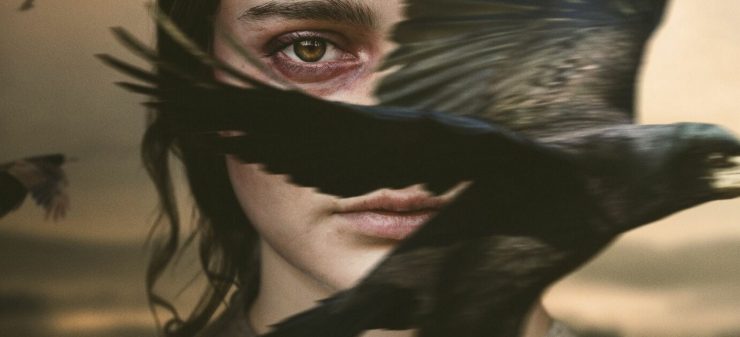
The Nightingale is an artistically polished piece of Gothic fiction. But for all its avant-garde beauty, The Nightingale was arguably the most brutal film to come from last year. Starring Aisling Franciosi, Sam Claflin and Baykali Ganambarr, the revenge thriller won multiple awards (a popular choice among critics) including the Special Jury Prize at Cannes Film Festival in 2018. Director Jennifer Kent made her breakthrough stamp on indie cinema back in 2014, with her Australian psychological horror The Babadook. Now available on Netflix, Kent has dared us with yet another darkly twisted tale– this time set in 1825.
With breath-taking visuals framed in a square ratio, The Nightingale takes place among the sweeping natural landscapes of Tasmania, not yet tainted by modern industrialism. A beautiful woman sings a beautiful song with a beautiful voice—but the story is anything but. Despite what romantic Hollywood would have you believe life was like back then, the 19th century was a violent and prejudice time—especially for minority groups. Lives were thrown away like dust in the wind, littering the film with corpses without any warning.
Where modern audiences would usually be desensitized to such things – Tarantino being one of the bloodiest and most popular film-maker to date – The Nightingale is filmed in such a way that you feel you really have stepped back in time. Back into that room, witnessing these horrifying acts. Kent gives us a hard and sudden reality check, slapping us in the face with graphic brutality (yet never glamourising it). It’s safe to say I’m not the only one who’s jaw dropped—and multiple times.
Aisling Franciosi delivers an emotionally raw, astounding performance as Clare: a young Irish convict shackled to the service of British officer Hawkins (Sam Claflin). Stuck in the harsh Tasmanian wilderness, Clare must risk her life for thirsty revenge, plagued by the trauma Hawkins and his officers have inflicted. Claflin gives a similarly flawless, gritty performance as the villainous white man—riling up even the most passive of viewers. The entire cast takes up their difficult roles admirably, staring pain straight in the face to expose the truth of England’s prejudicial past.
Not only must many of the scenes been difficult for the cast to act out, it’s hard for us to watch too. Kent lingers on even the most despicable of acts, holding steady long headshots, face-on. This said, Kent also knows when to cut away and when to leave the viewers to their imagination; this is done right at the last moment, when we’ve seen the worst things a human can do, and left to simmer with it whilst the screen cuts to black. Music is used sparingly, evoking a strong sense of realism within its gorgeously decorative cinematography.
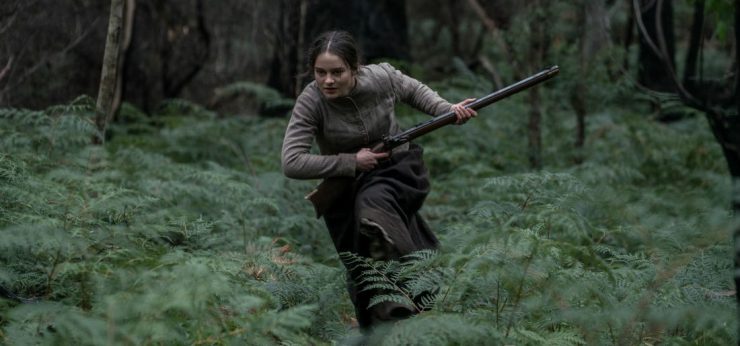
What’s often used instead of a music in The Nightingale is the diegetic screams of victimized characters. The nagging screech of a baby; the pleads of their mother; the cry of dying soldier. These plague Hawkins surroundings constantly, never letting him enjoy his criminal victories in peace (perhaps as a symbol of guilt—or karma). When we do hear music, it’s mainly in the form of old folk songs, performed by our two main protagonists during their mid-psychotic breakdowns. Clare and her guide, Billy, share a tragic past marked with clear parallels; they both hark back to their native cultures through song when pushed to breaking point; they are both innocent prisoners to society; they both hate the English.
The Nightingale cleverly needles threads of racism, patriarchy and colonialism throughout the narrative, adopting an objective perspective that exposes everyone’s flaws— even our heroes. What the story comes down to is human nature; none of us are morally perfect, yet there is a certain kind of ‘good vs evil’ that hangs in the balance, always in favour of the powerful but never providing them with a satisfied end. Hawkins will always hear the screams, and Clare will always return back to her native Irish land, even if only in her heart.
What really reverberates most from The Nightingale is its pulsating sense of agony—you can almost feel the emotional turmoil radiating off the screen. Clare and Billy— or anyone except the wealthy, white man—are subject to intense trauma that’s almost unbearable to watch, sending them into a kind of vengeful delirium. Yet, we cannot look away, with elements of the Gothic genre elevating the narrative as well as the aesthetics. In a Thomas Hardy-esque tale of tragedy (Clare as the fallen Tess; Hawkins the predatorial Alec) Kent has made a memorable piece of indie horror cinema.
The Nightingale is available to own on Blu-Ray, DVD, Digital Download and Netflix UK.
Discover more from
Subscribe to get the latest posts sent to your email.
About the Author