Feature:The Appeal of the Road Movie
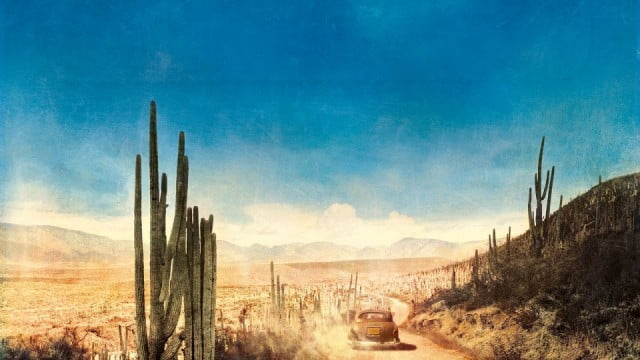
 Ah the open road. A place which for most is a nightmare, a tarmac track they share for hours shoulder to shoulder with countless others, back dropping their journey from A to B has been transformed, by cinema, into something of magical folklore, a place of opportunity, freedom and possibility.
Last month we were treated to the first trailer for the much anticipated adaptation of Jack Kerouac’s On The Road, starring Sam Riley as Sal Paradise, Garrett Hedland as the wild Dean Moriarty and her from Twilight Kristen Stewart in her pants. The seminal novel of the often referenced beat generation highlighted the freedom that a life on the open road can bring. Untied to anything as mundane as work or family, the possibility of being able to arrive in towns one night and leave when it became boring or you fancied a change of scenery resonated with great numbers across the globe and, importantly for film, in America. It’s arguably the success of this 1957 beat generation bible that propelled the road movie genre, acting as a template for a wild ride across the country. Dennis Hopper certainly took note, making Easy Rider in 1969 and introducing a hedonistic, care-free life on the road as well as Jack Nicholson to mainstream America. Arriving at the tail end of the hippy dream, Hopper uses music, narcotics and improvisation to evoke the free-wheeling adventure he, Nicholson and Peter Fonda have across the States on their Harley’s.
These early ‘blow-out’ tales carried with them elements of Americana, the long journeys across the country’s great planes that echoed with America’s history. From the early settlers and nomadic communities to the 19th century gold rush and depression era work travellers these grand journeys are already ingrained in the nations psyche, the format is recognisable and it is up to directors to utilise this familiarity and understanding of the conceit to project their takes on the pilgrimages, quests, spiritual journeys their characters undertake on the road.
David Lynch decided to use it to tell his straightest story to date, the aptly named Straight Story where Richard Farnsworth (playing Alvin Straight) journeys across the country on a John Deere lawnmower to pay a visit to his dying brother who he hasn’t seen in countless years. His pilgrimage is dotted with meetings with strangers who all come out a little wiser after time spent with ol’ Alvin Straight. The narrative can be cynically viewed as sentimental but the hope is that you are already too involved in the journey itself – the physical one just as much as the personal.
This bildungsroman genre, in which characters change, grow or improve over the course of the story fit perfectly with the road movie as the ‘life is a journey’ folk proverb is spelt out on screen. This rings true in a number of modern US indie takes on the genre. Broken Flowers saw a track-suited Bill Murray change, Little Miss Sunshine saw a whole family change and The Wristcutters saw Shannyn Sossamon and Patrick Fugit change so much they came back to life after being dead.
Others saw the road as a place of freedom for criminals seeking escape. Warren Beatty’s Bonnie and Clyde saw crowds flock to see him and Faye Dunaway’s gun spree across the country in the middle of the motor industry boom and established the on-the-run sub genre. 1971’s Vanishing Point added a cult element for music and car enthusiasts as a laconic antihero outruns police officers in a Dodge Challenger before 1991’s Thelma and Louise added a feminist turn on the tale while Oliver Stone lead Woody Harelson and Juliette Lewis on a psychedelic murder spree across America under the gaze of the nations media.
Road movies are not consigned to America however, the European new wave were making road adventures too with Godard’s Pierrot Le Fou arriving in 1965 telling the tale of runaway lovers and becoming the continents Bonnie and Clyde. More recently, South America has produced a number of road movies showcasing their stunning scenery. 2001’s Y tu Mama Tambien shared the biloungsroman blueprint in a coming of age story touching on Mexico’s political state and featuring a near-perfect road movie quest; to find a mythical beach called Heavens Mouth. Familia Rodante can be seen as an Argentine fore-runner for Little Miss Sunshine as tension and comedy collide in a family’s long van journey. Bombon El Perro’s man and dog tale achieved mild crossover success and, alongside fellow Argentine release Historias Minimas showed the Patagonian country in a beautiful light.
Brazilian filmmaker Walter Salles focussed on the road to bring a biopic of Che Guevera to life in The Motorcycle Diaries. Adapted from Guevara’s memoirs of the same name, it stars Gael Garcia Bernal as the then doctor travelling across Argentina and South America as the title suggests by motorcycle, shaping the young revolutionary’s outlook. Widely lauded at the time of release, much was credited to the director and use of cinematography. Shooting gorgeous empty scenery and changing landscapes, Salles wonderfully framed each scene with picture perfection.
This clearly impressed studios as Salles was quickly signed up to direct On The Road, his work on The Motorcycle Diaries acting as an audition for the role of bringing Kerouac’s novel to the screen. The neat camera work, no doubt, would have appealed to Hollywood knowing how much of the road’s charm, mystique and attraction is down to its shooting. The lure of the road movie is often the road itself, a visual metaphor for the lack of restrictions and openness a life in transit can bring. Its vast landscapes and stretching highways are perfect for letting us and the characters know there could be anything out there for those willing to take it on.
This is the challenge for Salles, to capture the sense of adventure, lack of restraint and excitement apparent in the novel while adding visuals to a story most people have already imagined in their minds. Until the film gets its UK release we’ll just have to hope it’s more Motorcycle Diaries than Crossroads.
Discover more from
Subscribe to get the latest posts sent to your email.
About the Author