Escape From 21st Century Review

Time travel, as a concept, is often inherently illogical. Different films approach it with their own sets of rules and restrictions. Back to the Future operates on the premise that changes made in the past alter the future, while Primer delves into intricate multiple timelines—so complex that dedicated graphs and video essays exist to explain its mechanics. I mention this because, at its core, Escape from the 21st Century is both a time travel story and a martial arts extravaganza.
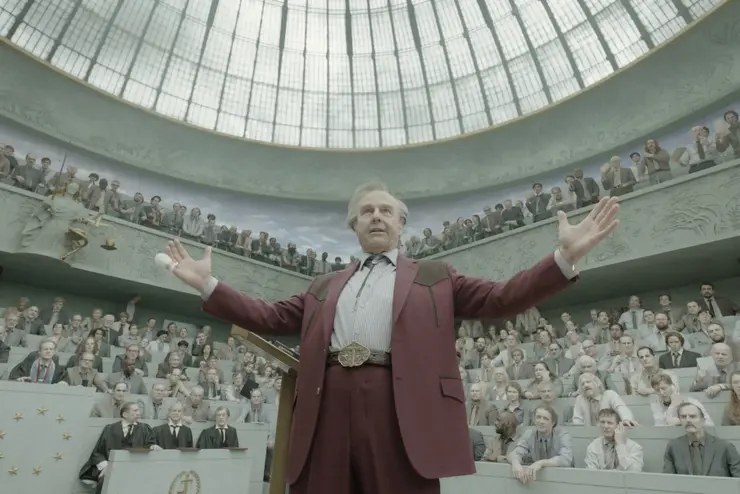
The film follows three protagonists: Cheng Yong Wang (Yang Song), Zha Wang (Ruoyun Zhang), and Pao Pao (Chenhao Li), who all live on a distant planet similar to Earth. It’s the year 1999 when, after an accident, they discover that sneezing propels them twenty years into the future. In this new timeline, Cheng Yong Wang has become entangled in a criminal network, Zha Wang is a reporter, and Pao Pao is dating Cheng Yong Wang’s dream girl. Realizing how bleak their future has become, they set out with one goal: to change it for the better.
Escape from the 21st Century feels like a modern Stephen Chow film from the very start. The opening scene is pure adrenaline, featuring a character being pulled out of the path of a speeding steam train while Cheng Yong Wang and Zha Wang battle local bullies between the gaps of the train cars. The film hits the ground running and never slows down. Not since Kung Fu Hustle has a movie so fully embraced its zany side—and done so unapologetically.
This playful, unrestrained tone permeates the entire film, from its incredible needle drops—including Here’s to You, which instantly transported me back to the release of Metal Gear Solid V, to a hilariously unexpected use of Scotland the Brave. The music drives the film forward, enhancing each scene with expert precision. Even the film’s core plot embraces this irreverence, as its approach to time travel is completely nonsensical. But it doesn’t need to make sense—here, time travel is simply a vehicle for a richer, more meaningful narrative.
At its heart, Escape from the 21st Century is a surprisingly anti-nostalgia film. Its use of color reinforces this theme, with 1999 depicted through a warm, rose-tinted lens. The film suggests that, even if the ’90s—or any past era—felt better, we can’t spend our lives yearning for what once was. We change, we grow, and the people we are now won’t be the same 20 years from today.
What surprised me most about Escape from the 21st Century was the strength of its filmmaking. Stylistically, the film is both imaginative and inventive, utilizing shifting aspect ratios and color palettes to signify different time periods. Scenes set in 1999 use a 4:3 aspect ratio with a vibrant color scheme, while those in 2019 are presented in widescreen with darker, more muted tones. These visual cues create a clear distinction between timelines, ensuring that even when the film jumps between them rapidly, the audience is never lost.
That said, Escape from the 21st Century isn’t flawless. The story stumbles slightly around the midway point, briefly losing focus before regaining momentum and charging toward a strong conclusion. Still, this high-energy, time-bending martial arts film is an absolute blast. It’s ridiculous, but so irresistibly charming that I couldn’t help but love it.
★★★★
Out on Blu-ray, DVD in UK and Ireland 24th March 2025 (UK)| China, 2021 | Signature Entertainment | Yang Song, Ruoyun Zhang, Chenhao Li | Dir. Yang Li | 15
This was originally post for our 2024 Toronto Film Festival coverage | original review link
SUPPORT US!!! WE ARE A SMALL, INDEPENDENT FILM WEBSITE WITH NO BIG BACKERS SO IF YOU LOVE OUR SITE AND OUR WRITERS, PLEASE CONSIDER HELPING US TO KEEP FILM JOURNALISM ALIVE!
Discover more from
Subscribe to get the latest posts sent to your email.
About the Author