Emmanuelle Review

Audrey Diwan’s Emmanuelle is a visually striking exploration of isolation, desire, and identity within the gilded cage of luxury.
Emmanuelle tells the story of a woman navigating her desires and identity in a world that feels distinctly foreign to her. A quality controller for a prestigious luxury hotel chain, she travels to Hong Kong on a professional mission to evaluate a local hotel that has recently suffered a decline in customer ratings. Amid the backdrop of her work, she embarks on a personal journey, seeking pleasure and fulfillment in a city that is both alluring and unfamiliar. Her pursuit leads to an intriguing and enigmatic connection with a mysterious guest, blurring the lines between professional obligation and personal longing.
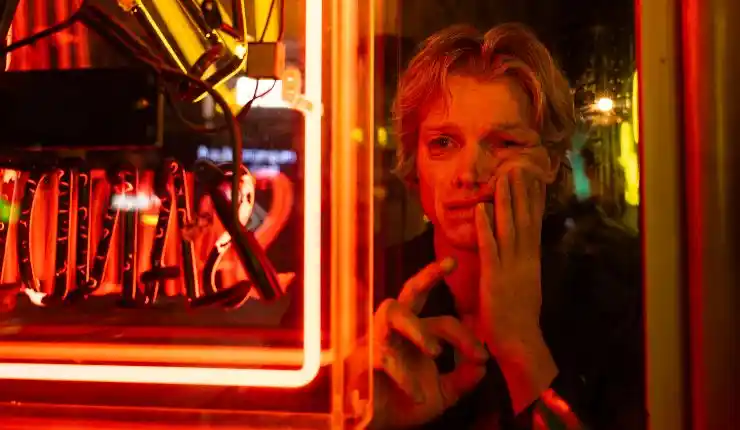
Audrey Diwan’s film immerses its audience in a world of longing, alienation, and identity, though it takes time to fully invite viewers into its narrative. The deliberate pacing reflects the protagonist’s own sense of disconnection, drawing the audience into an experience of isolation that resonates throughout much of the film. Portrayed by a fantastic Noémie Merlant, Emmanuelle is constantly surrounded by guests and staff, and she moves through a world of opulence and endless encounters. Many of them are sexual, yet she remains profoundly alone and Merlant’s performance captures this duality perfectly: her calm and confident personality hides an inner turmoil and sense of being adrift. Even in her most intimate moments, she is detached, her loneliness palpable.
Diwan’s direction intensifies this isolation through masterful use of the camera angles. Her lead is frequently framed apart from the crowds, creating visual and emotional separation that amplifies her solitude. The effect is hauntingly immersive: we are Emmanuelle, and her loneliness becomes ours. This frustration, as we watch her navigate a cycle of empty connections, underscores her imprisonment within a life that feels disconnected from her true self. The film explores her relentless search for meaning, pleasure, and identity. Her life is confined to the upper echelons of the hotel — a gilded cage where luxury offers little solace. But when she meets Kei Shinohara – played with enigmatic intensity by Will Sharpe – her path shifts. Kei represents an escape, drawing her into a darker, riskier journey that leads from the pristine heights of her “golden prison” to the gritty, chaotic world of the hotel’s hidden underbelly and beyond, into Hong Kong’s bustling streets.
Diwan’s attention to detail anchors the film’s thematic depth. Emmanuelle’s body and its vulnerabilities are mirrored in the hotel’s structure: the elegant public spaces represent her polished façade, while the concealed lower floors, buzzing with unseen labour, reflect her suppressed self. This duality extends to the film’s settings, contrasting the lavish hotel with the vibrant, messy reality of Hong Kong’s markets and back alleys. Naomi Watts, as the hotel’s manager, underscores this contrast by obsessively maintaining the illusion of perfection while suppressing the grittier truths of the establishment. Adapting a story as iconic and controversial as Just Jaeckin’s original for a contemporary audience was undoubtedly a bold move, but Diwan rises to the challenge. She preserves the sensuality and introspection of the original while layering it with a modern critique of privilege, isolation, and the search for authenticity. The result is a visually stunning and emotionally resonant film that captures the tension between desire and detachment, luxury and emptiness.
Emmanuelle is a profound exploration of a woman’s struggle to reconcile her external world with her inner self, proving once again that Diwan is a master of blending intimacy and societal commentary with cinematic precision.
★★★1/2
In UK cinemas from 17th January 2025 / Noémie Merlant, Will Sharpe, Naomi Watts, Chacha Huang, Jamie Campbell Bower / Dir: Audrey Diwan / Pathé / 18
Discover more from
Subscribe to get the latest posts sent to your email.
About the Author