The Violinist Review (2026 Toronto Film Festival)
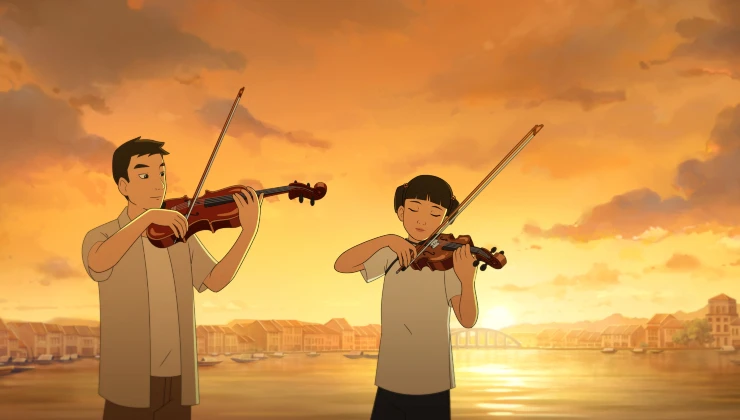
“Animation is not a genre; it’s a technique,” proclaimed one of the directors ahead of the North American premiere of The Violinist. Coming off its successful run at the Annecy Film Festival, where it won the festival’s most prestigious prize, the Crystal Award, my expectations were high. As someone who is slowly shifting towards dedicating their career to animation as a whole. I wanted to understand what had taken the world’s biggest animation festival by storm. To say I was disappointed would be an understatement.
We open on a journalist who, while attending a classical music performance, notices that virtuoso and music legend Fei (Kheng Hua Tan) is in attendance. Hoping to speak with her, he follows her home and finally manages to approach her after showing an old photo of Fei with a young boy named Kai, who is holding the violin she performed with throughout her entire career. Moved by the photograph, Fei begins to open up about her past and the history of the violin.
Narratively, the film strives to be a wartime epic, yet it ultimately becomes a run‑of‑the‑mill Japanese‑occupation story. I never imagined it would be presumptuous to assume that a film called The Violinist would be about the titular subject. The film does feel like a genuine attempt to explore the impact of Japanese occupation in Singapore, especially given that many films approach the topic from Chinese, Hong Kong, or Korean perspectives. Still, I was never invested enough in the drama to fully care, particularly because of the framing device.
Told through flashbacks, with Fei narrating the story, we witness moments and events from outside her perspective—mainly Kai’s. This typically wouldn’t be an issue, given that he is the main male lead. Much of her story revolves around longing for Kai and searching for him; it often feels as though her entire narrative is defined by him. So when we shift to watching Kai work as a spy for the Allied forces against Japan, I felt nothing, especially when the more compelling story is with Fei. As she looks after two orphan children, but at a certain point that is dropped to focus on reuniting with Kai.
It feels regressive, in a way. Her entire driving force is to find this man who, as the film itself shows, is portrayed as more talented than she ever was, adding insult to injury. The animation may also prove polarising. The directors say it’s blending Disney, warner bros. animation with Japanese anime, but it is oddly reminiscent of the rushed episodes of Psycho‑Pass season 2. Using a mix of 2D animation and 3D computer animation. The film has moments where scenes feel weightless, with objects gliding across the screen. The biggest culprit is the vehicles.
However, the 2D work also feels strangely plane and, at times, lifeless. With characters appearing oddly flat on screen and lack detail. It’s not all bad; the voice cast do a commendable job of bringing the characters to life, despite the fact that they speak English throughout rather than the languages spoken in that region. The score is truly mesmerising, a triumphant highlight of the film that utilises a full orchestra to great effect.
While it might seem that I hate The Violinist, that isn’t the case. It’s a film that had the foundations to be incredible, but its lacklustre story and uneven animation never work in tandem to bring its ideas to life in a meaningful way. While animation may be more than a genre, this film is certainly not the case study that proves it’s a technique.
★★★
Had its North American Premiere at the 2026 Toronto Film Festival / Kheng Hua Tan, Ayden Sng, Kazuya Tanabe, Adrian Pang, Rong Fang / Dir: Ervin Han, Raúl García

Discover more from
Subscribe to get the latest posts sent to your email.
About the Author


You must be logged in to post a comment.