The Liberation Review (2026 BFI London Film Festival)
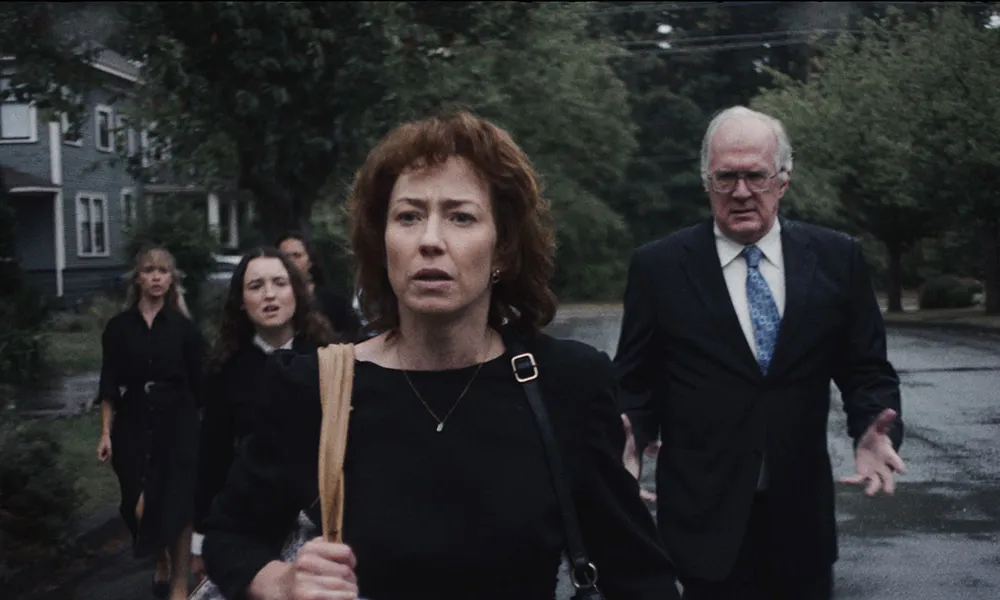
Guy Nattiv’s 1980s cult drama stars Carrie Coon as a Holocaust survivor who decides to leave her family after being seduced by an all-female commune and its fearsome leader. Based on the true story of his own grandmother, Rita Cooper, this is Nattiv’s most personal film yet; a story that has haunted him his entire life.
The film begins with Rita’s daughters, Ella (Bella Ramsey) and Jo (Odessa Young), who have come to visit their estranged mother in an isolated commune after she sent a birthday card revealing her location. Shocked by their arrival and unsure whether to unlock the gates, the women fetch their leader, Ricki King (an unnerving Lily James). Ricki welcomes the girls and takes them to their mother, a thin, worn-down version of the woman they knew. Ella is entirely unconvinced by the commune and works tirelessly to rescue Rita, whilst the free-spirited Jo is more susceptible to Ricki’s dangerous wiles.
This plotline is interspersed with flashbacks to Rita’s life before – living as a bank manager in New Jersey with her daughters and husband, Reuben (Coon’s real husband, Tracy Letts). Ricki comes to the bank to deposit a large sum of cash, and immediately identifies the sadness within Rita, a burden she carries from the traumatic childhood that stole her mother and two sisters. At home, Rita has a loving husband and two kind, intelligent daughters, yet she is unfulfilled, haunted by her past and desperate to find meaning.
Ricki offers her an escape – in the form of sunsets on the beach, nude swimming and “healing” sessions turned sleepovers with kindred women. The rest of the group are equally unsettling and totally enamoured with Ricki, who, aside from being a spiritual leader, is a self-professed healer, promoting natural remedies and a complete distrust in modern medicine. Playing on Rita’s emotional weakness, Ricki provides her with a new name, Naia, and thus an entirely new woman is born, and this is who Ella and Jo encounter when they arrive at the commune.
Read more of our LFF 2026 coverage →
Carrie Coon is magnificent as Rita, managing to command sympathy through even the most objectionable actions. Past Rita is full to the brim with unreleased tension, depressed, uncomfortable in her own body. At the commune, Rita is distant and strikingly mellow. It appears the tension within her has indeed been released, but with it her entire sense of self. We watch with horror as her facade of strength slowly cracks, before shattering for good. In the present, Rita no longer thinks for herself without Ricki’s approval – a shell of the woman she once was. Rita’s new life holds disturbing parallels with her childhood environment, in ways I’ll leave audiences to decipher for themselves.
In her best role to date, Lily James is perfectly seductive as the destructively narcissistic Ricki. James easily convinces us of Ricki’s charms; she is exciting, confident, magnetic. Her calculated kindness is all too transparent to us, yet Rita has fallen under its spell. Bella Ramsey brings so much energy to every scene, with an earnest desperation that makes them impossible not to root for. Odessa Young is great as the rather insouciant Jo, and Tracy Letts is endlessly endearing as Rita’s forsaken husband, although both are given far less to do.
Academy Award winner Guy Nattiv, best known for 2018’s Skin starring Jamie Bell, has crafted a robust, grounded cult drama, slower-burning than anticipated, but this works to the film’s credit. Co-written by Nattiv and Noa Berman-Herzberg, the film’s non-linear storytelling is more of an inoffensive choice than it is an enhancement. There are a few half-baked subplots, such as one involving a journalist, and the ending feels unfortunately rushed. With grainy visuals, the film uses some handheld footage to perhaps recreate the style of archival clips, a choice I felt was somewhat mismatched with the tone of these scenes. Past Rita wears tight suits, and her hair is 1980s stiff, yet in the commune she wears loose, floral dresses. Her transformation is clear, yet the faded colours of the dresses hint to us that all might not be what it seems. The commune itself is designed and shot to feel spacious and dreamlike, a cleaner version of the Manson ranch in Once Upon a Time in Hollywood. In contrast, Rita’s family home is claustrophobic, with narrow hallways and a camera that remains close.
The Liberation had scope for a more interesting take on the typical cult film, but unfortunately by its conclusion it falls prey to too many conventions. It seems the film itself was seduced by its cult leader, placing too much focus on the manipulation techniques, probably the most well-trodden aspect of the cult genre. The novelty of a female leader and the fascinating historical context are sadly underexplored, and we are never quite liberated from a fairly standard psychological drama. Carrie Coon’s performance is not to be ignored, however, delivering a superb, nuanced deconstruction of the meaning of liberation.
★★★
Played at the 2026 BFI London Film Festival. UK release date TBA / Carrie Coon, Lily James, Bella Ramsey, Odessa Young, Tracy Letts / Dir: Guy Nattiv / Bleecker Street

Discover more from
Subscribe to get the latest posts sent to your email.
About the Author



You must be logged in to post a comment.