Ghost in the Shell Review (Prime Video): A Faithful But Divisive Return
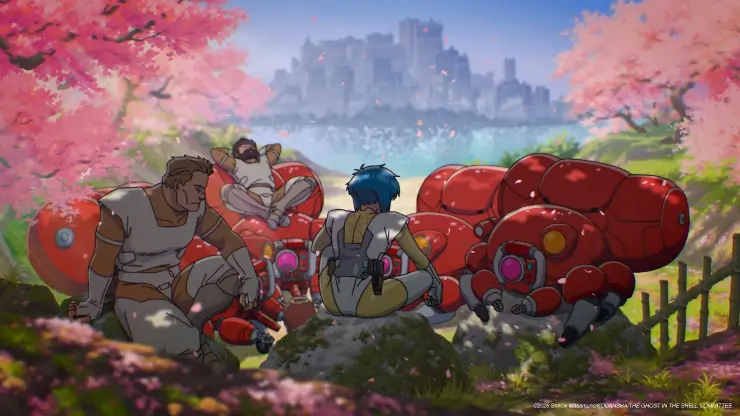
When people think of Ghost in the Shell, what typically springs to mind is the opening credits: the green numeric effect interspersed with the formation of Major Kusanagi, accompanied by very operatic and intense music. The tone and style are very serious, focusing more on thematic resonance than its manga counterpart. In 2026, however, we have a new adaptation of this legendary material. The Ghost in the Shell by Science Saru aims to be a more faithful adaptation, translating the style and feel of the manga. Based on the first two episodes, that faithfulness may alienate fans who fell in love with Mamoru Oshii’s more philosophical vision.
The first two episodes follow Major Motoko Kusanagi, who, after assassinating a foreign diplomat to stop the extradition of a hacker out of Japan, forms an elite task force that becomes Public Security Section 9. While taking on various missions, their latest threat is a hacker known as the Puppet Master, who has recently hacked the translator of a government minister.
Saying it sounds similar would be an obvious and somewhat dim‑witted observation. As it naturally covers the same material as the 1995 film, given that both are based on the same manga. However, as someone who hasn’t read the source material, what I can conclude from research is that the original manga featured the overarching narrative of the Puppet Master, which would come in and out while Section 9 tackled other missions. This is reflected in episode one, where they investigate a facility that is abusing and brainwashing children.
It makes sense to include this, as many of the creators wanted this anime to be a more faithful adaptation. Putting the tone aside for now, the show looks breathtaking. Returning to the original manga aesthetic, with more expressive and stylised characters compared to the more true-to-life approach of previous adaptations, is striking. From the many outfits we see our cast featured in, the police record style, as a way of framing the footage we are seeing as evidence, is aesthetically unique.
The series also uses a more jazz‑infused soundtrack that, during the iconic assassination scene, is simply extraordinary. Throughout the first two episodes, the music complements the visuals with real flair and vision. Another standout moment, when a bullet travels through multiple walls to reach its target, is genuinely enthralling. The English dub is exceptional as well, with SungWon Cho delivering a remarkable performance as Daisuke Aramaki. He truly blew me away. Suzie Yeung is also excellent as Major Motoko Kusanagi, bringing this new interpretation of the character vividly to life.
Visually and audibly, the film sinks its claws into you within moments. However, let’s take the pin out of the tone: the manga is far more comedic, with the Major portrayed as more playful and outgoing than in any of her previous adaptations. While this approach is certainly more faithful, I personally didn’t find it better. Instead, it felt strangely bizarre—almost like I wasn’t watching Ghost in the Shell at all. It made me wonder whether the version of this IP so many people fell in love with was visionary auteur Oshii’s interpretation. It also made me question whether later adaptations were trying to recapture his vision rather than the tone and style of the source material.
Being more faithful also means an increase in sexual content. To be clear, I’m not against sexual content in anime or media; as a Monogatari fan, that would be blasphemous to say. However, I don’t think I need a comedic scene in which Batou (Bill Butts) tries to communicate with the Major while she is engaged in a sexual encounter with two women, during which Batou experiences the same emotions as she does. While it’s not as explicit as the manga counterpart, it still feels like pure fan service. This is part of a broader trend in how the series presents the Major as an object of desire for the camera. There is nothing wrong with her being attractive and sexually active, but when it feels like these moments exist primarily to please a male audience, then we have a problem.
The Ghost in the Shell, across its first two episodes, lays the foundation for what could become stellar television, but it also left me cold. It made me wonder whether the version of the franchise I fell in love with was really the adaptation shaped by an auteur’s vision rather than the mangaka’s. As the series progresses, we’ll see where it ultimately lands, but I still can’t wait to see more.
★★★★
🎬 Watch, Stream & Buy
Want to watch The Ghost in the Shell? Here’s where you can stream the series…
📺 Stream Now
💿 Own It
🛒 Buy more Ghost in the Shell products on Zavvi
🛒Buy more Ghost in the Shell products on Amazon
Streaming on Prime Video from July 7th / Suzie Yeung, SungWon Cho, Bill Butts, Nick Apostolides, John Bentley / Dir: Mokochan / Prime Video / 15
Discover more from
Subscribe to get the latest posts sent to your email.
About the Author