Salem’s Lot Review (Arrow Films)
In his introduction to the paperback release of Salem’s Lot, Stephen King described his lofty ambitions for what was only his second novel: to combine the gothic terror of Dracula with the sensationalism of EC Comics and the naturalistic fiction of Frank Norris. The result is one of his most overt works of horror – a traditional vampire story transposed into small-town New England – and it remains one of his most genuinely frightening books.
The 1979 miniseries adaptation, directed by Tobe Hooper and written by Paul Monash (of Peyton Place fame, itself a key influence on the novel), is that rare thing: an adaptation that honours the source material while existing as its own thing entirely. This comprehensive UHD release from Arrow presents the original two-part broadcast version, a truncated theatrical cut, and a seamless three-hour edit of the miniseries, which offers the most satisfying viewing experience.
Coming hot off the heels of The Texas Chainsaw Massacre, Hooper was a canny choice to direct. Famously, some of the nastiest moments in his breakthrough film rely more on suggestion than anything explicit, which worked perfectly within the constraints of network television. It’s something that Hooper apparently embraced, and the result is a version of the story that feels both classical in construction and quietly subversive in execution.
The story itself is fairly simple – writer Ben Mears (David Soul) returns to his hometown of Jerusalem’s Lot, looking for inspiration in the terrifying Marsten House, a house with its own evil history, which he has been inexorably drawn to ever since his childhood. Mears’ arrival coincides with that of another newcomer, antiques dealer Mr Straker (James Mason) who has just moved into the Marsten House. What follows is an interweaving of domestic drama – the estate agent having an affair, Mears’ budding romance with young Susan Norton (Bonnie Bedelia), and traditional horror tropes, as Straker prepares for the arrival of his partner, the enigmatic Mr Barlow.
Though the image most associated with the film remains that of the floating Ralphie Glick scratching at his brother’s bedroom window, Hooper’s approach owes as much to Alfred Hitchcock as to traditional horror. Early in production, Hooper and producer Richard Kobritz agreed on an “Alfred Hitchcock language,” and its influence is palpable throughout, recalling Psycho in particular. The malignant shadow cast by the Marsten house over the rest of the town feels distinctly like that of the Bates Motel; Dr Norton’s (Ed Flanders) fateful investigation upstairs the Marston house has more than a touch of Martin Balsam’s death scene, and the constable’s casual interrogation of Straker feels like a homage to a similar scene between the private eye and Norman Bates. Even Harry Sukman’s score emulates Bernard Herrmann without feeling derivative.
For all its strengths, the production bears the marks of its television origins. Some bits of dialogue are fairly archaic, certain effects have inevitably dated, and elements of the film’s gender politics feel rooted in an earlier era. Yet Hooper repeatedly finds inventive ways to enhance the production, through the framing, the performances (he worked with the actors at length) and his own ingenuity. The decision to film the vampires in reverse and play the footage forward lends them a disquieting, unnatural quality that remains genuinely uncanny.
Crucially, Hooper understood what to preserve and what to reshape. In one of the special features in this release, Douglas Winter notes, “in terms of film adaptations, the importance is in honouring the novel – that doesn’t mean replicating it.” This is precisely Hooper’s approach. Key moments, such as Mike Ryerson (Geoffrey Lewis) becoming entranced by something unnatural at the Glick boy’s grave, are recreated faithfully, capturing the seductive power of the vampires, while other moments are created specifically for the film and yet still feel entirely in keeping with the novel. Other scenes that are cut short arguably benefit from their brevity. The battle of faith between Barlow and Father Callahan (James Gallery) is a much longer scene in the book, but here distilled into a single, devastating gesture as Barlow crushes his crucifix with ease.
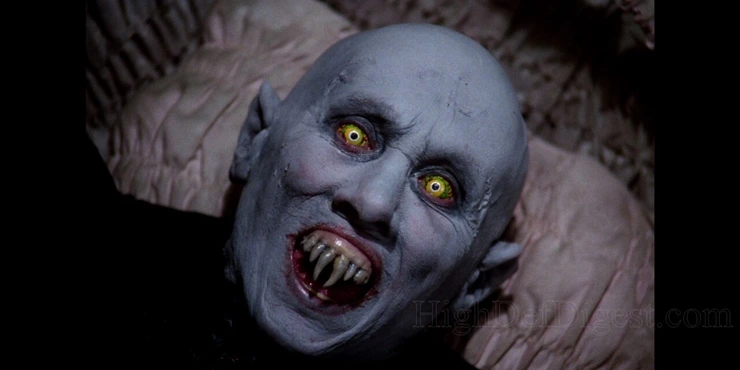
The most significant change from the novel is the reimagining of Barlow himself. In the novel, he is a Dracula-like figure, casting a spell on the town, one inhabitant at a time. Monash and Hooper, worried that audiences were growing bored of the urbane, charming vampire, went back to the Nosferatu mould. As played by Reggie Nalder, Barlow is a feral, terrifying creation. It’s a bold decision, but one that heightens the primal terror of the film, and tellingly, the consensus is that this was, if not an improvement on the novel, at least the best option for this adaptation.
As Mears, David Soul is much better than you might think, given his reputation as something of a lightweight actor. James Mason is brilliant as the sinister Mr Straker, combining his suave elegance with something much more sinister. His delivery of “You’ll enjoy Mr Barlow… and he’ll enjoy you.” is laced with malevolent glee. Kenneth MacMillan is similarly great as the town’s Columbo-esque constable, bringing a wry intelligence to what could have been a throwaway part. He’s much more canny than he lets on, and his disarming questioning technique is one of the more fun aspects of the film. He’s also the smartest character in the film, and the only one who knows when to cut his losses and get out of dodge!
The rest of the town is populated with excellent character actors, and the mix of up-and-coming actors (Geoffrey Lewis, Fred Willard, George Dzundza) and holdovers from the golden era of Hollywood (Lew Ayres, Elisha Cook Jr and Marie Windsor – reuniting for the first time since their dysfunctional married couple in The Killing) adds texture and depth to the story, while mirroring the film’s own fusion of old and new.
This contrast is ultimately what makes Salem’s Lot endure. It is, at heart, a classical horror story told through a distinctly modern lens: Gothic tradition filtered through New Hollywood sensibilities. It’s a unique blend of the modern and the old-fashioned, and perhaps because it feels nostalgic, it hasn’t dated all that badly.
For all the adaptations that have followed, Hooper’s Salem’s Lot still feels definitive (give or take Midnight Mass). It’s an intelligent, inventive, and deeply unsettling adaptation of one of King’s most haunting works. Most importantly, it remains genuinely frightening in a way most films can’t achieve, a primal fear that cuts right to your core. Ralphie Glick at the window has rightfully entered film lexicon as one of cinema’s defining horror scenes, but the film is packed with terrifying moments. Mike’s dawning realisation that he’s being watched from within the coffin, the creak of a rocking chair on the floorboards, and the rasping “Looook at meeee teacher,” drifting through the dark.
Special Features
Brand new audio commentary on both versions of the film, with Tobe Hooper on an archive commentary, and newly recorded commentaries from film critics Bill Ackerman, Amanda Reyes and Chris Alexander. King of the Vampires, a new interview with Stephen King biographer Douglas Winter; Second Coming, a new visual essay by writer Grady Hendrix; New England Nosferatu, a new interview with filmmaker Mick Garris; Fear Lives Here, a new featurette looking at the locations of Salem’s Lot today; We Can All Be Heroes, a new featurette with film critic Heather Wixson; A Gold Standard for Small Screen Screams, a new featurette with film critics Joe Lipsett and Trace Thurman.
★★★★★
On UHD Blu-ray from March 30th / David Soul, James Mason, Bonnie Bedelia, Lance Kerwin / Dir: Tobe Hooper / Arrow Entertainment, Paramount Pictures / 18
Discover more from
Subscribe to get the latest posts sent to your email.
About the Author