Past Future Continuous Review (IDFA 2025)
Maryam, an only child, belongs to the large wave of young Iranians who fled to America after the eruption of the 1979 Iranian Revolution. There, she has built a career and, most likely, a life. But she does not share an intimate connection with her parents. Nearly seven hours and seven thousand kilometres separate a family striving to remain intact despite the political unrest of their homeland.
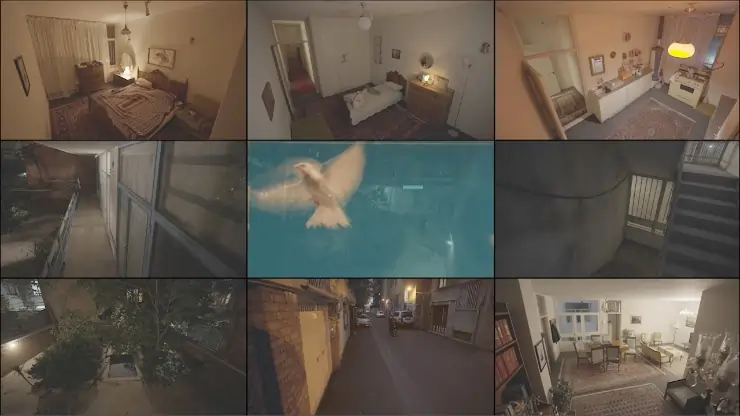
Maryam’s way of staying close to her parents is through surveillance cameras, which she has installed in every corner of their home, inside and out, with the consent of both Mother and Father. Day and night, she watches them through live transmissions on her phone. Images of the two going about their mundane days of retirement and loneliness fill the screen time of Past Future Continuous. The frequent split-screen reminds us of reality’s multiplicity. In this case, reality is clearly discernible in its entirety: Mother and Father, defenceless in the face of age and the looming war, are slowly fading away.
Directors Morteza Ahmadvand and Firouzeh Khosrovani have previously collaborated on the affecting and emotionally demanding Radiography of a Family (2020). Since then, they have established a strong foundation in portraying families within domestic spaces (the concept of Hestia comes irresistibly to mind) and exploring their endurance or disintegration under the weight of national conflict. The Revolution (as any) remains a crucial reference point, exposing with clarity the political ties to social life and the transformative effect such an event continues to have on a family’s history.
The script accompanying the images is sensitive and at times remarkably poignant. Through her narration, Maryam gives voice not only to her affection and agonizing concern for her parents’ health and well-being but also to a sharp emotional reflection on the implications of political upheaval. Alongside her voice, a fictional narrator (resembling her father in his younger years) articulates thoughts on immigration and parental hope. The two monologues alternate in a choreography that feels almost celebratory of Maryam’s act of observing her parents through the installed cameras. It is a choreography infused with poetics, a finely placed reflection on the still despair of home, and on the guilt of living life far away, in silence and peace.
Ahmadvand and Khosrovani have composed a visual memoir rooted in national identity, as shaped by the revolution, the ensuing eight-year war, and the passage of time since. Apart from the complementary stop-motion and animation segments (which at times stretch their meaning too thin) the visual collages of Past Future Continuous hold a distinct artistic and emotional power. They gently reveal how memories construct stories, in ways that feel both suggestive and greeting.
Intertwined with the story of Maryam’s home in Tehran, this documentary resonates with the thousands of neighbouring stories still burning to be heard—those of people who have “left longing for simple desires.”
Past Future Continuous was first screened at the 2025 Venice Film Festival and has its international premiere at the International Documentary Festival of Amsterdam (IDFA), as part of the Envision Competition.
★★★★
Past Future Continuous (Gli Uccelli del Monte Qaf), 80’/ Dir. & Writers: Morteza Ahmadv and, Firouzeh Khosrovani / Cinematography: Mohammad Hadidi/ Production: Firouzeh Khosrovani namens FiFi Film/ World Sales: Taskovski Films / Iran, Italy, Norway
Discover more from
Subscribe to get the latest posts sent to your email.
About the Author